Where to Buy CS2 Skins the Cheapest (2026 Guide)
Pick any liquid skin and check it on five marketplaces right now: you'll find five prices, and the spread between the cheapest and the most expensive is routinely 20–40%. That spread isn't a glitch — it's the structure of the market. This is the venue map for 2026: which tiers exist, why they're priced the way they are, and how to figure out what a skin actually costs you after fees, locks, and friction.
Why the same skin has five prices
The CS2 market isn't one market. It's a loose federation of venues with different fee schedules, different payment rails, and different exit options, and each of those differences gets priced in. Steam sits at the top of the price range because it's the default: maximum liquidity, zero setup, and a captive currency. Everything below Steam is discounted in rough proportion to its friction — regional access hurdles, trade locks, KYC, counterparty risk, or simply fewer buyers.
The practical consequence: "where is this skin cheapest?" has a stable structural answer even though the specific numbers move daily. Venues sort into tiers, and the tiers have held for years.
The venue map, tier by tier
Tier 1 — Chinese venues: the global price floor
Buff163 and Youpin (UUYP) host the deepest CS2 liquidity outside Steam, and for most liquid items they set the global low. Chinese sellers cash out at scale there, supply is enormous, and prices on liquid skins commonly sit well below Western venues. The catch is access: registration has historically required a Chinese phone number or local verification, payment rails are awkward for foreigners, and workarounds (agents, resellers) eat part of the discount and add counterparty risk. If you have clean access, this tier is hard to beat on sticker price. If you don't, the friction is the fee.
Tier 2 — Discount P2P: cheap, with homework
Peer-to-peer venues like Market.CSGO, ShadowPay, and Waxpeer are usually the cheapest tier that's practically open to Western buyers. Sellers hold the items in their own inventories and trade directly with you, so the platform's cut stays low and prices follow. The trade-offs are P2P trade-offs: delivery depends on a human (or their bot) sending the trade, listings can go stale, and you're expected to verify what you're buying. Fine for patient buyers; annoying for anyone who wants a vending machine.
Tier 3 — On-site inventory: competitive and automation-friendly
DMarket and SkinBaron occupy the useful middle: prices meaningfully below the convenience tier, instant or near-instant delivery from on-site inventory, and — the underrated part — proper APIs and prepaid balances. That combination is why this tier dominates automated buying: a bot can compare, buy, and receive without waiting on a counterparty. On any given day either venue can be cheaper for a given item, which is exactly why comparing them per purchase matters more than picking a favorite.
Tier 4 — Convenience premium
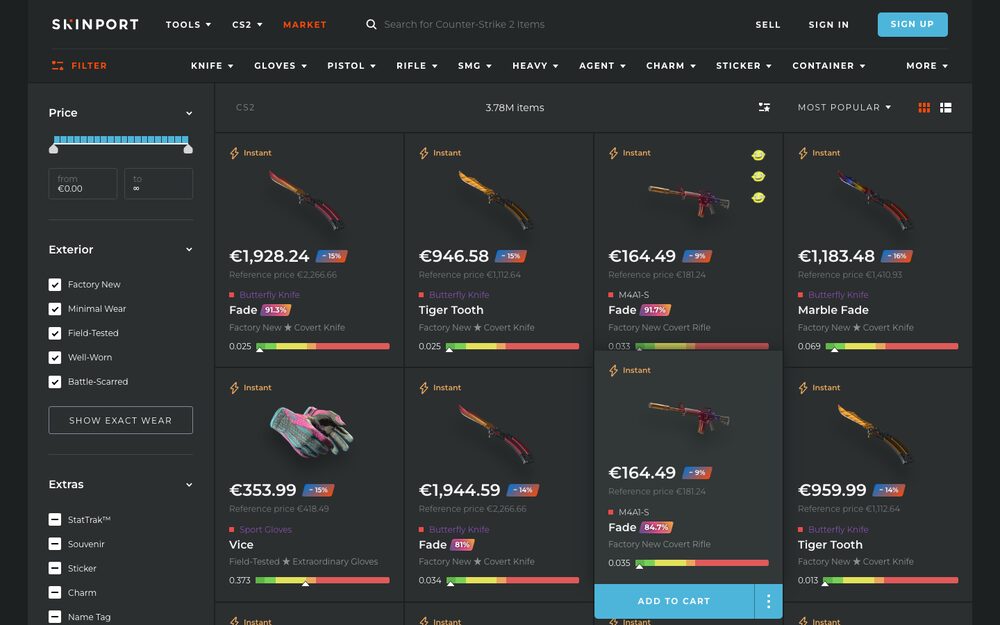
Skinport and CS.MONEY charge for polish: clean interfaces, buyer protection flows, easy card payments. Prices are typically below Steam but above the tiers underneath. Nothing wrong with paying for convenience — just know that's what you're paying for.
Tier 5 — Steam: the reference price, not the buying venue
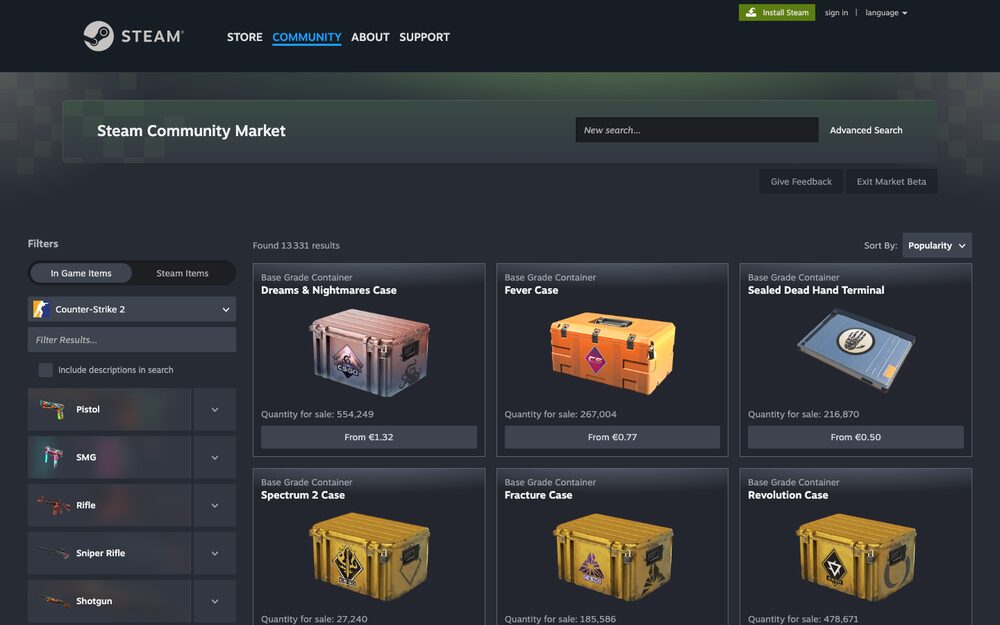
Steam takes roughly 15% on every sale — the fee structure is worth understanding in full — and, more importantly, everything you spend or receive there is locked wallet credit. You can never withdraw it. Priced honestly, a dollar of Steam credit is worth meaningfully less than a cash dollar, because converting skins back to money always routes around Steam at a discount. Stack the fee and the wallet lock together and buying on Steam works out to roughly a 30% overpay in real-money terms versus the cash tiers. Use Steam as your reference price. Buy elsewhere.
Sticker price is not landed cost
The number on the listing is the start of the math, not the end. What a skin actually costs you is:
- Listing price — the headline number.
- Deposit or payment fees — card processing, crypto spreads, or the markup on topping up a balance; per each venue's published fee schedule, and they differ a lot.
- FX — EUR-priced venues like SkinBaron can be cheaper or dearer for you depending on the day's rate and your bank's conversion cut.
- Trade locks — a skin you can't move for days has a carrying cost if you ever intend to resell; locks vary by venue and item.
- Exit fees — if the plan includes selling later, the sale-side commission belongs in today's math. Fee schedules across venues commonly run anywhere from ~2% to ~15% all-in, and they change; verify before you rely on any number.
Here's the map in one table. Treat the discount column as structural tendency, not a quote — as of late 2026 the specifics move week to week:
| Tier | Venues | Typical price vs Steam | Main friction |
|---|---|---|---|
| Chinese venues | Buff163, Youpin | Lowest, often by a wide margin | Regional access, payment rails |
| Discount P2P | Market.CSGO, ShadowPay, Waxpeer | Deep discounts | Counterparty delivery, verification burden |
| On-site inventory | DMarket, SkinBaron | Competitive discounts | Modest fees; balance top-ups |
| Convenience | Skinport, CS.MONEY | Below Steam, above the rest | You pay for the polish |
| Steam | Community Market | Reference price + locked wallet | ~15% fee, credit you can never withdraw |
A 12% cheaper listing on a venue with a 6% deposit markup and a punitive lock is not 12% cheaper. Do the landed-cost math once per venue and it stops surprising you. The broader venue comparison goes deeper on each platform's mechanics.
The safety floor: cheapest unknown site is not a deal
Every tier above assumes the venue actually delivers the item and would still exist next month. That assumption is the whole game. A site you've never heard of undercutting Buff163 by another 10% isn't a sixth tier — it's usually a phishing front, an exit scam in progress, or a place your balance goes to die. The market's history is littered with venues that were "cheapest" right up until withdrawals stopped. Stick to venues with years of track record and real dispute volume behind them; the safety shortlist is short for a reason. The corollary: never store more balance on any venue than you're actively deploying, no matter how established it is.
Automating the comparison
Full disclosure: this site is the product in this paragraph. cs2stack automates exactly one slice of the map above — the on-site-inventory tier. For each item you track it monitors the live lowest price on DMarket and SkinBaron, and when you enable autobuy it purchases from whichever venue is cheaper at that moment, under a daily budget, a per-item ceiling, and a hard cap. It's non-custodial (your own API keys and prepaid balances), ships with dry-run on by default, and the founder runs it live at $20/day with a public ledger — where purchases have averaged roughly 36% below same-day Steam price. If your buying is on those two venues anyway, the per-purchase comparison is the part worth never doing by hand again; here's exactly how the routing works.
The short answer
If someone asks where to buy CS2 skins cheapest in 2026, the honest ranking is: Chinese venues if you have real access, discount P2P if you'll tolerate the delivery dance, DMarket/SkinBaron if you want cheap plus instant plus automatable, the convenience tier if you're buying twice a year and want zero thought, and Steam only when you're spending wallet credit you're never getting out anyway. Whatever tier you land on: compute landed cost, not sticker price; verify every fee against the venue's own schedule before trusting it; and never chase a discount below the safety floor. The spread between venues is the most reliable "discount" in this market — you don't have to snipe anything to collect it.