
Market.CSGO Review (2026): Deep P2P Liquidity, Manual Everything
Bargain hunters, this one's for you. Market.CSGO pairs some of the deepest peer-to-peer listing books in the CS2 economy with sticker prices that routinely sit near the very bottom of the board — real, repeatable savings for anyone willing to accept a Steam trade offer at the end of each buy. The RU/CIS-origin venue is utilitarian and asks for a little patience, but the discounts are the kind you build a rotation around. Here's what buying there is actually like.
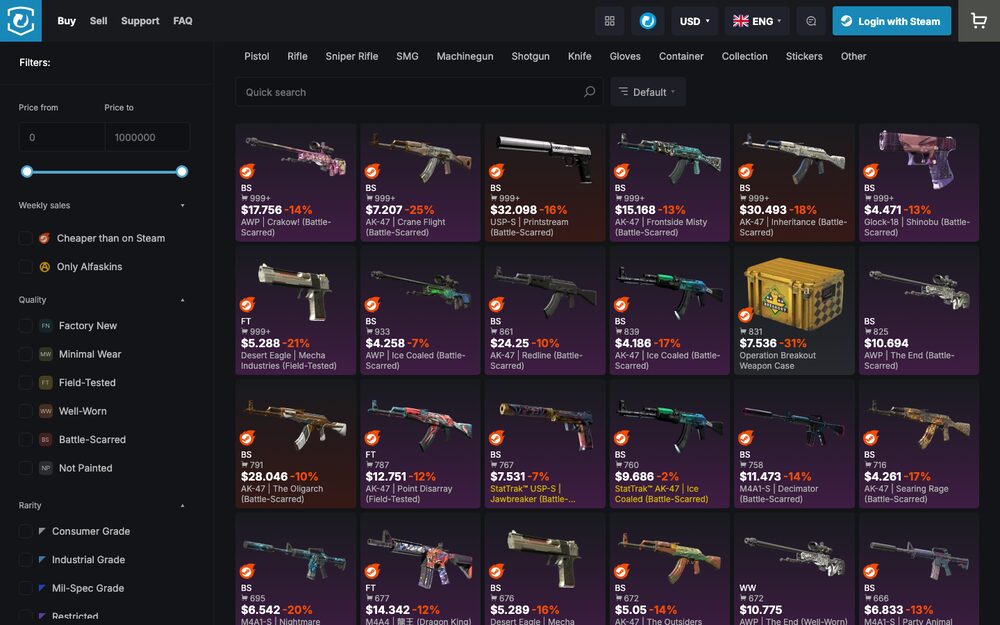
What Market.CSGO is
Market.CSGO — also branded CS.Market, at market.csgo.com — is one of the older third-party CS venues still standing, with roots in the Russian and CIS trading scene. That origin explains most of its character: an enormous seller base that lists aggressively on price, a no-frills interface that has evolved slowly, and an API that regional trader tooling has been built on for years. Prices on liquid items have historically sat among the lowest of any venue outside China, which is precisely why buyers keep tolerating everything else about it.
The model: pure P2P, seller online required
Market.CSGO sits firmly on the peer-to-peer side of the divide that defines how every CS2 marketplace behaves. Items never enter the venue's custody: a listing is a pointer to a skin sitting in a seller's own Steam inventory. When you buy, the venue holds your money and tells the seller to deliver. The seller — usually running the venue's client software or a bot — must be online to send the Steam trade offer, and you must accept it. If delivery doesn't happen inside the window, the purchase cancels and your balance is refunded.
Everything good and bad about the venue flows from that design. Sellers don't part with their items until the moment of sale and don't pre-deposit into anyone's vault, so listing is frictionless and cheap — which is why the books are so deep and the prices so keen. But the buyer inherits the coordination problem: an offline seller means a wait, a timeout, a refund, and a re-buy at whatever the next listing costs. The refund mechanism works, to be clear — you don't lose money, you lose time and occasionally the price you thought you'd locked.
Strengths
- Listing depth. On popular items the book is stacked many listings deep, which keeps spreads tight and gives patient buyers real choice on float and price.
- Genuinely low prices. Cheap listing economics plus a seller base pricing in a lower-cost region produce sticker prices that frequently undercut Western venues — the effect we dissect in regional price differences across marketplaces.
- Trader-grade API. The venue's API is mature and widely used by inventory-management and pricing tools; for programmatic sellers it's one of the better-documented P2P surfaces.
- Honest failure mode. When delivery fails, the system refunds. It's an annoying failure mode but not a dangerous one.
Weaknesses
- Seller-online dependency. The defining tax. Buying at off-peak hours for the seller base means waits and cancellations; you'll sometimes buy the same item twice before it arrives once.
- Dated UX. The interface is functional and fast but visibly built by traders for traders; newcomers find it cold.
- Payment rails for Westerners. Deposit and withdrawal options vary sharply by region and have been reshaped repeatedly by sanctions-era banking constraints. What works from one country fails from another — verify your specific path before funding an account, and hedge every assumption.
- Patience is mandatory. Structurally hostile to instant gratification and to naive automation, since every fill still ends in a manual trade-offer accept.
Fees, payments, cash-out, KYC
Seller commission lands in the modest single-digit range typical of P2P venues, varying with options and promotions, per its published schedule — verify current numbers before listing, because schedules move. The buyer mostly pays sticker price plus deposit costs. It's the rails, not the fees, that need your attention: card processing, regional wallets, and crypto options rotate with the regulatory weather, and crypto is often the most reliable path for non-CIS users — our guide to buying skins with crypto covers the tradeoffs. Cash-out follows the same regional logic. Identity checks scale with money movement, and the venue's KYC posture varies by payment method; our KYC comparison across venues has the fuller picture. As with any venue where your balance sits on someone else's books, size your float with counterparty risk in mind.
At a glance
| Strengths | Weaknesses |
|---|---|
| Deep books, tight spreads on liquid items | Seller must be online; waits and cancels happen |
| Frequently among the lowest non-China prices | Utilitarian, dated interface |
| Mature API used by real trader tooling | Regional payment complexity for Westerners |
| Failed deliveries refund cleanly | Every fill ends in a manual trade-offer accept |
Who it's for — and the verdict
One sentence of disclosure: you're reading cs2stack's blog, and our product automates purchases on DMarket and SkinBaron — on-site-inventory venues, the architectural opposite of this one — so we have a stated preference for the other model. Preference noted, credit given: Market.CSGO is a terrific hunting ground for the price-first buyer. Deep books mean real choice on float, tight spreads mean fair entries, and an aggressive seller base keeps the venue near the floor of the cheapest-venue rankings with a consistency that convenience-tier marketplaces simply can't offer — buy liquid items where the depth lives and it will reliably save you money. Bring some patience for the trade-offer choreography and confirm your payment rail works from your country; those are the two tolls on an otherwise excellent road. Market.CSGO takes the floor on plenty of days and cedes it on plenty of others. The habit that actually compounds is comparing it against the other strong venues before every buy — pennies per order, real money per year.