
Every CS2 Marketplace Fee, Compared (2026)
Here's the good news hiding in every fee schedule: fees are exactly why the same skin sells cheaper on one venue than another — and knowing them is how you buy cheaper, every time. This is the reference page for all four charges: who pays what, at which step, on every major category of CS2 venue, plus the round-trip math that shows what a trade really costs end to end.
"The fee" is four numbers, not one
Every venue's cost structure decomposes into the same four charges. Marketplaces advertise whichever one flatters them and stay quiet about the rest:
- Seller commission. The headline number — the cut taken from the sale price before proceeds hit the seller's balance. This is the figure on the pricing page, and the only one most comparisons use.
- Buyer premium. Some venues quote a listing price and then add a service fee, payment-processing surcharge, or checkout markup on top. Others bake it into the displayed price. Either way, the buyer's true cost is what leaves the card, not what's on the tag.
- Deposit cost. Getting money onto a balance-based venue can itself cost 0–5% depending on rail — cards and PayPal-type processors at the high end, SEPA and crypto usually cheaper.
- Withdrawal cost. Getting money out is where quiet venues get loud: flat fees, percentage fees, minimums, and processor cuts. For a cash trader this is not optional — it's the last toll booth on every profit. Speed and reliability vary as much as price.
There's a fifth cost hiding under the other four: FX spread. EUR-native venues quote in euros, Chinese venues in yuan, crypto venues in stablecoins — and every conversion between your currency and theirs eats a slice that never appears on any fee schedule. We've broken down that layer, along with the rest of the invisible stack, in the hidden costs of buying skins.
The reference table
As of late 2026 — every venue changes fees, runs promotions, and tiers commissions by volume. Treat these as category-level ranges from published schedules, and verify on the venue's own pricing page before trading. We deliberately give ranges, not decimals: a table full of false precision would be stale the week it was published.
| Category | Examples | Seller cut | Buyer premium | Cash-out | The catch |
|---|---|---|---|---|---|
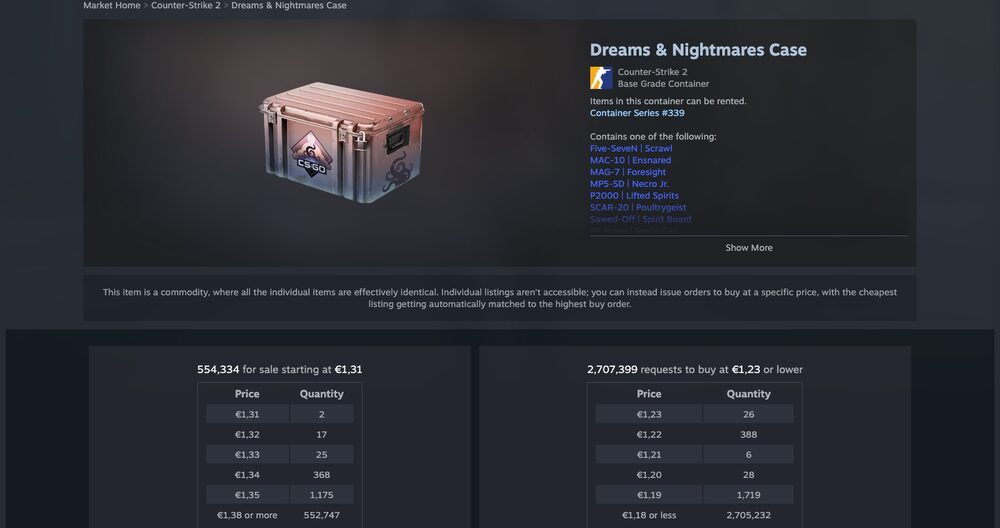
| Steam Community Market | Steam | 15% total (5% Steam + 10% CS2) | Baked into price | None — proceeds are wallet-locked forever | Highest prices, deepest liquidity, and money that can never leave. Full breakdown. |
| Chinese venues | Buff163, YouPin898 | Low single digits per published schedules | Typically none | Regional payment rails | The lowest commissions in the market — behind regional payment apps, ID verification, and rails most western traders can't easily use. |
| P2P discount venues | Market.CSGO, Waxpeer, ShadowPay | Mid single digits per published schedules | Usually none stated | Varies by rail; crypto often cheapest | You are the escrow: peer-to-peer trades mean you handle trade offers, bots, and counterparty timing yourself. |
| On-site balance venues | DMarket, SkinBaron | Roughly 5–10%, tiered by item and volume | Sometimes small checkout fees by payment method | Flat or % withdrawal fees by rail | The middle of the market: instant delivery from on-site inventory, real cash-out, fees in the middle too. |
| Convenience venues | Skinport, CS.MONEY | Roughly 8–12%+, or a wide trade spread | Payment/service fees common | Processor-dependent | Smooth checkout, big audience, strong support — priced in. On trade-based venues the spread is the fee, and it's rarely printed anywhere. |
| Crypto venues | White.Market | Low-to-mid single digits per published schedules | Typically none | Network fees + stablecoin off-ramp | Cheap headline fees; the real costs are network gas, exchange withdrawal fees, and the FX hop from stablecoin to your bank. |
Read the columns together, not the seller cut alone. Steam's 15% funds the deepest order book in the ecosystem; Buff's low single digits are gated by payment friction; a P2P venue's mid-single-digit fee comes with you doing the delivery work a pricier venue would do for you. Every discount in this table is compensation for something.
Round-trip math: one $100 skin, six venues
Headline fees describe half a trade. Most traders make round trips — buy, hold, sell, withdraw — so the honest question is: if I push $100 through a full cycle at flat prices, what comes back? Illustrative, using mid-range figures from the table:
- Steam: buy at $100, sell at $100, receive ~$87 — in wallet credit. In cash terms the round trip returns $0; the proceeds can only ever buy more Steam things.
- Chinese venue: a couple of dollars in commission, so ~$97–98 back on paper — minus whatever the currency conversion and regional rails cost you in both directions, which for a non-Chinese trader can quietly dominate.
- P2P discount venue: ~$94–95 after a mid-single-digit seller fee, less a withdrawal fee that might be a flat dollar or a percentage point depending on rail. Call it ~$92–94 in your bank.
- On-site venue: ~$90–95 after commission, then withdrawal fees take another slice — ~$88–93 landing in your account.
- Convenience venue: ~$85–90 after the higher commission and any checkout fees on the buy side.
- Crypto venue: ~$94–96 on-platform, then network fees and the stablecoin-to-fiat hop decide how much of that survives — anywhere from a rounding error to several dollars on small amounts.
Two things jump out. First, the spread between the cheapest and priciest legitimate cash routes on a flat trade is roughly $5–10 per $100 — which is most of a flipper's expected margin. Second, flat-price round trips lose money everywhere. Fees are why reselling only works when you bought below market, and why cashing out deserves as much venue thought as buying in.
Effective price beats headline fee
Here's the trap in every fee table, including this one: fees are knowable, but you trade against prices, and prices already contain the fees. A venue charging sellers 5% where nobody buys forces sellers to undercut for weeks or accept a lowball — that's a liquidity cost no schedule prints. A venue charging 10% with deep demand fills you same-day at a firm price. The 10% venue frequently nets you more.
The practical rule: compute your effective exit price — realistic sale price minus all four fees, on a venue where the item actually moves at that price. A "cheap" venue whose order book is three stale listings deep isn't cheap; it's illiquid with good marketing. We rank venues on exactly this dimension in the CS2 marketplace liquidity rankings — read the two tables side by side and the venue picture changes considerably.
Same logic on the buy side: the cheapest venue for an item today isn't a category, it's a listing. Cross-venue gaps of a few percent on identical items are routine — which is a standing discount for whoever compares before buying: venue choice per purchase matters as much as venue choice in general.
Fees compound — which is why per-buy comparison pays
A one-off trade can shrug at a 3% venue gap; a standing strategy can't, because the same skin is genuinely cheaper somewhere different almost every day. Overpay a few percent on every buy and your whole cost basis drifts; compare venues on every buy and the same few percent compounds in your favor. Knowing this table is step one — applying it at the moment of each purchase is the actual edge.