
Buff163 Review (2026): the Chinese Price Floor, With Caveats
If cheap is what you're after, Buff163 is where cheap lives. Ask any serious trader what a skin is "really" worth and they'll quote you Buff — because the deepest books in the world keep its prices at or near the global floor, session after session. For buyers who can register, this is arguably the single best place on Earth to buy liquid CS2 skins for less; for most Western readers the access hurdles are real, and we cover them honestly below — but even then, Buff's prices will sharpen every purchase you make elsewhere. (This is cs2stack's blog; our product automates buying on DMarket and SkinBaron, so we have no horse in the Buff race.)
What Buff163 is
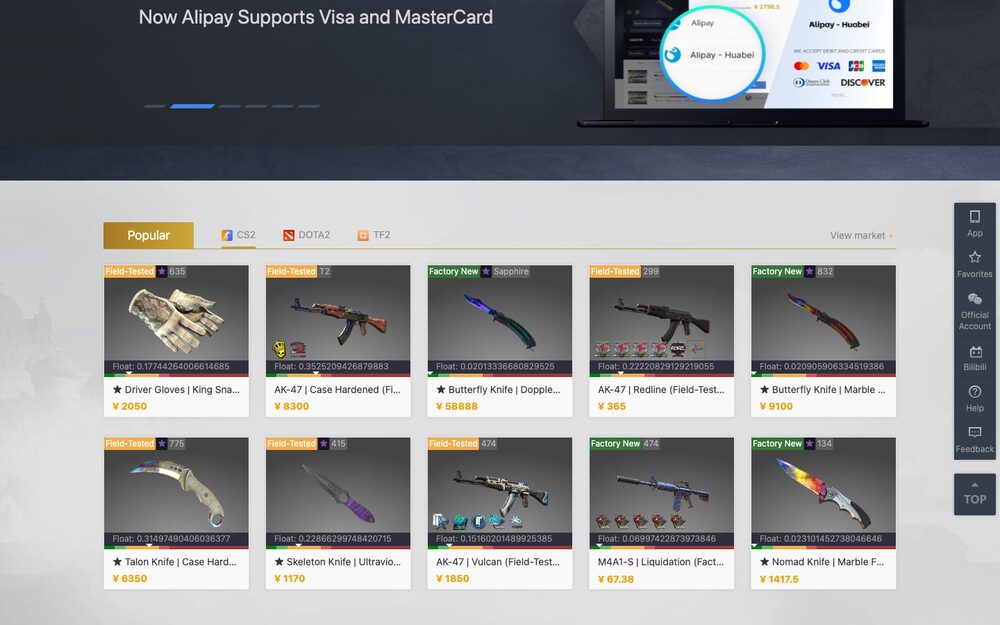
Buff163 is a Chinese CS2 marketplace operated by an affiliate of NetEase, one of China's largest gaming companies. It serves the biggest single-country Counter-Strike audience on Earth, and its liquid-item order books are correspondingly deep. When people talk about China's outsized role in the skin economy, Buff is usually the concrete thing they mean: the venue where Chinese demand and Chinese supply meet, at prices the whole global market watches.
The model: P2P, with a balance in the middle
Buff163 runs the peer-to-peer model — the architecture we break down in P2P vs on-site inventory marketplaces, and the key thing to understand before comparing it to anything. Money is handled on-platform (you hold a Buff balance), but the items never enter the venue's custody: when you buy, the seller sends you a Steam trade offer, and the deal completes when both sides have done their part. That gives Buff the classic P2P profile: lower structural costs and enormous listing breadth, paid for with delivery friction — offers to accept, sellers who are asleep, timeouts. It is the opposite of the on-site inventory model where a purchase settles instantly into a venue-side inventory with no human in the loop.
Why its prices sit low
Buff's reputation as the global floor is structural, not mystical. A huge domestic seller base competing for a huge domestic buyer base compresses spreads; P2P economics keep fees modest; and Chinese sellers cashing out around holidays or market events add recurring supply pressure. The result is that on liquid items — popular rifles, knives with standard patterns, mainstream cases — Buff's price is frequently at or near the global low, which is why every serious valuation framework checks Buff first and why price aggregators anchor to it. It is not always the floor, and on Western-taste niche items it can even run rich; but as a single reference number, nothing else has earned the same status.
Strengths
- Liquidity that nothing Western matches. On liquid items the books are deep on both sides, listings refresh constantly, and large orders move without the slippage smaller venues impose.
- Prices frequently at the global low. For a buyer with access, Buff is often simply the cheapest place on Earth to buy a liquid skin.
- The reference dataset. Even if you never buy there, Buff's price history is the closest thing the market has to a benchmark index — a public good the entire trading ecosystem free-rides on.
- Serious corporate backing. A NetEase-affiliated operator is a different trust class from the anonymous-founder venues this industry is littered with.
Weaknesses
- Access friction for Westerners. Registration has historically required a Chinese phone number and real-name identity verification, and the rules shift over time — verify the current requirements yourself. For most non-Chinese readers this is the end of the story.
- Payment rails built for China. Deposits and withdrawals are oriented around Alipay/WeChat-style rails and Chinese banking. Without those, holding and moving money on the platform ranges from awkward to impossible.
- P2P delivery friction. Every purchase ends in a Steam trade offer with a human counterparty — fine at retail scale, hostile to automation and to impatience alike.
- Regulatory and policy risk. Chinese platform rules, cross-border payment policy, and Valve policy all sit upstream of your access, and all three have moved before. Hedge accordingly.
One thing this review will not do is tell you how to route around the registration requirements. Bought accounts and borrowed identities violate the platform's terms, concentrate your money behind credentials you don't control, and are a standing invitation to lose everything with no recourse — the same category of self-inflicted risk we catalog in marketplace scam red flags.
Fees, payments, and KYC posture
Per its published schedule, Buff's seller commission sits in the low single digits — cheap by global standards, and part of why its stickers run low — but verify current numbers, and remember the schedule is written for a domestic audience. KYC is real-name and identity-based in the Chinese style, applied at registration rather than only at cash-out; our cross-venue KYC comparison puts that in context. Cash-out flows to Chinese rails. For fee shapes across the whole field, see the 2026 fee comparison.
Strengths vs weaknesses at a glance
| Strengths | Weaknesses |
|---|---|
| Deepest liquid-item books in the market | Registration effectively closed to most Westerners |
| Prices often the global low | Alipay/WeChat-oriented payment rails |
| The price dataset everyone benchmarks against | P2P trade-offer delivery friction |
| NetEase-affiliated operator | Regulatory and policy risk upstream of access |
Who it's for — and the honest alternative
With legitimate access to Chinese payment rails, Buff163 is about as good as skin buying gets: first-rate liquidity, floor-level prices, serious corporate backing — a default venue in the strongest sense of the word. And even without access, Buff still saves you money: its prices are the perfect valuation anchor for shopping everywhere else, and the same corporate family runs a Western-facing sibling, Buff.Market, that brings much of the same DNA to buyers abroad. The gap between Chinese and Western venue prices is a real, recurring phenomenon we map in regional price differences across marketplaces.
Verdict
Buff163 earns every bit of its reputation: deep, cheap, and credibly operated — the marketplace every price-conscious buyer wishes they could use, and a benchmark even non-users profit from daily. If you can reach it legitimately, it belongs at the very top of your rotation; if you can't, skip the ToS-lawyering, let Buff set your reference price, and do your buying on rails you can actually reach. Even Buff's legendary depth doesn't make it the low print every session. Treat 'which venue is cheapest right now' as a question you re-ask on every purchase; answered consistently, it's worth more than any one-time discount.