
Buff.Market Review (2026): Buff for the Rest of Us
Buff.Market grants a wish every Western trader has made: shopping the Buff ecosystem with USD prices and payment methods you actually have. It's the official Western-facing sibling of Buff163 — same corporate family, same clean design, same low-fee P2P economics — and on liquid skins it regularly posts stickers that beat the big Western venues outright. The liquidity is a fraction of its legendary sibling's, and we'll be straight about that below, but as a place to buy popular skins cheaper it's one of the most underrated doors in the market. (Disclosure: you're reading cs2stack's blog — our tool automates buying on DMarket and SkinBaron, not here.)
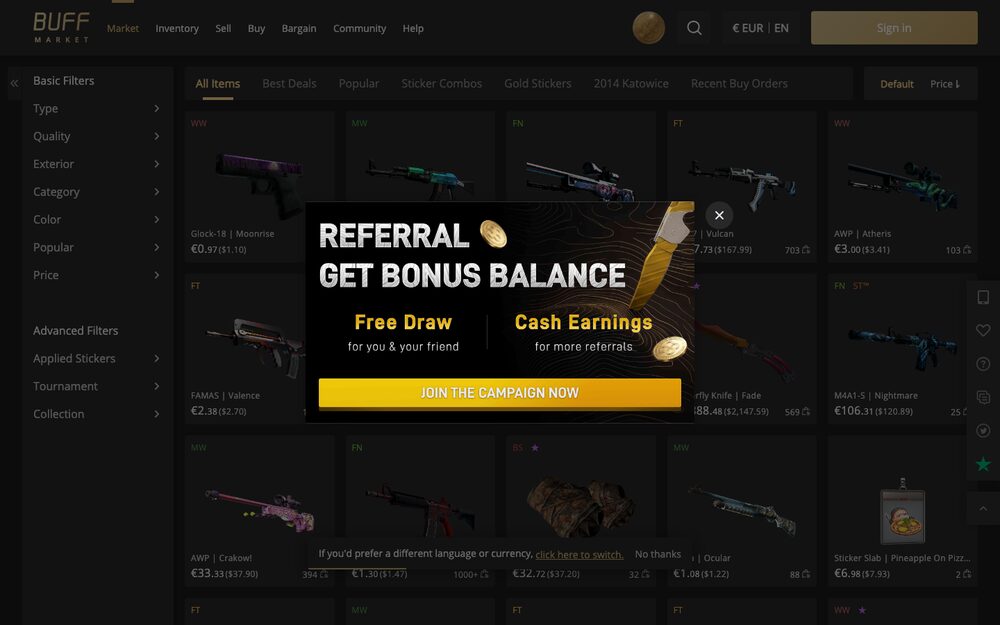
What Buff.Market is
Buff.Market is the international edition of Buff163, the NetEase-affiliated Chinese marketplace whose prices anchor the global skin economy — background we cover in the full Buff163 review and in our look at China's role in the CS2 market. Where Buff163 requires Chinese identity verification and Chinese payment rails, Buff.Market prices in USD, accepts Western payment methods (cards among them — verify the current list for your region), and registers with a normal Steam-plus-email flow. Same design language, same general mechanics, doors open to the rest of the world.
The model: P2P, like its sibling
Buff.Market inherits the peer-to-peer architecture: the platform holds your money as a balance, but items stay in sellers' Steam inventories until sold, and delivery happens via a Steam trade offer between buyer and seller. That places it firmly on the P2P side of the P2P vs on-site inventory divide — the single most consequential fact about any venue. The upside is structural: no custody layer to pay for, so fees can stay low. The downside is the familiar P2P ritual — waiting on a counterparty, accepting offers, and the occasional deal that times out because a seller went to bed. If you want purchases that settle instantly with nobody awake, that is a different architecture and a different set of venues.
Strengths
- Buff economics, Western access. The fee posture is on the low side for Western venues per its published schedule (verify current), and the whole point of the venue is passing the low-fee P2P model to buyers who can't reach Buff163. Stickers here are frequently competitive.
- A legitimate route, not a workaround. This is the sanctioned way to shop the Buff ecosystem from abroad. No borrowed identities, no gray-market accounts, none of the self-inflicted risks we warn about in our catalog of marketplace scam red flags.
- Clean, familiar UX. The Buff design carries over: good filtering, clear listings, sensible search. It is one of the more pleasant P2P venues to actually browse.
- Serious parentage. The same corporate family as Buff163 stands behind it — a meaningful trust signal in a field where operator credibility is half the battle.
Weaknesses
- Liquidity is a fraction of its sibling's. This is the big one. The books are thinner, listings are sparser, and fills are slower. The name promises Buff; the depth does not deliver Buff.
- Thin catalog on the long tail. Liquid items are covered; exotic floats, rare patterns, and niche collections often simply aren't listed.
- It is not the price floor its sibling is. With fewer sellers competing, prices track the Western field more than they undercut it. Sometimes it wins the price check; it doesn't set the global reference.
- Smaller ecosystem. Fewer integrations, fewer tools, less third-party data coverage than the big Western venues — a practical annoyance if you run a multi-venue price comparison workflow.
Fees, payments, and cash-out
The usual hedge applies: per its published schedule, seller commission sits toward the lower end of the Western range, and buyers pay sticker plus payment-method costs — verify current numbers before committing money, and see our 2026 cross-venue fee comparison for how that shape compares. Deposits use Western rails; cash-out options and their costs vary by region and method, with identity checks scaling as amounts grow — the standard posture we map in marketplace KYC requirements. Nothing exotic in either direction; the venue's genuine differentiator is lineage and fee posture, not payment innovation.
Strengths vs weaknesses at a glance
| Strengths | Weaknesses |
|---|---|
| Low-side fees per published schedule | Liquidity far below Buff163's |
| Legitimate Western access to the Buff ecosystem | Thin long-tail catalog |
| Clean, familiar Buff-style UX | Competitive but not floor-setting prices |
| NetEase-family operator credibility | Small tooling and data ecosystem |
Who it's for
Buff.Market is a genuine win for the patient Western buyer of liquid items: popular skins at low-fee prices, a legitimate route into the Buff ecosystem, and one of the more pleasant browsing experiences in P2P. Sellers who want low commission and can wait for the right buyer do well here too. Rare-float hunters, buyers in a hurry, and automation-first shoppers should look elsewhere — the long-tail books are thin and delivery is manual — but that caveat applies to most P2P venues. For a broader map of who should shop where, our marketplace comparison and cheapest-venue guide are the wider lens.
Verdict
Judge Buff.Market as what it actually is — a low-fee, credibly operated, Western-accessible P2P venue for liquid skins — and it's an easy recommendation: real savings, real legitimacy, real pedigree, with patient buyers getting the most out of it. Don't expect the full depth of Buff163 (that liquidity didn't board the plane), but do expect it to win the price check more often than its modest profile suggests. BUFF Market earns its slot, but the top of the discount leaderboard changes hands daily across these marketplaces. The edge isn't in finding the right venue once — it's in re-running the comparison at every checkout, forever.