
CS2 Marketplace Liquidity, Ranked (2026)
"Where should I sell?" has a boring true answer: wherever your item finds a buyer fastest at a price closest to fair. That's liquidity, it varies enormously between venues, and it's worth more than any fee discount — because a 2% cheaper commission means nothing on a listing that sits unsold for six weeks. The same map read backwards is a buyer's treasure chart — the third-party books are where skins go for less than Steam, and liquidity tells you which discounts you can trust. Here's our tiered ranking, with the methodology stated honestly up front.
Methodology, and its limits
There is no audited volume data in this market. What exists: each venue's own published listing counts and activity pages, third-party trackers that aggregate listings and sale observations, and the slow evidence of trading there daily. This ranking synthesizes those — per third-party trackers and each venue's published pages, late 2026 — and should be read as informed judgment, not measurement. Venues also inflate: wash trading and bot relistings exist, and no outside observer can fully strip them out, a problem we've written about in the market-measurement piece. Tiers, not decimals, are the honest resolution.
We score three things: depth (how many real listings and buyers per item), time-to-sell (how long a fairly-priced listing takes to fill), and spread (how far below fair value you must price to sell fast). The conceptual background is in our liquidity explainer.
The tiers
Tier 1 — the gravity wells
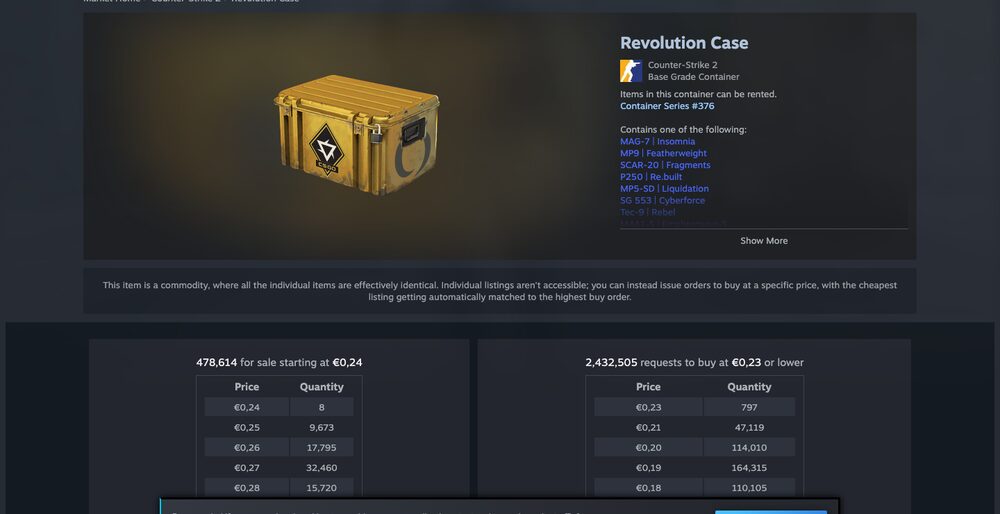
- Steam Community Market. The deepest order book in the ecosystem, period. Liquid items fill in seconds against standing buy orders. The catch never changes: proceeds are wallet-locked forever, and the 15% cut comes off the top. Deepest liquidity, shallowest money.
- Buff163 / the Chinese venues. By most third-party tracking, the largest cash-market volume on Earth — often the venue whose price the rest of the market quotes as "the real price." Access from the West is gated by regional rails and ID requirements; see our Buff163 review. Enormous depth you may not be able to reach.
Tier 2 — deep western cash markets
- Skinport. The biggest western convenience audience; fairly-priced liquid items typically move quickly, and high-tier items have real buyer traffic.
- CSFloat. Lean fees keep the listing flow heavy and the asks sharp; buy orders add genuine bid-side depth on popular items.
- DMarket. Solid depth on cases and liquid skins, boosted by its API crowd; thinner at the exotic tail.
Tier 3 — regional and specialist books
- SkinBaron. Germany's home market: reliable on cases and liquid items, slower on the long tail.
- P2P discount venues (Market.CSGO, Waxpeer, ShadowPay class). Volume concentrated in liquid, flip-friendly items; fine for standard goods, thin for anything unusual.
Tier 4 — everything newer, smaller, or narrower
- Niche venues, auction sites, and new entrants. Some are excellent at their specialty; all share the same liquidity reality — fewer eyeballs, longer waits, wider spreads. Apply the red-flags checklist before trusting activity numbers here.
Liquidity is per-item, not per-venue
The tiers above average across the whole catalog, and averages hide the most useful fact: liquidity belongs to items first, venues second. A popular case is liquid nearly everywhere — the venue barely matters. A $30,000 pattern knife is illiquid everywhere — the buyer pool is a few dozen humans globally, and what matters is reaching them, not the venue's aggregate volume. The practical matrix:
| Item type | Where it's liquid | Realistic time-to-sell at fair price |
|---|---|---|
| Cases, liquid mid-tier skins | Tiers 1–3, effectively everywhere | Minutes to a day |
| Popular knives/gloves, standard floats | Tiers 1–2 | Days |
| High-tier, rare floats and patterns | Wherever collectors actually browse | Weeks to months — patience is the price |
This is also why "which venue is best" threads go in circles: a case stacker, a knife collector, and a flipper are asking three different questions and each is correct about their own answer. Name the item class you actually trade before you argue about venues — the tiers reshuffle per row of that table, and a venue that's Tier 2 for your cases can be effectively Tier 4 for your pattern knife.
Why liquidity beats headline fees
Run one honest scenario. Venue A charges 5% and your item sells in three weeks after two undercuts. Venue B charges 10% and fills same-day at fair value. On a $100 item, venue B nets you more the moment the undercutting on A exceeds 5% — which, on a thin book, it usually does. Add three weeks of price risk on A (this market repricies on a patch note) and the "expensive" venue is clearly the cheap one. Fee tables — including ours — only make sense read against a liquidity ranking; that's why these two posts cross-reference each other.
The same holds on the buy side, inverted: deep books quote fair prices with tight spreads, thin books occasionally misprice. Which means thin venues are where bargains appear, and deep venues are where they're absent but everything is fairly priced — a structural fact behind cross-market price lag, and behind the strategy of buying liquid items wherever they're momentarily cheapest.
Takeaways
- Sell liquid items on deep books; the fee premium buys speed and price firmness.
- Sell rare items where their collectors are, and accept that time, not venue choice, is the main variable.
- Buy where the item is cheapest today — for liquid goods that venue rotates, which is why comparing per purchase beats loyalty. Disclosure: that's the principle cs2stack automates, checking DMarket against SkinBaron on every buy and taking the cheaper fill under your price caps.
- Distrust precision. Anyone quoting exact venue volumes is quoting marketing. Tiers are the truth this market can support.
The tiers will reshuffle; the principle won't. For liquid items, the reputable marketplaces are consistently the cheapest place to buy — but which one is cheapest changes by the day, so the durable edge is comparing them on every single purchase rather than crowning a favorite. Rank venues once a year; compare prices every time you buy.