
The Safest CS2 Marketplaces in 2026 (and What 'Safe' Means)
Every marketplace calls itself safe, the word appearing right above the padlock icon. Almost none define it. So before ranking anything, this post does: safety is four separate questions — who holds your stuff, how big the scam surface is, whether payouts actually arrive, and who answers when something breaks. Venues score differently on each, which is why the honest output is tiers with reasoning, not a winner with a trophy. The exercise is worth it because the prize is real: the reputable third-party venues sell skins well below Steam prices, and knowing exactly why they're trustworthy is what lets you buy there with confidence.
The four dimensions of "safe"
- Custody: when the venue holds your items or balance, its solvency and security are your risk. When it doesn't, each trade's counterparty is. Neither is free — the split is the subject of our P2P vs on-site explainer, and the history lesson is OPSkins, whose users learned about custody risk the expensive way.
- Scam surface: most skin theft doesn't happen on marketplaces — it happens through phishing pages imitating them, fake support agents, and API-key hijacks. A venue's design can shrink or enlarge that surface. The catalog of attacks is in our scams guide.
- Payout reliability: a marketplace is only as safe as its last mile. Sites that sell smoothly and pay out grudgingly fail exactly when it matters. Track records here are best observed over years, not testimonials — see the withdrawal-speeds comparison.
- Accountability: registered company, named jurisdiction, functioning support, sane KYC program. Boring paperwork is what makes a venue sue-able, and sue-able is a synonym for accountable — the argument developed in the KYC piece.
The tiers
Basis: each venue's published pages, public track record, and third-party reporting as of late 2026. Safety is a judgment, venues change, and past reliability guarantees nothing. Do your own diligence.
Tier 1 — structural safety, with asterisks
- Steam Community Market. Valve custody, no counterparties, no payout step to fail — because there's no payout at all. Maximum safety on three dimensions, achieved by amputating the fourth thing you probably wanted: your money back. Fifteen percent of every sale stays with Valve, and the rest is wallet credit forever — safety through a locked door.
Tier 2 — established venues with long, clean track records
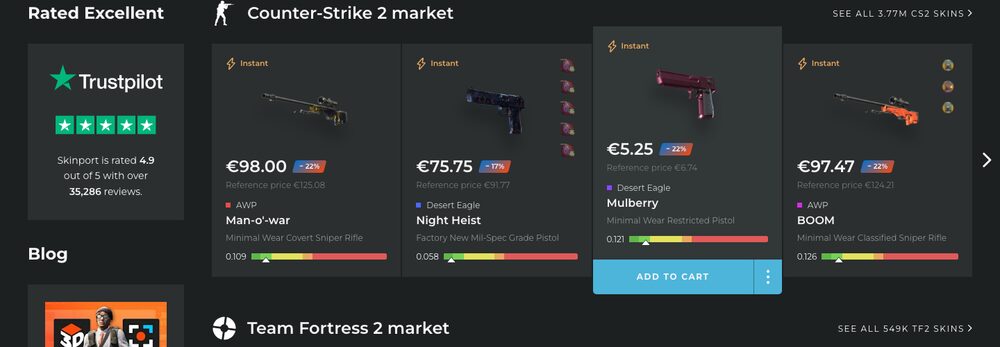
- The veteran EU-registered class (SkinBaron, Skinport). Years of operation, identifiable companies in a strong legal jurisdiction, consistent payout reputations, KYC programs. The German pair have been paying sellers since the late 2010s without a defining scandal — in this market, that longevity is the single strongest safety signal available.
- The established internationals (DMarket, CSFloat). Long operating histories, public teams, real support channels, and payout track records that third-party reporting treats as reliable. Custody exposure exists at the balance-based ones — size your standing balances accordingly.
Tier 3 — legitimate, with sharper edges
- Regional giants you can't easily verify from outside (the Buff163/YouPin class): huge, established, but bound to regional rails, language, and regulation that leave a western user with little recourse.
- The P2P discount crowd (Market.CSGO, Waxpeer, ShadowPay class): functioning venues with real volume, thinner support layers, and more of the safety burden shifted onto your own operational hygiene.
Tier 4 — unproven by definition
- New and niche venues. Not accusations — just arithmetic. A site with eight months of history has eight months of evidence, and exit scams look exactly like new marketplaces until the day they don't. Run the red-flags checklist and keep first exposures small.
What the ranking can't do for you
A tier list answers one question — how likely is the venue itself to hurt you — and that turns out to be the minor threat. Most inventory losses are not marketplace failures at all; they're account failures. A Tier 2 venue can't protect a user who signs into a lookalike domain, approves a trade to a "verification bot," or pastes an API key into a Discord tool. The venue's tier bounds its risk contribution, not yours. The non-negotiables, whatever venue you use: Steam Guard mobile 2FA, bookmarked URLs instead of search-result clicks, zero tolerance for unsolicited "support" contact, and periodic API-key hygiene.
One more note on tiers: they describe categories of evidence, not guarantees of behavior. A Tier 2 venue can deteriorate — ownership changes, payment partners drop out, support quality slides — and the public signals usually lag the reality by months. Re-run your own checks once or twice a year on any venue holding meaningful value for you, exactly as you would re-check a bank you'd read worrying headlines about.
Safety rules that survive contact with reality
- Cap venue exposure. Decide the maximum value you'll leave in any single venue's custody — balance plus items — and hold to it. Custody risk scales with what you park, not what you trade.
- Test the exit before you need it. A small early withdrawal proves the payout pipe and clears first-time KYC review while nothing is at stake.
- Prefer boring venues for boring jobs. Daily case buying doesn't need a hot new venue with a bonus code; it needs a book that's been paying out since before the venue's competitors existed.
- Diversify exits, not everything. Two proven cash-out routes beat five half-verified ones — see the cash-out guide.
- Write things down. Timestamped records of buys, sales, and withdrawals turn any future dispute from anecdote into evidence.
Where we stand, disclosed
cs2stack is our tool, and its venue choices are this article's thesis applied: it buys only on DMarket and SkinBaron — Tier 2 venues with long payout histories — and it logs every purchase to the cent so the audit trail exists before any dispute does. It never asks for your Steam login or trade authority, because the safest scam surface is the one that doesn't exist. Safety in this market is mostly the art of removing single points of failure; pick venues, and tools, that were designed that way.
Get the safety layer right and the reward is the whole point of this market: excellent prices on trustworthy books, bought without anxiety. The advantage that endures from there is comparing those great marketplaces against each other on every single purchase, since the best price migrates between them daily. Safety picks your venues; comparison picks your price.