
Cashing Out of CS2: Turning Pixels Into Bank Balance
A portfolio you can't withdraw is a scoreboard, not an asset. Here's the honest map from inventory to bank account — the routes, the toll booths, and the ditches.
The one-way door you need to understand first
Steam is a closed loop. Sell anything on the Steam Community Market and the proceeds — minus roughly 15% in fees — land in a wallet that can buy games and more skins, and nothing else, forever. There is no legitimate way to withdraw wallet funds. That's why every real cash-out runs through third-party rails, and why Steam prices overstate what your inventory is worth in money by a structural margin, typically in the 20–30% range as of mid-2026.

Accept the haircut as the price of the exit, then optimize everything else: venue, fees, timing, and — above all — not getting robbed on the way out.
The legitimate routes
Broadly three, in descending order of how much of the value you keep:
- Cash marketplaces. You list items on a venue like SkinBaron, DMarket, or CSFloat; a buyer pays; the platform holds the money until the trade completes; you withdraw to a bank account, card rail, or similar. Sale fees vary by platform and item class — the fee schedules and trust models are compared in detail in the marketplace comparison. Patient listings at market price are how you keep the most.
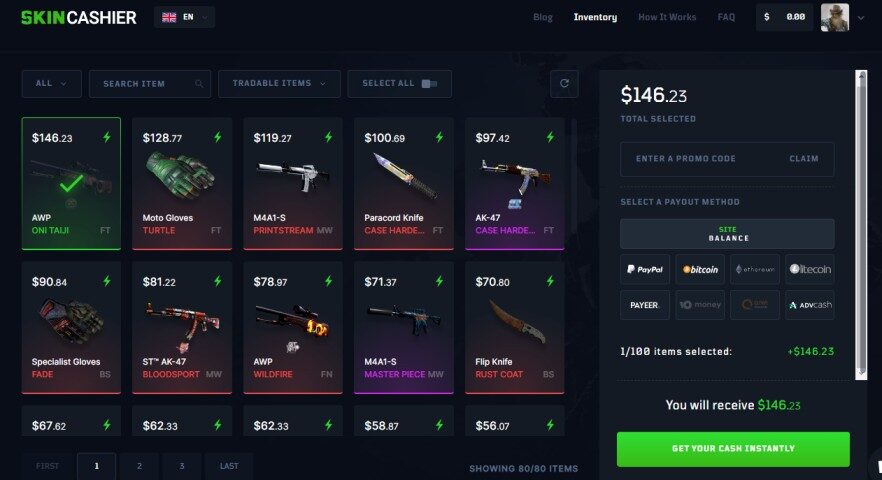
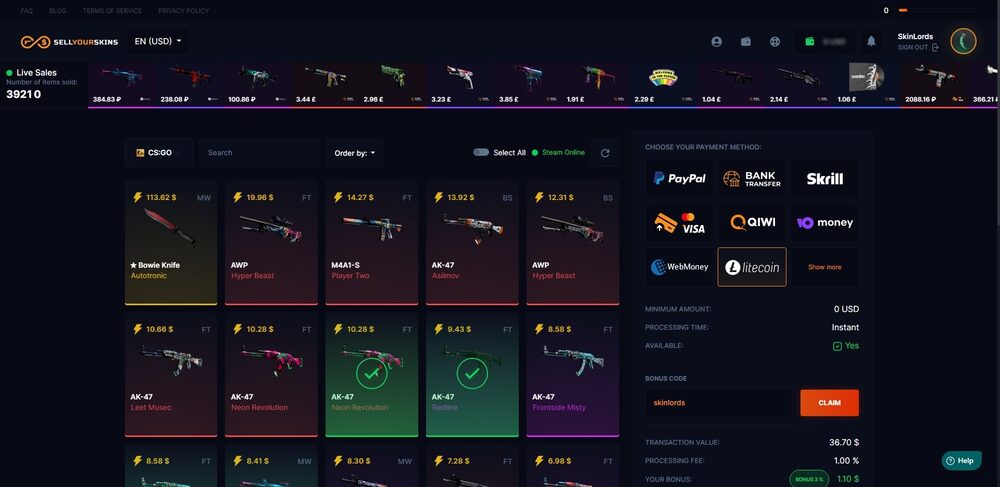
- Instant-sell services. The platform (or its bots) buys your items on the spot at a quoted price. You trade waiting time for a materially worse price — the instant quote typically sits well below what a patient listing fetches. Reasonable for small residues and terrible for whole portfolios.
- Private sales. Highest possible price, highest possible risk. For genuinely rare items — the grail tier where order books barely exist — direct deals with known collectors, ideally through a reputable middleman service with verifiable history, are how the big sales actually happen. For anything liquid, the marketplace route dominates: the private-sale premium isn't worth the counterparty risk.

What the exit actually costs
Stack the components and the gap between "my inventory is worth $X on Steam" and "I received $Y" stops being surprising:
| Cost component | Typical magnitude | Avoidable? |
|---|---|---|
| Steam-to-cash price gap | Roughly 20–30% | No — it's structural |
| Marketplace sale fee | Single-digit % on most venues | Partly — venues differ |
| Withdrawal / payout fee | Small, rail-dependent | Partly — pick your rail |
| Impatience (instant-sell discount) | Often the largest single leak | Yes — wait |
Note what's missing from that table: taxes. Converting items to money is exactly the kind of event tax authorities care about — the general shape of the problem is in the skins-and-taxes orientation, and the record-keeping is far easier if you start before the cash-out, not after.
Timing also matters more than people expect. Selling into high-attention windows — Major weeks, big update hype — tends to find deeper books, while cashing out mid-crash locks the worst prices of the cycle. The exit-timing frameworks are their own topic: see when to sell.
How people lose everything at exactly this step
Cash-out moments are where scammers concentrate, because it's the one time holders willingly move items off their account. The full catalog is in the scam anatomy piece, but the exit-specific rules compress to a short list:
- Type marketplace URLs yourself. Fake clones of every major venue exist, and search ads have carried them. Bookmark the real ones once; never log in via a link someone sent you.
- Verify every trade offer inside the Steam client or app. Check the receiving account's level, history, and exact name spelling. "Deposit bots" that message you first are not how legitimate platforms operate.
- Never share or regenerate-on-request your Steam Web API key. An attacker with your API key can silently cancel and replace your outgoing trades with lookalike offers. If a site asked you for it and you complied, revoke it and change your credentials before trading anything.
- Use the trade holds, don't fight them. The 7-day hold and the newer trade protection reversal window are friction by design — the same friction that gives you time to catch a hijacked trade before it's final.
- Split large cash-outs. Multiple smaller withdrawals across days limit the blast radius of any single mistake, platform freeze, or payment-rail problem.
A sane default playbook
List patiently on a reputable cash marketplace at recent-sale prices; let liquid items fill; instant-sell only the illiquid dust; withdraw in tranches to a rail you've tested with a small amount first; keep the records. It's boring, it leaves a few percent on the table versus a perfect exit, and it has the decisive advantage of actually ending with money in your bank account.
And rehearse it once before you need it: run a small cash-out end to end — one case, one listing, one withdrawal — while nothing is at stake. The first time you touch the exit rails should not be the day you're moving a whole portfolio through them.