
When to Sell: Exit Discipline for Skin Holders
Skins pay no dividends and report no earnings. There is no "fair value" to revert to — which means your exit has to come from a rule, because the market will never hand you a signal.
Why exits are harder than entries in this market
An entry mistake in cases costs you a few percent of average price. An exit mistake costs you the whole thesis: holders who rode a case up 300% and then watched the 2025 trade-up update claw half of it back in a week learned that unrealized gains in a Valve-controlled economy are a courtesy, not a balance.
Three structural features make selling uniquely uncomfortable here:
- No fundamentals. There's no P/E ratio telling you a case is expensive. Every valuation argument is a supply-and-flows story, which can stay true — or be rewritten by one patch note, as every era of updates has shown.
- Round-trip drag. Between marketplace fees, the Steam-to-cash haircut, and possible tax on realized gains, a sell-and-rebuy round trip can easily cost 10–20% of position value. Exits should be deliberate, not twitchy.
- The endowment effect. You've watched these items for years. Behavioral finance has a name for why you value what you hold above what the market pays: you're not special, you're human. A rule written in advance is the only known cure.
Framework 1: position-based exits (rebalancing)
The least clever and most robust framework: decide what share of your net worth (or of your skin portfolio) each bucket may occupy, and sell whatever grows past its band. If discontinued cases were meant to be 40% of the portfolio and a run-up makes them 60%, you sell a third of them — not because you predict a top, but because your own policy says so.
This pairs naturally with accumulation strategies: if you're buying in with daily DCA, rebalancing is just DCA's mirror image on the way out. The entry rule ignored your feelings about dips; the exit rule ignores your feelings about tops. A diversified structure gives the bands something to work against.
Framework 2: event-driven exits
The CS2 calendar is not random. Attention — and with it, demand — clusters around Majors, operation launches, and case releases; sell pressure clusters around Steam sales and Lunar New Year cash-outs. An event-driven seller doesn't predict prices; they predict liquidity, and sell into the windows when the most buyers are online.
The other half of event-driven exits is defensive: reducing exposure ahead of known unknowns. When credible leaks point to a mechanic change that touches your holdings, trimming is not panic — it's acknowledging that in this market, policy risk is the dominant risk. The holders who did best through past shocks were rarely the ones who called the top; they were the ones who weren't maximally exposed at it.
Framework 3: laddered selling
If you can't decide between "sell now" and "let it ride," don't — split the decision. A ladder sells fixed tranches at pre-set prices: say, 20% of the position at +50% from cost, another 20% at +100%, and so on. Every fill locks profit; every miss means the rest of the position is still riding a trend.
The ladder's real product isn't optimal pricing — it's the end of the internal argument. You will never again be fully wrong, so you can stop refreshing the chart.
Ladders work best on liquid items — cases and popular skins with deep books. On illiquid grails, the order book is thin enough that your own tranches move the price, and a single patient buyer-negotiation often beats any ladder.
There is a fourth trigger that overrides all three frameworks: the thesis break. If you bought a discontinued case because its supply only shrinks, and Valve re-adds it to a drop pool, the reason you own it no longer exists — and the correct size for a position whose thesis is dead is zero, whether the position is up or down. Selling at a loss because the story changed isn't a failure of discipline; it is the discipline. The one thing that should never trigger a sale on its own is the price doing something exciting in either direction.
The mechanics: where and how to actually exit
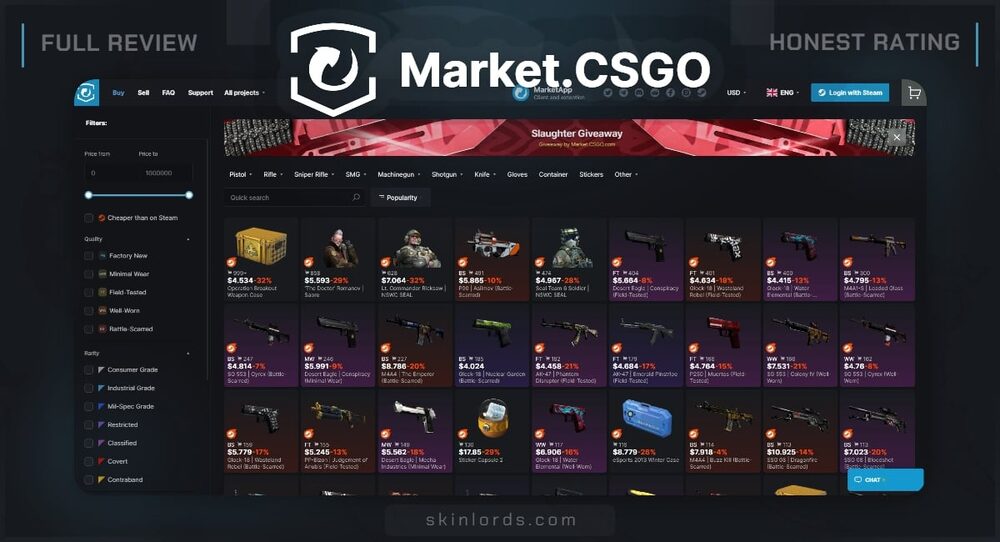
Deciding to sell is half the job; the venue decides how much you keep. Steam Market fills fast but pays in wallet funds that never become cash. Cash marketplaces pay real money at a discount to Steam's sticker price — the honest comparison across DMarket, SkinBaron, CSFloat and the rest is covered in the marketplace comparison, and the full inventory-to-bank pipeline in cashing out safely.
Two mechanical rules regardless of venue: price against recent sales, not listings (asks are wishes; sales are facts), and remember that instant-sell quotes typically run meaningfully below patient listings — instant liquidity is a service you pay for, and it should be a choice, not a default.