How Majors Move Skin Prices (a Repeatable Pattern)
Twice a year, the market runs the same three-act script: speculate, spike, digest. Knowing the script doesn't guarantee profits — but not knowing it guarantees you'll be someone else's exit liquidity.

Act one: the pre-event speculation phase
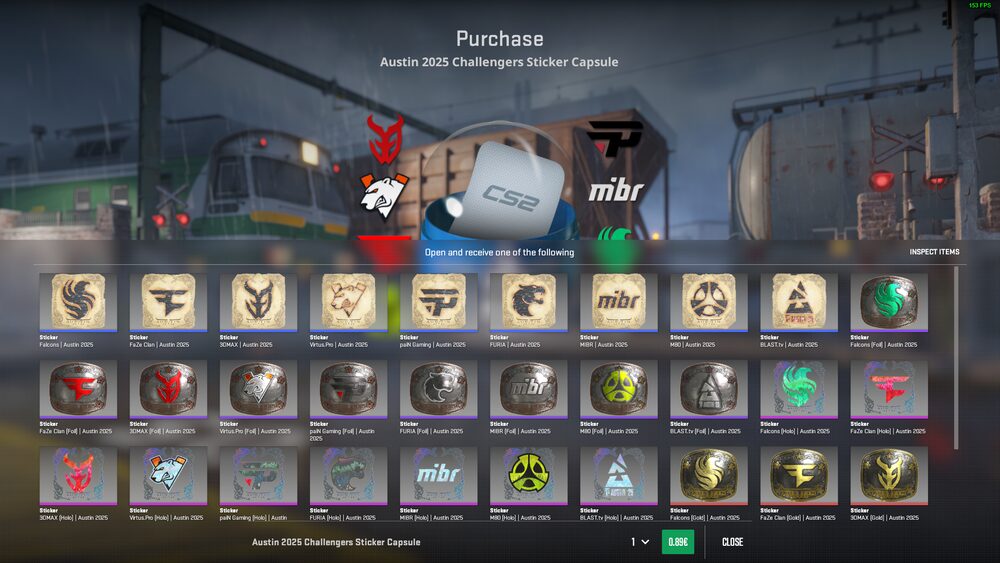
Weeks before a Major, the market starts trading the event rather than the game. Capsule speculation is the loudest part — traders positioning for the new sticker mint, and re-pricing old tournament items whose teams or players are back in the spotlight. But the effect spreads wider: skins associated with qualified teams' star players, previous capsules from the same host city or organizer, and the general "attention is coming" bid under liquid items. It's a classic buy-the-rumor structure, and like all such structures it's crowded — the marginal buyer in this phase is usually another trader running the same playbook, which is worth remembering before paying pre-event prices for anything.

Recent cycles show both the pattern and its decay. The run-in to Copenhagen 2024 carried a genuine novelty bid — the first CS2-era capsules were an unknown, and old tournament items re-rated on the era-transition narrative. By Austin 2025, the pre-event trade was so telegraphed that much of the move happened absurdly early and faded before the event began. Patterns that everyone trades converge toward being priced in; the pre-Major bid still exists, but it arrives earlier and pays less each cycle.
Act two: event weeks — demand meets a supply valve
During the event itself, two opposing forces run simultaneously:
- Demand floods in. Viewership peaks — ~1.8M concurrents at Copenhagen per third-party trackers — and with it comes the returning-player effect: lapsed players reinstall, top up wallets, and buy. Marketplace activity measurably rises in Major weeks; it's the most reliable recurring demand event on the CS2 calendar.
- Supply opens a valve. The event store mints capsules continuously for the duration of the window. Whatever the demand, fresh supply meets it — which is why capsule prices during the window are usually unremarkable, and why "I bought during the event" is rarely the origin story of a great sticker position.
The old-school mechanism — random souvenir drops for anyone watching — is long gone; tournament item acquisition has been gated and formalized for years, with the souvenir pipeline tied to the event rather than sprayed at viewers. Modern Major-week demand is attention economics, not drop farming: people watch, people want, people buy.

Act three: the post-event digestion
When the store closes, the capsule supply is frozen forever — the single most important moment in any tournament item's life, and the foundation of the sticker investment thesis. It's also the moment the market's clock changes speed: everything before it trades in days, everything after it trades in years. What follows is remarkably consistent across events:
- The hype bid evaporates. Attention-driven demand leaves faster than it arrived. Capsules and event-adjacent items commonly drift down in the weeks after the final, as event buyers become sellers.
- The champion premium sorts itself out. Winning-team capsules and the MVP's autograph hold or re-rate; group-stage exits sink toward the flatline. Team-result risk resolving is what post-event pricing is.
- The long game begins. The frozen supply then meets the slow burn of openings and crafts over years. This unglamorous stretch — not event week — has historically been where patient buyers built the positions that later looked brilliant, Katowice 2014 being the canonical case.
What to actually do with the script
- If you're accumulating cases or liquid skins: ignore the calendar entirely. The Major effect on non-event items is an activity blip, not a trend change — pausing a DCA plan for it is overfitting.
- If you want event items: the historically favorable entry is the post-event drift, not the window and certainly not the pre-event run-up.
- If you're selling: attention peaks are liquidity peaks. Event weeks are when spreads tighten on liquid items and exit orders fill fastest — the one part of the script that works in a seller's favor.
The honest caveats
Three things keep this pattern from being a money printer. First, it's public knowledge — every phase is front-run by people reading the same history, and crowded patterns pay less each cycle. Second, the amplitude varies: a Major landing in a bull market (Copenhagen 2024) rhymes with but doesn't repeat one landing in a chop (later events), and a single Valve patch mid-event would dwarf every effect described here. Third, measurement is mushy — separating "Major effect" from ordinary volatility in a market this noisy is closer to reading tea leaves than backtesting. Treat the script as context for your decisions, not as a signal generator. If you hold event items, the exit-planning framework in when to sell matters more than any calendar pattern.