CS2 DCA: The Complete Guide to Dollar-Cost Averaging Into CS2 Cases
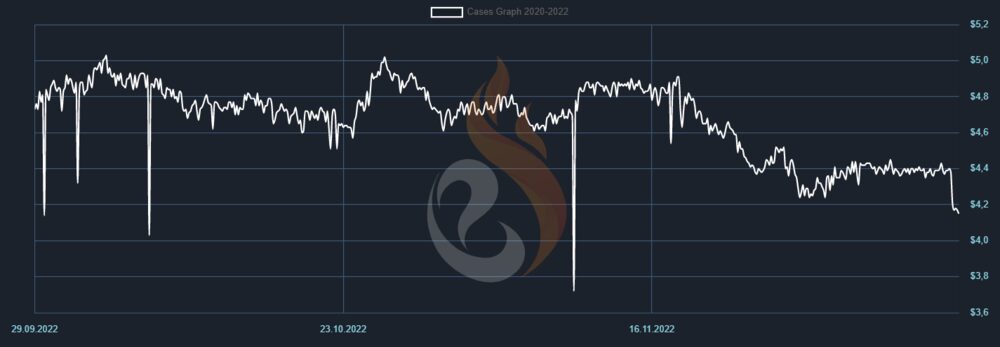
Everyone in this market has a story about the dip they didn't buy or the top they bought instead. DCA is the strategy for people who are done pretending they can time Valve.
What DCA means in a case market
Dollar-cost averaging is the least glamorous strategy in finance: you invest a fixed amount at a fixed interval — say, $20 every day — regardless of price. When cases are cheap your $20 buys more of them; when they're expensive it buys fewer. Over months, your average entry price converges toward the market's true average rather than toward your worst emotional decisions.

The idea comes from equities, but it maps onto CS2 cases unusually well, for three reasons:
- Cases are volatile. A single patch note can move the whole market double digits in a day — the 2025 trade-up update repriced knives in hours. Volatility is exactly what DCA converts from an enemy into an ally.
- Cases are cheap per unit. Unlike a knife, you can deploy $5 into most cases without leftover cash sitting idle. Granular units make small-interval buying practical.
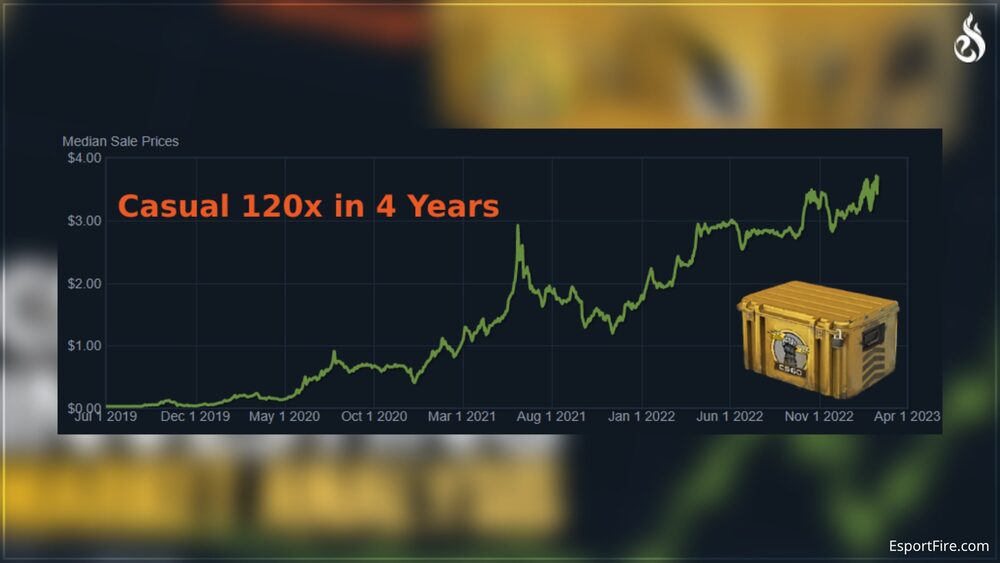
- The long-term drift has been up. Discontinued cases are a structurally deflationary asset: every opening permanently destroys supply while the player base has kept growing. DCA into a downtrending asset just averages your losses; the case market's decade-long trend is what makes averaging in attractive.
The math, briefly
Suppose a case oscillates between $0.80 and $1.20 around a $1.00 average. Buying $60 in one lump risks paying $1.20 — 50 cases. Spreading $20 across three buys at $1.20, $0.80, and $1.00 gets you 16.6 + 25 + 20 = 61.6 cases for the same $60. Your average cost is the harmonic mean of prices, which is always at or below the simple average. That's the whole trick: volatility mechanically lowers your entry when purchases are spread out.
It cuts the other way too — in a straight-up bull run, the lump sum wins because every day you wait costs you. DCA is not a return-maximizing strategy; it's a regret-minimizing one. In a market where a Valve update can land any Tuesday, regret minimization is worth a lot.

Designing your DCA plan
1. Pick the budget you won't miss
The strategy only works if it survives boring weeks and scary crashes. $5–$20 a day is the range most people sustain. If a 30% drawdown would make you stop buying, the budget is too big — the whole point is to keep buying through the crash.
2. Pick your cases deliberately
A common structure is a ladder across tiers: cheap active-drop cases for volume, mid-tier discontinued cases for the supply squeeze, and a small premium slice. Spreading the daily budget across three to six cases diversifies against the risk that any one case gets re-added to a drop pool.
3. Buy where it's cheapest
The same case often trades at different prices on Steam, DMarket, SkinBaron, and other venues — and Steam's ~15% fee plus wallet lock means Steam prices aren't real cash prices anyway. Comparing cash marketplaces per purchase adds up: saving 3–5% on every buy compounds exactly like extra market growth.
4. Log everything
DCA generates hundreds of small purchases — which is why most people end up wanting to autobuy rather than place each order by hand. Without a ledger you'll have no idea what your actual average cost is, which makes exit decisions emotional. Every buy should land in a record with date, venue, price, and fees.
The mistakes that break DCA
- Stopping during drawdowns. The purchases you skip in a crash were the entire reason the strategy works. This is the most common and most expensive failure.
- Chasing release hype. New cases follow a predictable lifecycle — spike, flood, long flatline. DCA-ing into a fresh case during its supply flood means averaging into falling prices for years.
- Ignoring per-unit ceilings. A max price per case protects you from thin-orderbook spikes. No ceiling means occasionally paying a 20% premium to an illiquid ask.
- Opening the cases. The sealed case is the asset. Opening it is a ~30%+ expected-value donation to variance.

DCA vs the alternatives
| Strategy | Best case | Worst case | Requires |
|---|---|---|---|
| Lump sum | Bought the bottom | Bought the top | Timing skill nobody has |
| DCA | Smooth average entry | Underperforms in straight bull run | Discipline only |
| "Buy the dip" | Great entries | Never triggers, or catches knives | Defining "dip" in advance |
The honest summary: if you knew where the market was going, you wouldn't need a strategy. Since you don't, DCA turns not-knowing into a system.