
Buff163 vs CSFloat (2026): the Global Price Benchmark Fight
Open any price checker, any Discord bot, any inventory tracker, and two numbers follow every item around: the Buff price and the CSFloat price. That's great news for buyers — the CS2 economy's two strongest reference quotes, one anchoring China and one the West, both pointing you toward cheaper skins. Buff163 does sit behind real regional access friction for most Westerners, so this comparison covers both roles: what each number means, and which venue you can actually use.
Why these two became the benchmarks
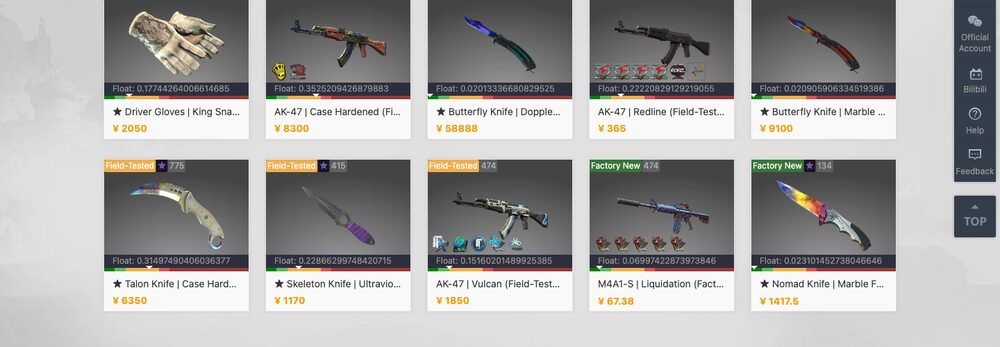
A reference price needs volume behind it. Buff163 — operated within the NetEase orbit, serving the largest CS2 trading population on Earth — has carried a dominant share of Chinese liquid-item volume for years, so its lowest-listing price genuinely reflects where the deepest demand pool clears. CSFloat earned the Western slot differently: it grew out of float-inspection tooling into a P2P marketplace with low fees, transparent data, and an accessible API surface that made it easy for the tool ecosystem to quote. Volume made Buff the benchmark; volume plus openness made CSFloat one. The pairing stuck because together they bracket the market: quote both and you know, within a band, what an item is worth to the world's two great demand pools. The two numbers routinely disagree — and that gap is itself a data point, the same regional spread that shapes the whole market map.
As venues: one open door, one wall
Here the fight is short. CSFloat is a Western venue any reader of this blog can register on today: P2P listings, escrowed trade-offer delivery, buy orders, cash-out over Western rails, KYC scaling with amounts. Buff163 sits behind China's identity and payment infrastructure — real-name verification and domestic payment linkage that non-Chinese users generally can't satisfy, with the details shifting over time and rarely announced in English. For most Westerners, Buff is a read-only website: consult the prices, never click buy. The mechanics of that wall, and why it persists, are covered in our China deep-dive — and treat any specific access claim, here included, as perishable and worth re-verifying.
Prices and fees, hedged
Structurally, Buff prices on liquid items tend to sit below Western venue prices — low commissions (reported in the low single digits percent, unverifiable from outside; hedge accordingly) plus enormous seller competition produce sharp stickers, which is precisely why the "Buff price" reads as the market's floor-ish reference. CSFloat's standard seller fee has, per its published schedule as of late 2026, also sat in the low single digits percent — verify live — making its stickers among the sharpest in the West, if usually above Buff's on the same item. The honest caveat cuts both ways: a Buff price you cannot transact at is not a price for you, and a Western tool quoting it is quoting someone else's market. Our valuation guide covers how to weigh the two quotes; the cross-venue fee table lives in the fee comparison.
Trust and protection
Both venues are institutionally serious. Buff operates inside China's regulated internet economy with mainstream corporate backing; CSFloat is a publicly identifiable Western operation with years of track record and a security-conscious culture inherited from its inspection-tool origins. Neither belongs anywhere near a scam list — the relevant risks are structural instead. For Buff-adjacent Westerners the risk is the workaround economy: account renters, payment agents, and middlemen who bridge the wall are unvetted counterparties, and every one of them is a line item in the red-flags guide. For CSFloat users the risks are the ordinary P2P ones: trade-offer hygiene and trade locks.
When you consume these two numbers through tools, two mechanical caveats keep them honest. Currency, first: Buff quotes originate in yuan, so every "Buff price" you see in dollars has a conversion baked in, and the tool's exchange rate — its source and its refresh cadence — is silently part of the quote. Staleness, second: aggregators poll on schedules, and in a fast market a benchmark scraped hours ago describes a market that no longer exists, which matters most for exactly the volatile items where you're leaning on the benchmark hardest. Neither caveat makes the quotes unusable; both are reasons to treat a single number as an estimate with error bars rather than a fact.
The line-by-line table
| Dimension | Buff163 | CSFloat |
|---|---|---|
| Home market | China — largest trading population | The West |
| Benchmark role | The global floor-ish reference quote | The Western reference quote |
| Access for Westerners | Effectively walled — CN identity/payment rails | Open registration |
| Model | Marketplace with escrowed Steam-trade delivery | P2P, escrowed trade offers |
| Fees | Reported low single digits % — unverifiable from outside | Low single digits % per published schedule — verify |
| Price level (liquid items) | Typically the lower of the two | Sharp for the West, usually above Buff |
| Buy orders | Domestic feature set — hedge specifics | Yes, native |
| Cash-out | Domestic Chinese rails | Western rails, KYC scales with size |
| Use for most readers | Price signal — read, don't transact | Actual venue — transact freely |
Verdict: one is a thermometer, one is a door
Both venues win here — just for different buyers. Buff163 wins as the price signal: the most demand-weighted quote in the market, essential for valuing anything liquid, though for most Westerners it stays read-only, with workarounds carrying more risk than the spread is worth. CSFloat wins as the venue: the Western marketplace where the benchmark price is also a button you can press. Quote both, buy cheaper on the one your access supports. Full solo treatments: Buff163 review and CSFloat review. (Disclosure: cs2stack, the product behind this blog, transacts on neither — it compares DMarket and SkinBaron on every automated buy — but the two-quote habit is the same discipline it automates.)
The honest conclusion is that both venues earn a bookmark, and neither earns blind trust on price. Whichever way your access and workflow point, checking the other side — and the wider market — before each buy is where the lasting savings come from.