
How to Buy CS2 Skins Automatically (2026)
"Buy skins automatically" means four very different things depending on who's selling you the idea: a ping on your phone, a resting order in a queue, a tool that spends real money by rule, or a bot you wrote yourself. Each level trades effort for speed and hands over a little more control. This is the whole ladder, compared honestly — including the rung where "automatic" quietly stops being automatic.
What "automatically" actually means
Every automated buy has three parts: something watches prices, something decides a listing matches your rules, and something executes the purchase. The ladder below is really about how many of those three you still do yourself:
- Level 1 — price alerts. A tool watches; you decide and you click. Free, and still the right answer for judgment-heavy purchases.
- Level 2 — standing buy orders. The venue watches and executes inside its own walls. You set a price once and wait your turn in a queue.
- Level 3 — autobuy tools. A third-party service watches across venues and executes with your money, inside limits you configure.
- Level 4 — custom bots. You build the watcher, the decider, and the executor on marketplace APIs — and you maintain all three forever.
Climbing a level buys you speed and removes screen time. It also raises the stakes of a misconfiguration, which is why the safety rails section at the end applies more, not less, the higher you go.
Levels 1 and 2: alerts and buy orders
Price alerts: free, effective, and you're still the trigger finger
An alert is automation of attention only. You define a threshold — this item below this price — and a tool pages you when it hits. It costs nothing, works on any venue you can open in a browser, and keeps every purchase decision human. The catch is response time: a genuinely underpriced listing on a liquid item lives seconds to minutes, and an alert you answer at your desk is a different instrument from one that lands while you sleep. Threshold design matters more than tool choice here, and the honest breakdown of where alerts lose to autobuy is mostly a breakdown of when you're awake.
Standing buy orders: the original autobuy
Buy orders predate every bot. On the Steam Community Market and on CSFloat, you can rest an order — "I'll pay $X for this item" — and the venue fills it automatically when a matching listing arrives at or below your price. No third party touches your money, execution is instant, and it works while you sleep. The limits are structural: your order only sees listings on that one venue, you wait in a price-then-time queue behind everyone who bid higher or earlier, and on Steam the proceeds of your whole strategy stay locked in wallet funds. The mechanics — queue priority, pricing an order so it actually fills, float-range orders on CSFloat — are covered in the standing buy orders explainer and the CSFloat-specific guide.
Levels 3 and 4: autobuy tools and custom bots
Autobuy tools: rules that spend for you
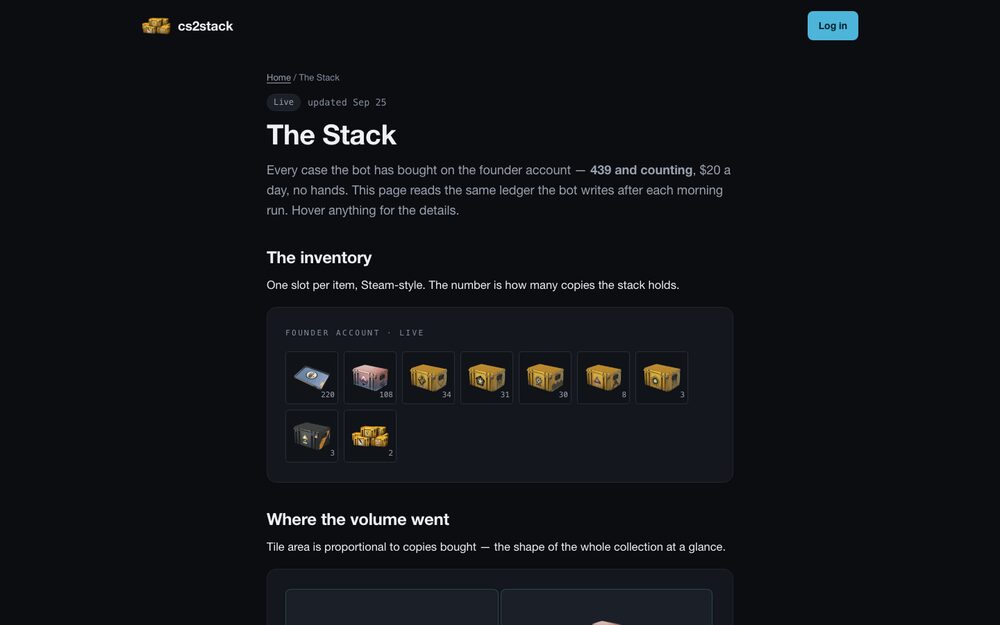
An autobuy tool is a service that watches one or more marketplaces and executes purchases with your funds when your rules match. This is where disclosure matters: cs2stack, the site you're reading, is one of these tools. Concretely, it keeps a monitoring sheet of live lowest prices across DMarket and SkinBaron for the items you pick, and its autobuy fills when your price rules hit — inside a daily budget, per-item price ceilings, and an absolute hard cap it cannot cross. It's non-custodial (your money sits in your own marketplace accounts, never with us), new rules start in dry-run mode by default, every fill is emailed to you in a ledger, and it's free to start at /signup. The founder runs it on his own money — $20 a day, published live at /stack — and per that public ledger, purchases have averaged roughly 36% below the same-day Steam price.
We're not the only one. CSWatcher, per its public pages as of late 2026, offers free multi-marketplace watching and alerts, with hands-free autobuy sold as a paid day pass across its supported venues — a genuinely different shape of tool, built more around sniping individual listings than accumulating on schedule. If your goal is catching one rare float rather than stacking items at a discount, it's a reasonable pick; evaluate it against its own documentation rather than our summary.
Custom bots: maximum control, maximum maintenance
The top rung is code you own, running against marketplace APIs. DMarket in particular exposes a full programmatic surface — target orders, scoped API keys, a balance model built for bots — and a competent developer can have a naive buyer running in a weekend. What the weekend estimate hides is everything after: uptime, rate limits, reconciling what you think you bought against what actually landed, and re-fixing the integration every time an API shifts. The build-vs-buy breakdown puts numbers on it; the short version is that DIY wins only when you have an edge no existing tool expresses, and costs a part-time job when you don't.
The four levels, side by side
| Effort | Speed | Custody | Cost | What it can't do | |
|---|---|---|---|---|---|
| Price alerts | Setup once, react forever | Your reaction time | Funds stay yours | Free | Buy while you sleep |
| Buy orders | Set and forget | Instant, after the queue | Funds parked on the venue | Venue fees only | See any other venue |
| Autobuy tools | Configure rules, read receipts | Seconds, hands-off | Varies — cs2stack is non-custodial | Free tiers exist; check each tool | Judgment calls (patterns, crafts) |
| Custom bots | Build and maintain forever | As fast as you engineer | Entirely on you | Your hours + infrastructure | Justify itself without a unique edge |
One column deserves a second look: custody. Alerts never touch your money. Buy orders require funds parked on one venue. Tools differ — some hold your balance, some (cs2stack included) only instruct accounts you own. Bots are whatever you build. The higher the level, the more that column should drive your choice.
The P2P caveat: when "auto" ends in a manual click
Here's the rung of fine print most autobuy marketing skips. CS2 marketplaces split into two structural families: peer-to-peer venues, where every purchase settles as a Steam trade offer from the seller to you, and on-site-inventory venues, where the item moves into a balance the marketplace holds for you. On a P2P venue, no level of automation removes the last step — you must accept the incoming Steam trade, with your own authenticated account, usually within a window measured in hours. Your "fully automatic" purchase becomes a push notification and a mobile-confirmation ritual, and an unaccepted trade is a cancelled purchase.
True hands-off buying therefore only exists on on-site-inventory venues, where the bought item lands in your marketplace inventory with no trade to accept and withdrawal happens later, on your schedule. This single distinction — where the bought skin lands — decides more about your automation options than any feature list, and it's the reason cs2stack runs on DMarket and SkinBaron rather than on P2P feeds.
Safety rails before any bot spends a dollar
Whatever level you pick above 1, the failure mode is the same: a machine repeating a mistake faster than you'd notice it. Four controls neutralize most of the risk. Caps — a per-item ceiling so one fat-fingered rule can't overpay, and a daily or absolute budget so a runaway loop can't drain a balance. Dry-run first — run every new rule in log-only mode and read a few days of would-have-bought output before arming it (cs2stack ships this as the default state, not an option). Scoped keys — API keys with buy permissions only, never withdrawal or trade rights, so a leaked key can at worst buy skins into your own account. Prepaid-only funding — top up marketplace balances from a card manually; never hand a bot a payment method that can pull more. The full checklist extends this to ledgers and kill switches, but these four are the floor.
Pick the lowest rung that solves your actual problem. If you buy twice a month on judgment, alerts are enough. If you accumulate the same items every week at prices you already know are fair, that's exactly the work the higher rungs were built to take off your hands.