
Skinport Review (2026): Convenience at a Premium
There's a reason Skinport is the first cash marketplace most players fall in love with: it just works. Buying a CS2 skin here feels like ordering from a proper store — polished, predictable, and pleasant, in a market segment where those three words are rare — and because listings are venue-held, delivery is about as close to guaranteed as this hobby gets. Yes, the polish can carry a small premium, but on plenty of days Skinport's sticker is genuinely the best deal on the board. Here's why it earns a spot in your buying rotation, and what to watch. (Disclosure: this is cs2stack's blog — our product automates buying on DMarket and SkinBaron, not on Skinport.)
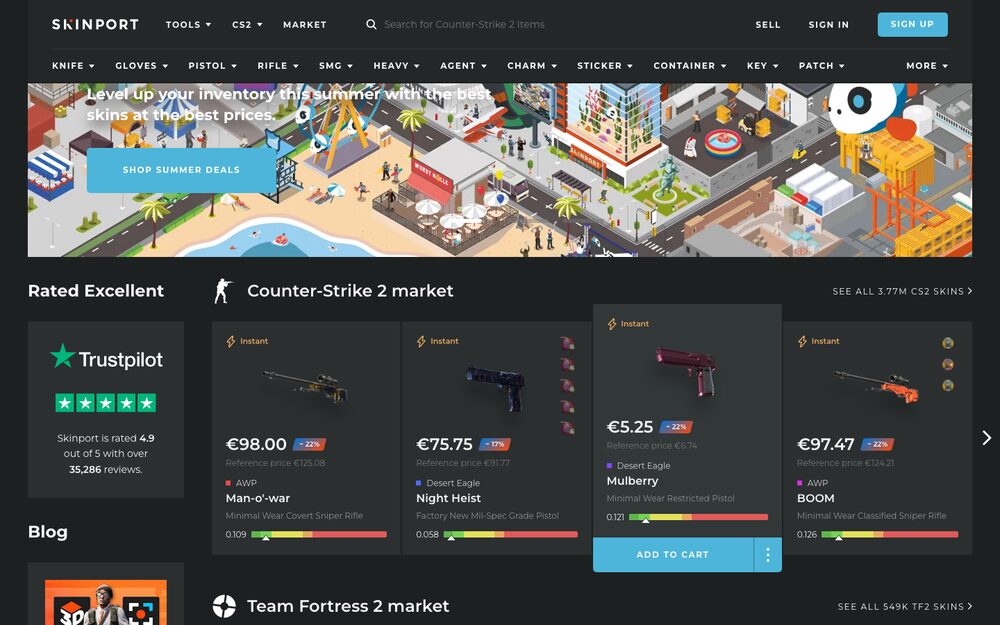
What Skinport is
Skinport is a European (German-rooted) cash marketplace for CS2 skins that has grown into one of the mainstream defaults for Western buyers. You browse a catalog, pay with a normal payment method, and receive the item into your Steam inventory. Sellers list items for cash and withdraw proceeds to real-world rails. No trading, no swapping, no balance games — it is a store-shaped marketplace, and it leans into that simplicity hard.
The model: venue-held listings, buyer-side trade offer
The single most important thing to understand about any CS2 marketplace is where the item sits between listing and delivery — we've written a full explainer on the P2P vs on-site inventory divide. Skinport occupies an interesting middle position. Sellers deposit items into Skinport's custody when they list, so the marketplace itself holds the inventory. That kills the worst P2P failure mode: you never wait on a stranger to wake up and send a trade offer, because the seller's part is already done.
But delivery to you still happens over Steam's rails: after purchase, Skinport's system sends you a trade offer, and you accept it. That's a small ritual, not a real burden, for a human shopping by hand. It does mean the last step isn't fully hands-off the way a pure on-site-inventory venue like DMarket or SkinBaron is — a distinction that matters mostly to people trying to automate, which is not who Skinport is built for.
Strengths
- The cleanest buying experience in the field. Search, filters, float and pattern display, checkout — it all works the way a modern e-commerce site works. For a first-time cash buyer working through a first-purchase checklist, there is less to get wrong here than almost anywhere else.
- Wide payment coverage. Skinport supports a broad set of local European payment methods alongside cards, which matters more than it sounds: payment friction is where many would-be cash buyers give up and go back to the Steam wallet.
- Reliable delivery. Because listings are venue-held, a purchase essentially always delivers. You are not exposed to seller flakiness, offline sellers, or expired offers — the classic P2P frustrations.
- Mainstream trust posture. Skinport has operated for years at scale with a boring, drama-light track record, which in this industry is a genuine asset — in our survey of the safest CS2 marketplaces, boring is the highest compliment we give.
Weaknesses
- Rarely the price floor. Skinport's sticker prices sit above the cheapest venues more often than not. The convenience premium is real, and on liquid items it is visible to anyone running a price comparison across venues.
- Fees on the higher side. Seller commission is moderate rather than cheap — per its published schedule it drops to a reduced rate above a price threshold, but verify the current numbers before listing. Higher seller fees flow into higher sticker prices.
- No meaningful automation surface for buyers. There is no buyer-facing API story to speak of; this is a venue designed for humans with mice.
- Demand-spike friction. At peak moments (big update days, sale seasons), popular listings move fast and the buying experience can feel like a race rather than a store.
Fees, payments, and cash-out
Treat all fee talk as shape, not gospel: per Skinport's published schedule, seller commission lands in the moderate single-digit-to-low-teens range typical of Western venues, with a reduced rate for higher-priced items — verify the current schedule before you list. Buyers pay the sticker price plus whatever their payment method costs. Against Steam's ~15% cut into a locked wallet, Skinport is clearly better for anyone who wants real money out; against the cheaper cash venues it is clearly pricier. Our 2026 fee comparison puts the whole field side by side.
Cash-out is a genuine strength in kind if not in cost: sellers withdraw to real banking rails, with identity checks that scale with amounts — standard KYC posture for anything touching real money, and covered more broadly in our marketplace KYC guide. For a European seller who wants euros in a bank account with minimum drama, Skinport is one of the shortest legitimate paths.
Strengths vs weaknesses at a glance
| Strengths | Weaknesses |
|---|---|
| Polished, beginner-proof UX | Convenience premium — rarely the cheapest sticker |
| Broad EU-friendly payment methods | Fees on the higher side of the field |
| Venue-held listings = dependable delivery | No buyer automation surface |
| Long, quiet, trustworthy track record | Race-like dynamics when demand spikes |
Who it's for
Skinport is a superb pick for the buyer who wants savings with certainty attached: one knife, one loadout, one gift — a familiar checkout, a guaranteed delivery, and a competitive price more often than its "premium" reputation suggests. It's also a strong first venue for sellers cashing out a modest inventory to a European bank; the safe cash-out playbook pairs well with it. Budget accumulators buying the same items on repeat will still want to shop wherever the floor sits that day — sometimes here, sometimes not — and our guide to where skins are actually cheapest shows how to find it.
Verdict
Skinport delivers exactly what it promises — a clean, dependable, mainstream cash marketplace — and on the right day it delivers it at a price that beats the field outright. That combination makes it an easy recommendation: keep it in the rotation, lean on it whenever the purchase matters, and see CSFloat vs Skinport and Skinport vs SkinBaron for how it fares against its closest rivals. Skinport's floor is real, but it rotates ownership of 'cheapest today' with its rivals constantly. Make the cross-market check part of every order — the compounding of hundreds of small saved percentages, not any single bargain, is what wins long-run.