
DMarket Review (2026): Strengths, Weaknesses, Fees
If you want CS2 skins cheaper without babysitting trade offers, DMarket belongs in your rotation. It's one of the few marketplaces where a purchase finishes the moment you click buy — no waiting for a seller to wake up — and that design choice powers everything buyers love here: a deep catalog, competitive prices on liquid items, and a real API. Here's why it earns the spot, and what to watch.
What DMarket is
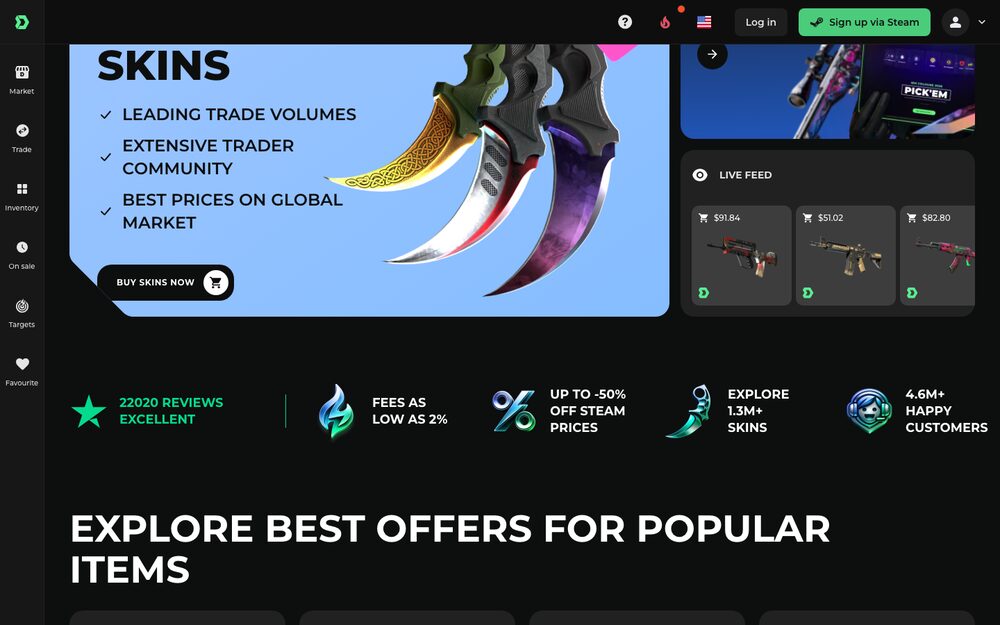
DMarket is a global third-party marketplace for CS2 items (plus a few other games), operating since around 2017 and pricing in USD. It's one of the longest-running cash venues in the skin economy — a meaningful credential in an industry where marketplaces have died loudly and taken inventories with them. It carries a broad catalog: cases, liquid mid-tier skins, and a long tail of floats and patterns that smaller venues simply don't stock.
Disclosure up front: this is cs2stack's blog, and cs2stack compares DMarket and SkinBaron on every purchase it makes — so we watch this venue daily and know its quirks well. We've written up the head-to-head between the two separately.
The model: on-site inventory, instant settlement
The most important fact about DMarket isn't a fee number — it's the settlement model. On peer-to-peer venues, a purchase kicks off a Steam trade offer that a human seller must send and a human buyer must accept. On DMarket, the seller's item already sits in the venue's custody, so buying is effectively a database update: the item lands in your on-site DMarket inventory within seconds, at any hour, with nobody awake. You withdraw to Steam later, in batches, on your schedule — noting that withdrawn items can carry a trade lock before they move again.
This is the split that decides which venues can be automated at all, and it's worth understanding before you pick any marketplace — we've compared the two architectures in depth. DMarket sits firmly on the automation-friendly side of the line.
Strengths
- Catalog breadth and depth. On liquid items, listings stack close together — the second-cheapest listing is usually nearly as cheap as the first, which matters if you buy regularly. On obscure items, DMarket is likelier than most venues to have the item at all.
- Instant settlement. Buys complete without trade-offer choreography. For anyone running automated buying, this is the property everything else depends on.
- A real, documented API. Market-data and trading endpoints are public, and target orders — standing bids that fill automatically when a matching listing appears — give you automation you don't even have to host. Our DMarket autobuy guide covers the practical setup.
- Track record. Nearly a decade of operation through multiple market cycles. Not a guarantee of anything, but survivorship is one of the few trust signals this industry offers.
Weaknesses
- Cash-out is region-dependent. Withdrawal options vary by country and method, and they've changed over time. If converting inventory to bank balance is your endgame, verify the current paths for your region before committing money.
- Fee complexity. Commissions vary by item category, seller volume, and promotions. The averages are reasonable, but predicting your exact cost on a given item takes reading the current schedule, not this review.
- Not always the cheapest. On hyped or fast-moving items, DMarket's sticker price can trail the true floor across venues. Global visibility attracts global bidders.
- Platform risk. Like every third-party venue, DMarket is not endorsed by Valve, and your on-site balance is a claim on a company, not items in your Steam inventory.
Fees, payments, and KYC
Treat fee specifics as shape, not gospel: per DMarket's published schedule, seller commissions typically land somewhere between the single digits and the low teens percent depending on category and volume — verify the current numbers before you list. Buyers mostly pay the sticker price plus whatever their deposit method costs. Against Steam's ~15% cut into a locked wallet, that's cheap; against other cash venues it's competitive rather than dominant. Our 2026 fee comparison has the fuller cross-venue table.
Deposits run through cards, crypto, and skin deposits. Identity checks scale with the amounts you move — small buys are low-friction, but expect KYC before meaningful money exits to the banking system. That posture is standard for anything touching real payment rails.
The scorecard
| Strengths | Weaknesses |
|---|---|
| Broad, deep catalog on liquid items | Cash-out paths vary by region; verify yours |
| Instant on-site settlement — automation-ready | Fee schedule varies by category and volume |
| Documented public API with target orders | Not always the cheapest venue on hyped items |
| Long track record through multiple cycles | Third-party platform risk, like every non-Valve venue |
Who it's for — and the verdict
DMarket is a great fit for three buyers in particular: the accumulator who buys cases or liquid skins on a schedule and wants fills at 4 a.m. without touching a phone; the builder who wants a documented API instead of reverse-engineering one; and the global user who deposits and withdraws in USD outside Europe. The brief caveats: it won't hold the absolute floor on every hyped item, and cash-out rails vary by region — verify yours before committing money.
Verdict: this venue earns a permanent spot in the rotation. Instant on-site settlement matters more than any fee decimal, the catalog is deep where it counts, and sticker prices on liquid items are consistently sharp. One more truth worth internalizing: DMarket wins the price race often, but not daily. The buyers who quietly come out ahead are the ones who check it against SkinBaron and the rest on every single order — small edges, claimed relentlessly, become the whole return.