
DMarket vs SkinBaron (2026): the On-Site Inventory Duel
Good news for CS2 buyers: this is a duel with two winners. DMarket and SkinBaron both deliver something the rest of the field mostly doesn't — when you buy, the item lands in your venue-side inventory instantly, with zero Steam trade offers to accept. For anyone automating purchases, that shared superpower makes both great options for buying skins cheaper. Here's the head-to-head, line by line — pick by use case.
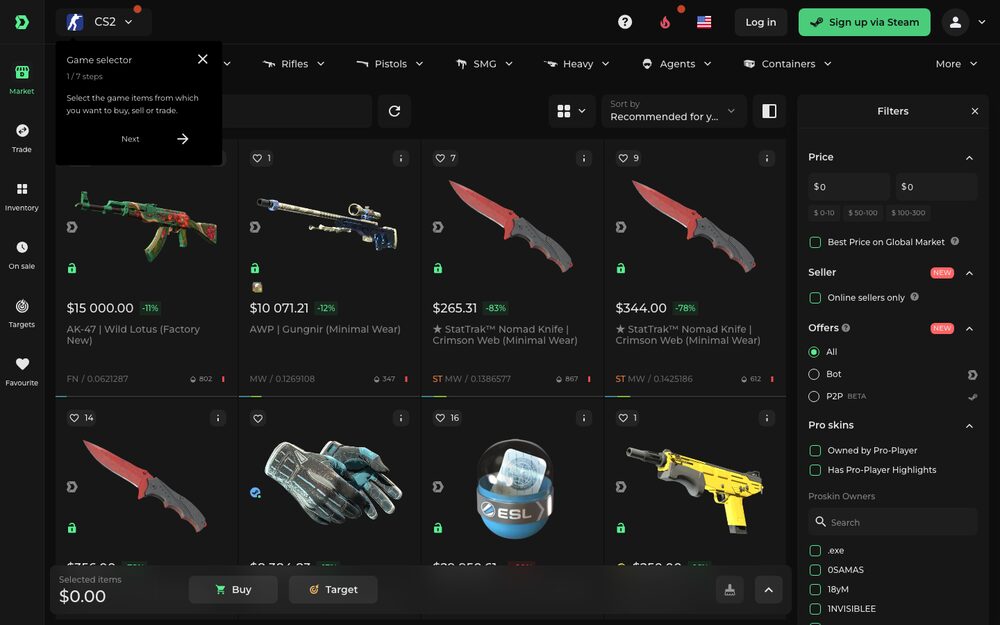
Why these two venues, specifically
On peer-to-peer marketplaces, every purchase ends with a human ritual: the seller sends a Steam trade offer, you confirm it on your phone, and if either side is asleep the deal times out. That model has real advantages — we've compared the two architectures in depth — but it is structurally hostile to automation. A bot can find the deal; it can't tap "accept" on your Steam Mobile app.
DMarket and SkinBaron both run the other model: the seller's item already sits in the venue's custody, so a purchase is just a database update. Your buy settles into your on-site inventory in seconds, at 4 a.m., with nobody awake. You withdraw to Steam later, in batches, on your schedule. That's why these two — not the bigger P2P names — are the natural rails for automated buying, and why they deserve a head-to-head of their own.
Catalog, liquidity, and the character of their prices
DMarket is the broader house. It serves a global audience, prices in USD, and carries deep listings across cases, mid-tier skins, and a long tail of patterns and floats. On liquid items you'll usually find many listings stacked close together, which matters for automation: a bot that buys daily wants the second-cheapest listing to be nearly as cheap as the first.
SkinBaron is the EU specialist. It's a German marketplace, prices in EUR, and its seller base skews heavily European. The catalog is narrower and the books are thinner on exotic items — but on the bread-and-butter inventory Europeans trade constantly, especially cases and mid-tier skins, SkinBaron is frequently the cheapest venue on the board once you convert currencies. Not always; frequently. EUR-side sellers pricing for EUR-side buyers, plus less bot traffic than the global venues, produces a euro floor that a USD-only shopper never sees.
Neither venue "wins" on price in general. The honest summary from watching both daily: DMarket wins on breadth and depth, SkinBaron wins the price check surprisingly often on the items it does carry, and the gap between them on the same item at the same minute is routinely a few percent in either direction. That gap is the entire reason to shop both — more on that below.
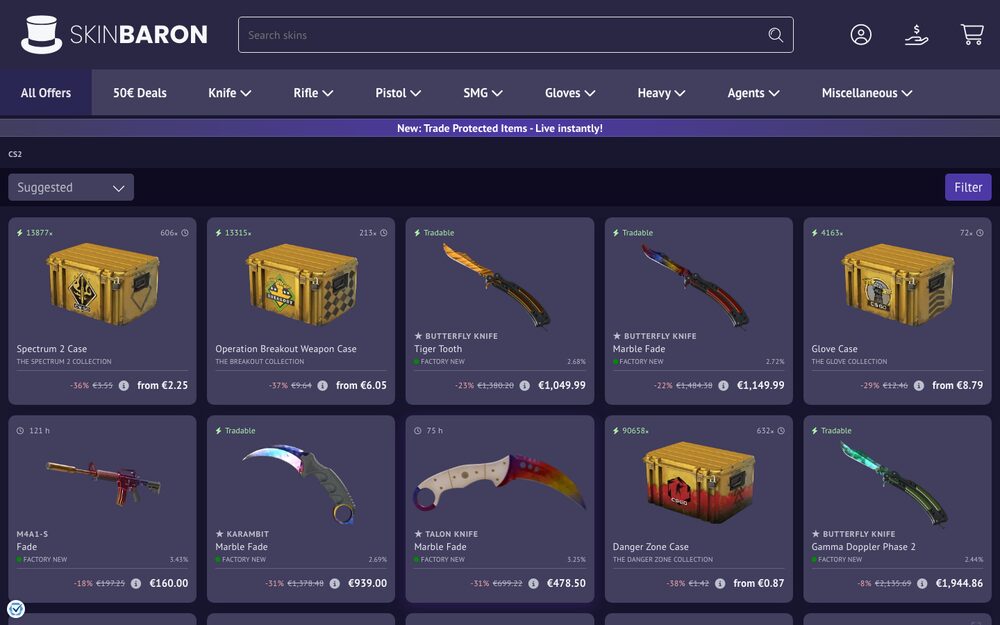
Fees, payments, and getting money out
Exact fee schedules move, so treat this section as shape rather than gospel: per their published fee schedules, seller commissions on both venues typically land in the single digits to low teens percent, varying by item category, seller volume, and promotions — as of late 2026, verify the current schedules before you list anything. Buyers on both venues mostly pay the sticker price plus whatever their deposit method costs. Compare that to Steam's ~15% cut into a wallet you can never empty, and both venues look cheap; against each other, the fee fight is close enough that it rarely decides a purchase. We keep a fuller cross-venue fee table in our 2026 fee comparison.
Where they genuinely differ is rails:
| Dimension | DMarket | SkinBaron |
|---|---|---|
| Base currency | USD | EUR |
| Audience | Global | EU-centric |
| Catalog depth | Broad, deep on liquid items | Narrower; strong on cases & mid-tier |
| Deposits | Cards, various global methods; skin deposits | European rails (bank transfer, cards, common EU wallets) |
| Cash-out | Withdrawal paths vary by region and method; check current options | Payouts oriented to EU bank accounts |
| Public API | Yes — documented, with market data and trading endpoints | Exists but quieter; less documented surface |
| Purchase settlement | Instant, to on-site inventory | Instant, to on-site inventory |
Both venues apply KYC before money leaves — identity checks scale with the amounts involved, which is standard for anything that touches real banking. If cashing out to a European bank account is your endgame, SkinBaron's EUR-native payouts are the shorter path. If you deposit and withdraw in USD from outside Europe, DMarket's global rails fit better. On track record: both are long-running venues, operating since the late 2010s, that have survived multiple market cycles — which in this industry, where marketplaces have died loudly before, is itself a data point. Neither is Valve-endorsed; no third-party venue is.
APIs and automation-readiness
This is DMarket's clearest win on paper. It publishes a public API with market-data and trading endpoints, and supports target orders — standing bids that fill when a matching listing appears, which is automation you don't even have to host. If you're building your own bot, DMarket is the venue that meets you halfway; our DMarket autobuy guide walks through the practical setup.
SkinBaron's API is quieter — it exists and supports the operations a buyer needs, but the documentation surface is thinner and the ecosystem around it smaller. In practice it's entirely automatable; it just asks a bit more reverse-engineering patience from the integrator. The SkinBaron autobuy guide covers what we learned doing it. The saving grace for both: because settlement is on-site, the automation only has to buy. There's no trade-offer choreography to script, which is where most P2P automation projects go to die.
Verdict: pick by use case (or don't pick at all)
Full disclosure before the verdict: cs2stack — the product behind this blog — compares exactly these two venues on every purchase it makes and buys whichever is cheaper after currency conversion, within your price caps. That coverage is no accident: these are two genuinely great venues, and the duel framing exists because each keeps winning on its own turf. It's also why we know their quirks: our own ledger is a running record of who was cheaper on what, day after day. When one venue undercuts the other by 3% on a case, our users simply pocket the 3%.
- EU case buyer: SkinBaron first. EUR rails, EUR payouts, and a frequent euro floor on exactly the items you're stacking.
- Global skin selection: DMarket. Breadth and depth are its game; if the item is obscure, DMarket is likelier to have it at all.
- Automation base: DMarket for the documented API and target orders; SkinBaron as the second leg once your bot works, because the price check across both is where the easy money is.
- Cash-out priority: match the venue to your bank. EU account → SkinBaron's payout rails; elsewhere → DMarket's options, verified for your region before you commit inventory.
The happy conclusion is the one the framing has been pointing at: for a buyer, this duel has two winners. Two excellent venues with instant settlement and overlapping catalogs but different seller bases means a persistent, harvestable spread. You don't have to pick a side — you profit by checking both, every time: manually if you enjoy it, or with software if you'd rather sleep. The full solo reviews go deeper: DMarket review and SkinBaron review.
So the real answer to "DMarket or SkinBaron?" is: yes — both, decided fresh on every purchase. The winner flips constantly, and buyers who make the comparison a reflex on each order bank a spread that compounds far past what any one-time venue choice could.