
The Cash-vs-Wallet Math: Why Steam Prices Are ~30% Fiction
Open any skin's Steam listing and you're looking at a price quoted in a currency you can't cash. Wallet dollars only exist inside Valve's ecosystem, and the market prices that captivity in: the same item on cash marketplaces routinely trades around 30% below its Steam figure. That gap isn't a temporary discount you're lucky to catch — it's an exchange rate between two currencies pretending to be one. This post walks the arithmetic end to end, with a worked $100 example and live data.
Two currencies wearing the same symbol
A Steam price and a cash price both say "$", but they denominate different things. Cash is cash. Wallet money is a claim on Valve's store and nothing else: it entered through a top-up or a Steam Market sale and it can never leave. Steam Wallet Dollars Are Not Dollars covers the closed-loop design in depth, but the market consequence is what matters here — any rational seller demands more wallet dollars than cash dollars for the same item, because wallet dollars are worth less to them. Steam prices are therefore quoted in a softer currency, which makes them systematically inflated relative to real money. Calling them "~30% fiction" isn't rhetoric; it's roughly the conversion rate.
The fee cascade that builds the gap
The 30% doesn't come from one fee. It accumulates across the round trip:
- Valve's cut, ~15%. Every Steam Market sale loses roughly 15% between what the buyer pays and what the seller receives — the exact split is documented here. Sellers price it in, lifting listings.
- The captivity discount. Even after Valve's cut, sellers hold wallet credit, not money. Anyone who ultimately wants cash must route their value out through third-party sales, where skins convert to money at a markdown. That expected markdown gets priced into how much wallet credit sellers demand today.
- Buy-side friction on the cash tier. Cash venues have their own fees — commonly a low single-digit percentage on payments or deposits, per venue schedules as of late 2026 — which is why the cash price sits ~30% below Steam rather than the full theoretical spread.
Stack these and you get the durable, boring, structural gap that has held for years across every liquid item class.
A worked example: the "$100" skin
Take a liquid skin listing at $100 on the Steam Community Market and follow the money in both directions:
- Buying on Steam: you top up $100 of real cash and receive the skin. Your cash is gone; you now own an item whose realizable cash value — what selling it for actual money would net after third-party pricing and fees — is commonly in the $65–75 range. You converted $100 into roughly $70 of value at the moment of purchase.
- Buying for cash: the same skin typically lists around $68–75 on cash marketplaces. Add a payment fee of a few percent and you own the identical item for roughly $70–78 all-in, with the option to resell it back into cash later.
- Selling side, for symmetry: if you owned this skin and sold it on Steam, you'd receive about $87 of wallet credit — which, converted honestly at the wallet-to-cash rate, is again roughly $65–70 of real value. Every road leads to the same ~$70.
The exact numbers wobble by item and by week — treat the ranges as structure, not quotes — but the shape never changes: the Steam figure overstates real value by roughly 30%, and paying it in fresh cash is the single most expensive way to acquire a skin.
What a live ledger shows
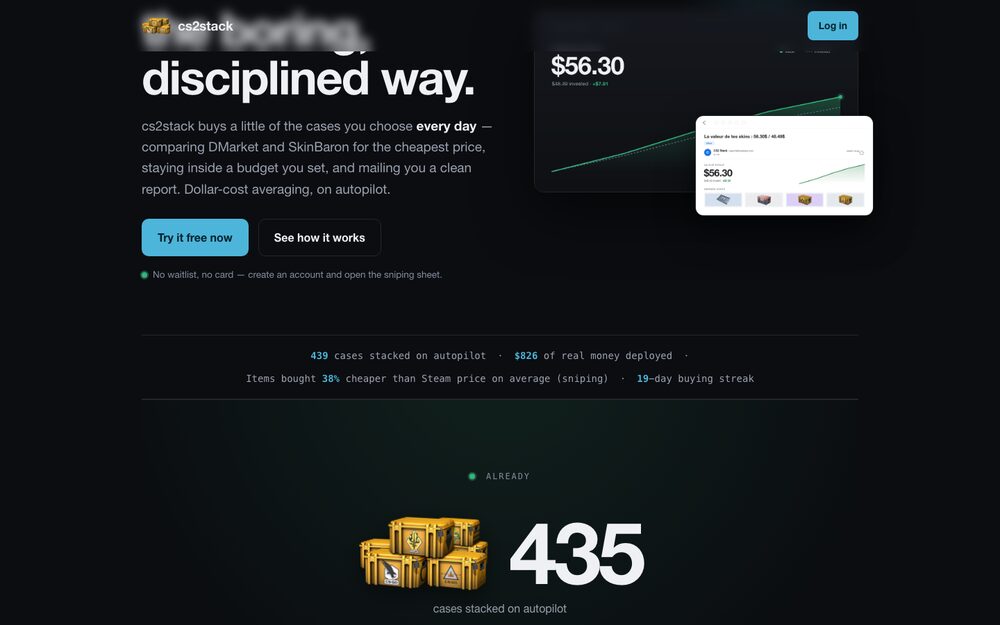
Disclosure first: cs2stack is this blog's product, an automated buyer that compares DMarket and SkinBaron on every purchase. Its founder runs it on his own money at $20/day with every fill logged to a public ledger — and across that ledger, purchases have averaged roughly 36% below the same-day Steam price for the same items. That's one account's buying pattern on liquid, automation-friendly items, not a universal promise; thin or hyped items can show smaller gaps, and the spread breathes with the market. But it's a real-money confirmation that the arithmetic above isn't theoretical: the discount is there every day, on ordinary items, for anyone buying on the cash tier. The venue map shows where along the cash tier the gap runs deepest.
How to think in cash terms from now on
Once you accept that wallet dollars are a soft currency, a few operating rules follow directly:
- Value everything at cash price. Your inventory's "Steam value" is a vanity number. Its cash value is what you could actually bank.
- Treat the Steam price as a ceiling, never a target. It's useful as a reference exactly because it marks the top of the range — paying under it isn't a deal by itself.
- Never top up cash to buy at Steam prices. The only wallet money worth spending there is credit already trapped from past Steam sales.
- Count every fee on the cash side too. Deposit fees, FX, and the less visible costs shrink the gap; they don't erase it.
- Do the comparison per purchase. Which cash venue is cheapest changes daily; the ~30% headline is the average of a spread worth checking each time.
One caveat keeps the math honest: the gap is an average over liquid items, not a law of nature. Freshly hyped releases, thin collectibles, and items mid-panic can trade at compressed or even inverted spreads for stretches. If a specific skin's cash price sits unusually close to its Steam price, that's information — usually about demand — not an error in the model.
The gap between wallet fiction and cash reality is the closest thing this market has to a free lunch — collected not by outsmarting anyone, but simply by refusing to pay in the wrong currency. Learn the conversion once, apply it to every listing you ever read, and the "$100" skin will never look like $100 again.