
How to Stop Overpaying for CS2 Skins
Nobody thinks of themselves as the person who overpays. But if your buying routine is "open the market I already have a tab for, search the skin, click buy," you are almost certainly leaving 10–30% on the table on a regular basis — not because you got scammed, but because convenience quietly outbid diligence. The fix isn't more knowledge. It's four habits, each of which takes under a minute.
The convenience tax is real, and you're probably paying it
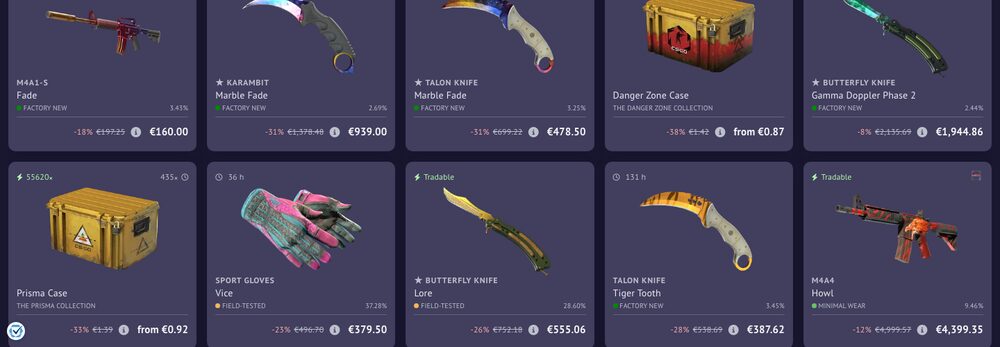
The CS2 market is fragmented across a dozen venues with different fees, payment rails, and buyer pools, and the same skin routinely carries five different prices at the same moment. The spread between the most convenient venue and the cheapest reasonable one is commonly in the 10–30% range for liquid items — sometimes more, sometimes less, but rarely zero. That spread is the convenience tax: the premium you pay for buying wherever you happen to already be logged in.
Steam is the canonical example. It takes roughly 15% on every market sale and traps everything in wallet credit you can never withdraw, which is why Steam prices sit structurally above cash prices. But the tax exists between third-party venues too. Convenience-tier marketplaces charge more than workhorse venues, which charge more than the high-friction discount tier. None of this is hidden. It's just ignored, because checking takes effort and buying takes one click.
The good news: overpaying is a habit problem, not an information problem. Four habits fix it.
Habit one: never buy without a reference price
Before any purchase, answer one question: what does this item actually trade for right now, across the market, not on the page in front of you? A single listing tells you what one seller hopes to get. A reference price tells you what the item is worth.
The cheapest version of this habit is a ten-second aggregator check — look the item up on a price aggregator that pulls from multiple venues and note the low end of the range. The slightly more rigorous version is a proper valuation pass: cash-market low, Steam price as the ceiling, and a sanity check on how many listings sit near the low. If the listing you're about to buy is more than a few percent above the cross-market low for no reason you can name (better float, cleaner stickers, instant delivery you actually need), that gap is your overpayment, quantified.
People skip this step because it feels like it won't matter "for a $12 skin." It matters precisely because it compounds: a buyer who overpays 15% on every purchase for a year has donated a couple of skins' worth of money to nobody in particular.
Habit two: check more than one venue, every time
A reference price tells you the item's value; a venue check tells you where to collect it. The venue map is stable even though the numbers move daily, so this doesn't need to be an expedition. A workable routine:
- Check two or three venues you trust — not twelve. Pick one workhorse cash market, one convenience market, and use Steam only as a ceiling reference.
- Compare landed cost, not sticker price — add deposit or payment fees and any FX conversion. Fee schedules differ enough to flip the ranking between two venues.
- Account for delivery friction — a P2P listing that saves 4% but requires babysitting a trade offer isn't free; price your own annoyance honestly.
- Stop after three checks. The marginal saving from venue four is usually noise. There's a full 60-second comparison workflow if you want the routine spelled out step by step.
Habit three: patience windows and price ceilings
The most reliable discount in this market is time. Liquid skins fluctuate constantly — sellers price emotionally, undercut wars break out, and recurring calendar effects like Steam sales and post-Major lulls put whole categories on discount. If you decide you want a skin and give yourself a one-to-two-week window instead of buying tonight, you'll frequently catch a listing meaningfully below today's low simply because someone wanted out fast.
The tool that makes patience practical is a price ceiling: decide in advance the maximum you'll pay, write it down, and refuse to cross it. This does two things. It converts "should I buy this listing?" — a question your impatience will always answer yes to — into "is this listing under my number?", which has an objective answer. And it protects you from the classic failure mode where you watch an item for a week, see it tick up 5%, panic, and buy at the top of its recent range.
Ceilings work even better as standing orders. Several venues support buy orders that execute automatically when a listing crosses your price, which means your patience runs 24/7 without you watching anything.
Habit four: make the discipline automatic
Every habit above fails the same way: you're tired, the skin looks good, and you click buy. The durable fix is to take the decision out of the moment. Disclosure — this is the part where this blog's product is relevant: cs2stack exists to be exactly this commitment device for recurring buys. You set the items, a per-item price ceiling, and a daily budget; it watches the live lowest price across DMarket and SkinBaron and only ever buys under your caps. The point isn't that a bot is smarter than you. It's that a config file doesn't get impatient at 1am.
Whether you automate or not, the principle stands: decide your rules when you're calm, and make the purchase moment as mechanical as possible. Reference price, two-venue check, ceiling, wait. Buyers who run that loop consistently don't snipe anything and still end up paying near the bottom of the range, purchase after purchase — which, compounded over a year, is the closest thing this market has to free money.