
Storage Units: The $2 Vault Every Case Investor Needs
Once your case count passes a few hundred, the constraint stops being capital and starts being inventory space. The fix costs about as much as a single case and holds a thousand of them.
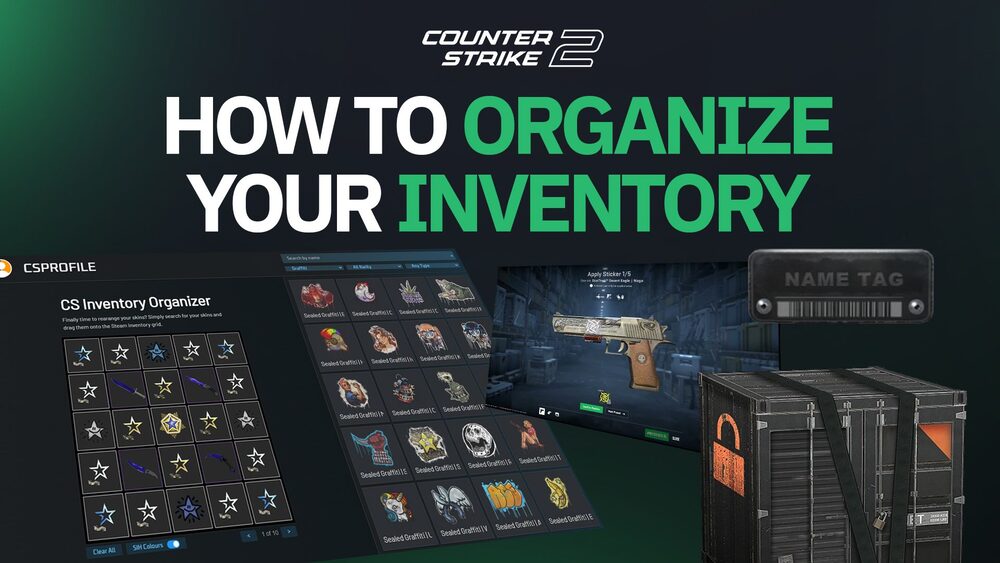
The mechanics: what a storage unit actually is
A storage unit is an in-game container bought from the CS2 store for roughly two dollars. Each unit holds up to 1,000 items, you can own as many units as you like, and moving items in and out is free and instant. Since your base inventory is itself capped at 1,000 items, anyone running a serious accumulation strategy — say, daily DCA into cases at even modest volume — hits the ceiling within a year or two. At $2 per thousand slots, storage is the cheapest infrastructure in the entire skin economy.

Three properties matter more than they first appear:
- Stored items are invisible to trades and the market. You cannot list, trade, or trade-up an item while it's in a unit. You have to withdraw it to your main inventory first, from the game client.
- Units are not transferable. A storage unit and its contents live and die with the account. There is no moving a full vault to another account in one action — items come out one inventory-load at a time, and then face the usual trade-hold friction when moved.
- Units are nameable. The label is your only metadata field. Serious holders treat it like a database key, not a joke field.
Organizing at scale: naming is a system, not a chore
The failure mode of big inventories isn't losing items — Valve doesn't lose them — it's losing track of them. When you can't see what you hold without clicking through twenty containers, you stop rebalancing, you double-buy positions you already have, and your exit decisions degrade into guesswork. A naming convention fixes most of this for free.
Conventions that work in practice:
- One unit per position. "KILOWATT — 800", "FRACTURE — 1000 FULL". The label carries the count so you rarely need to open it.
- Tier buckets for a ladder. If you run a tiered case ladder, mirror it: "T1 ACTIVE DROPS", "T2 DISCONTINUED", "T3 PREMIUM". Rebalancing becomes a visual exercise.
- Vintage buckets. Some accumulators split by acquisition period ("2025-H2 BUYS") to track cost basis by era, which pairs well with a purchase ledger.
- A quarantine unit. One unit for items you're unsure about — mispriced buys, gifts, trade-up material — so they don't pollute the clean positions.
Tracking value when the client won't do it
CS2 gives you no portfolio view — no cost basis, no unrealized P&L, nothing. Third-party inventory trackers fill the gap, pulling your inventory via your Steam profile and pricing it against market data. Two caveats worth respecting. First, most trackers can only see your main inventory, not inside storage units, unless you tell them what's stored — which is another argument for labels that carry counts. Second, the price they show is a mark, not an exit: a tracker quoting Steam prices overstates your cash value by the ~15% fee plus the wallet-to-cash discount. Mark your book in realistic cash-out terms or your returns are fiction. For the broader tooling landscape — price aggregators, float checkers, supply trackers — see the serious trader's data stack.
The most robust setup most holders converge on is boring: a spreadsheet or ledger of every purchase (date, item, venue, price, fees) as the source of truth, storage units organized to mirror it, and a tracker as a sanity check rather than the system of record.
Security: the vault is only as safe as the account
A storage unit protects against clutter, not theft. If an attacker controls your account, they can withdraw from your units just like you can. The security work happens one layer up:
- Steam Guard Mobile Authenticator, always. Trades without the mobile confirmations face additional holds, and an account without 2FA is the softest target in the ecosystem.
- Treat your Steam Web API key as a credential. API-key hijacks — where a phished login lets an attacker register their own key and silently redirect your outgoing trades — remain among the most common inventory-emptying attacks. Check periodically that no key you don't recognize is registered, and revoke on any suspicion. The full defensive catalog is in our scams breakdown.
- Never log in through a link someone sent you. Every fake-tournament invite and "vote for my team" message is the same phish wearing a different jersey.
- Big inventories justify a clean machine. If your vault is five figures, treating the account like a bank account — dedicated email, unique password, no shared sessions — is proportionate, not paranoid.
One structural consolation: items sitting in storage generate no trade offers, appear in no listings, and can't be moved by a single misclick on a malicious trade. For a pure holder, deep storage plus 2FA is a genuinely hard target — most attacks in the wild are optimized for active traders with liquid, unlocked inventories.
The bottom line
Storage units are the rare part of this market where the right move is obvious and cheap. Buy them before you need them, name them like a database, keep a ledger the client refuses to keep for you, and lock the account layer down. The investors who compound through crashes and droughts are disproportionately the ones whose operations are boring.