The Five Biggest CS Skin Market Crashes, Ranked
Thirteen years of skin prices contain a handful of days that everyone who held through them remembers exactly where they were. Ranked by structural damage, not just by the depth of the red candle.
How this list is ranked
Depth alone is a bad metric — a 30% dip that fully recovers in a month matters less than a 15% move that permanently deletes a business model. This ranking weighs three things: the size of the immediate repricing, how much market structure changed permanently, and what the episode taught about the risks that actually govern this asset class. Magnitudes below are hedged where trackers disagree; the dates and mechanisms are well documented.
The ranking
1. The 2025 trade-up update — the repricing
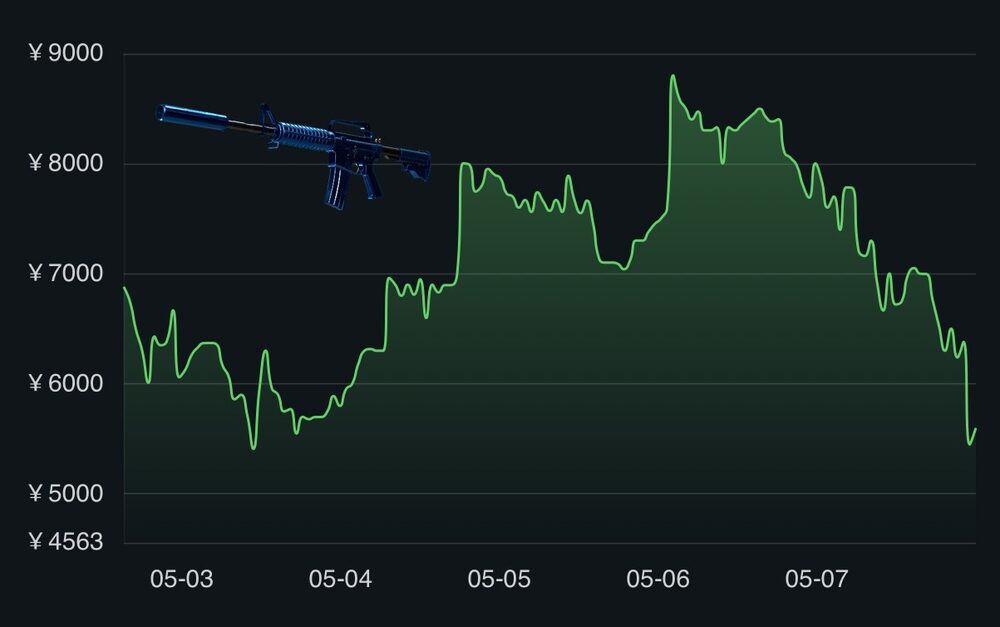
In May 2025 Valve allowed five Covert skins to trade up into a knife or gloves, and the top of the market repriced in hours: floor-tier knives fell hard toward their new manufacturing cost while cheap Coverts spiked as the input commodity. Paper-value estimates in the billions circulated, though no tracker can measure this market cleanly. It ranks first because of what it revealed: even the gold tier — the market's supposed bedrock — is one patch note away from a new supply curve. The full anatomy is in the trade-up crash article.
2. The 2019 key removal — the asset execution
On October 28, 2019, Valve made newly purchased CS:GO keys untradable and unmarketable, stating that "nearly all" key resales had become fraud-sourced. Keys were the market's de facto currency — the unit of account for every big trade — and their monetary role ended overnight. The twist that keeps this crash near the top: legacy tradable keys flipped from currency to fixed-supply collectible and appreciated for years afterward. No other event so cleanly demonstrated that Valve will delete a market function entirely when fraud is involved. Full story in the key purge retrospective.
3. The 2018 trade holds — the liquidity strangling
March 2018: every peer-to-peer trade without mobile-authenticator confirmation acquired a seven-day hold. Prices moved less than in the headline crashes, but the structural damage was the largest on this list until 2025 — instant-trade sites died or pivoted, arbitrage cycles stretched from minutes to weeks, and OPSkins began the descent chronicled in its rise-and-fall story. The holds never left. Every liquidity calculation made since, including the friction added by the 2025 trade protection update, stacks on top of this one. Background in the trade holds deep dive.
4. The post-launch CS2 correction — the hangover
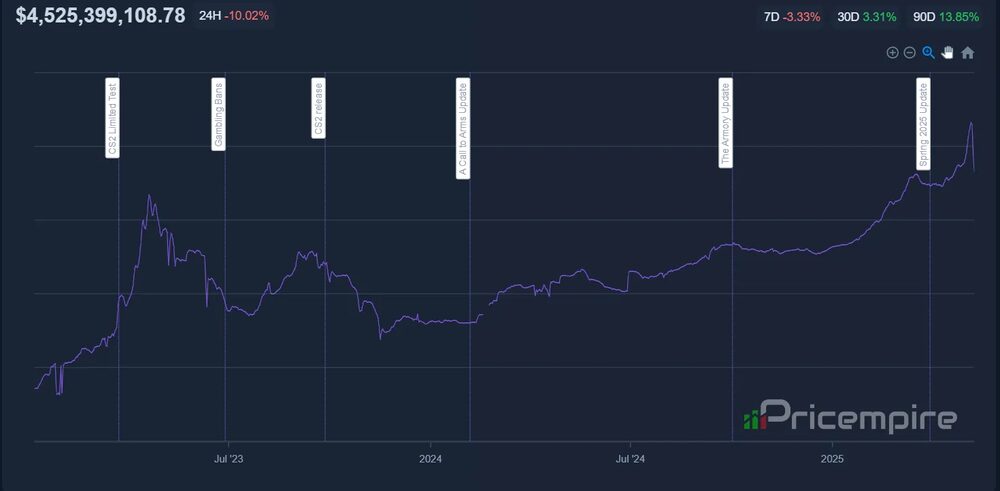
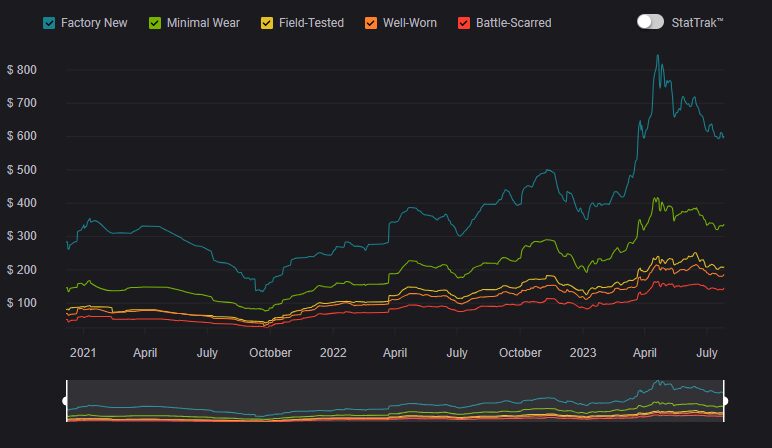
The March 2023 CS2 announcement ignited one of the great bull runs in skin history: cases multiplied through the summer on the promise that every item would carry over. Then the game actually shipped in September 2023 — missing modes, a rocky technical start — and the speculative froth came off. Cases that had run hardest reportedly gave back a large share of their announcement-era gains over the following months. It ranks fourth because the damage was cyclical, not structural: the carry-over promise was kept, trust compounded, and the market went on to new highs. The whole arc is in the CS2 launch analysis.
5. China-driven dips — the recurring one
Not one crash but a family of them. Chinese platforms carry an outsized share of global skin volume, so China-side shocks — Lunar New Year cash-out season, platform policy changes, regulatory scares — repeatedly show up as market-wide dips of hedged but noticeable size. Individually the smallest moves on this list; collectively a permanent feature. The mechanism is covered in the China analysis and the Lunar New Year piece.
The pattern across all five
| Crash | Trigger type | Permanent change | Recovered? |
|---|---|---|---|
| 2025 trade-up | Mechanic change | Tier premiums repriced | Partially — floor knives didn't |
| 2019 key ban | Policy / fraud | Key currency era ended | Legacy keys exceeded old highs |
| 2018 trade holds | Policy / fraud | Liquidity permanently slower | Prices yes, velocity no |
| 2023 post-launch | Sentiment cycle | None structural | Fully, then some |
| China dips | External demand | None — it recurs | Every time so far |
Two regularities stand out. First, every structural crash came from Valve, not from demand — the taxonomy in how updates move markets holds across the full sample. Second, broad demand-driven dips have always recovered, while mechanism-driven repricings are permanent for the directly affected assets and temporary for everything else.

What holders should actually take from this
- Assume the next crash is not on this list yet. Nobody's 2024 risk model contained "Coverts become knife tickets." The specific mechanism is always a surprise; the existence of a mechanism never is.
- Sized-right positions survive anything here. Every crash on this list was survivable — and usually profitable within a year or two — for anyone not forced to sell into it.
- Panic has been the only unrecoverable loss. The sellers at each bottom converted a temporary drawdown into a permanent one. The playbook for not being that person is in the crash survival guide.
- Diversify against mechanisms, not just items. Owning six knives was zero diversification in May 2025.