The 2018 Trade Holds: When Valve Chose Fraud-Control Over Liquidity
In March 2018 Valve put a seven-day timer on CS:GO trades and, in one patch note, redesigned the microstructure of the entire market. The community screamed. Valve never blinked.

What changed in March 2018
The change itself was one sentence long: items received in a trade would be trade-locked for seven days before they could be traded or sold again. Valve had already used the mechanism elsewhere — Dota 2 items and Steam Market purchases carried holds — but extending it to CS:GO trading hit the game with the most financialized item economy on the platform.

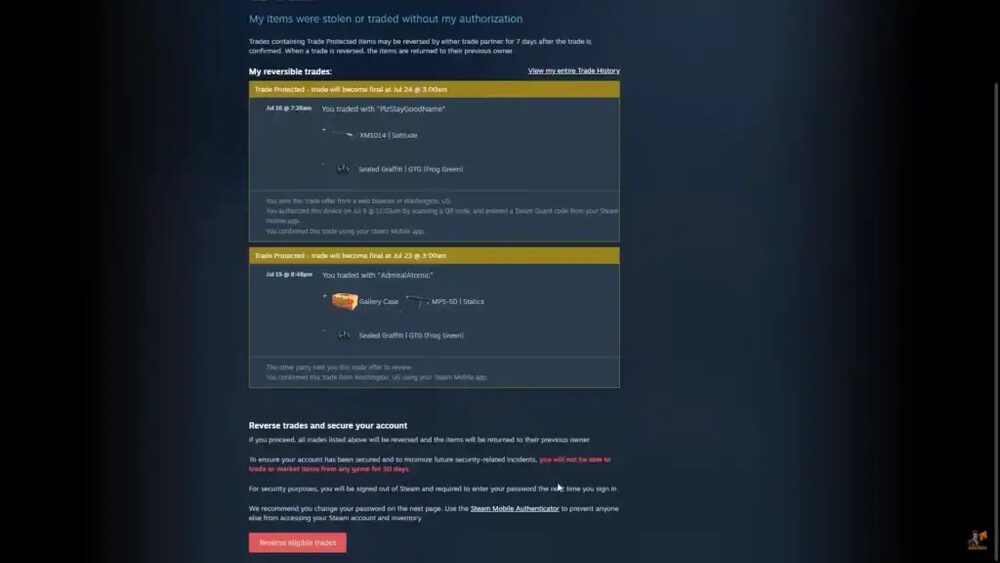
Valve's stated reasoning was fraud: hijacked accounts were being drained in minutes, items laundered through chains of bots and mule accounts, and stolen goods sold before victims even noticed. Steam Guard Mobile Authenticator holds (introduced 2015–2016) had reduced but not eliminated the problem, because fraud rings simply automated the laundering to run faster than support tickets. A mandatory week of dead time between hops broke the chain. Stolen items became traceable and recoverable; the resale window closed.
Why the trading scene revolted
The uproar wasn't about casual players swapping skins with friends. It was about everything that had been built on instant transferability:
- Middlemen and item-for-item traders — the classic profit traders whose edge was flipping inventory many times per day — saw their turnover mechanically capped. Velocity was the business; the business died.
- Cash marketplaces that delivered items on demand from seller to buyer could no longer promise instant delivery. OPSkins re-engineered around pre-held bot inventory — a workaround that ended badly for everyone involved.
- Gambling and jackpot sites, already wounded by the 2016 crackdown, relied on rapid deposit-and-withdraw loops. A seven-day cycle time made the model nearly unworkable — which, most observers concluded, was not an accident.
- Arbitrageurs lost the ability to move items between venues fast enough to capture spreads, so spreads widened and stayed wider.
A petition against the change gathered hundreds of thousands of signatures. Valve's response was, characteristically, nothing. The holds were not walked back, not softened for verified traders, not revisited. Eight years later they're still here, inherited intact by CS2 — the full current mechanics are covered in our trade locks explainer.
The asymmetry of the reaction is worth dwelling on. For the median player — someone who opens a case occasionally, buys a skin to use it — the hold changed nothing they would ever notice. The rage came almost entirely from the professionalized layer: sites, services, and traders whose business models embedded an assumption Valve had never actually promised, that items would move instantly forever. March 2018 was the moment that assumption was repriced to zero, and the episode became the canonical example of a rule every builder in this ecosystem now internalizes: features of Steam's plumbing are not commitments, and revenue built on them is revenue Valve can delete with a patch note.
The market-structure consequences
Trade holds didn't crash prices the way the 2019 key ban did — cases and skins mostly shrugged on price. What changed was plumbing, and plumbing compounds:
- Liquidity got a time tax. An item is only worth its price if you can move it. A week of forced holding added inventory risk to every flip, and marketplaces began pricing trade-locked items at a visible discount to unlocked ones — a discount that persists as of mid-2026.
- Bot-inventory marketplaces won. Venues holding large pre-aged inventories could still deliver instantly; peer-to-peer models couldn't. The hold quietly selected for the custodial marketplace architecture that dominates today.
- The trader class professionalized. High-frequency item flipping stopped being viable for individuals, pushing the ecosystem toward slower, position-based strategies — buy, hold, exit — that look a lot more like investing than trading.
The verdict, eight years on
The honest assessment is that Valve was mostly right. Account-theft losses fell, the stolen-item laundering industry shrank drastically, and the market adapted faster than the petition signers predicted. The traders who thrived afterward were the ones who stopped fighting the constraint and built strategies where a seven-day timer is irrelevant — accumulation strategies with horizons measured in months, not minutes.
The holds also set the template for everything after: the 2025 trade protection update, with its reversible-trade window, is philosophically the same move — friction as fraud defense — applied with more modern tooling. And in the ranking of market shocks, 2018 stands out as the one that hurt least on the price chart and mattered most in the long run. Structure beats price. It usually does.
For today's holder, the practical takeaway is simple: model the hold as a fixed cost of the asset class, like a settlement period in traditional markets. Price it into exits (your "sell now" is really "sell in a week" for anything recently acquired), prefer strategies whose edge doesn't decay in seven days, and treat any service promising to route around the lock as a red flag rather than a convenience. The market that grew up after 2018 is slower, safer, and — measured by everything that came after — considerably larger. That trade, in hindsight, was cheap.