
How the Armory Update Rewired CS2's Skin Supply
The October 2024 Armory update didn't crash anything. It did something subtler: it gave Valve a supply dial it can turn at will — and permanently complicated the math on every case it touches.
The mechanic: pay to grind
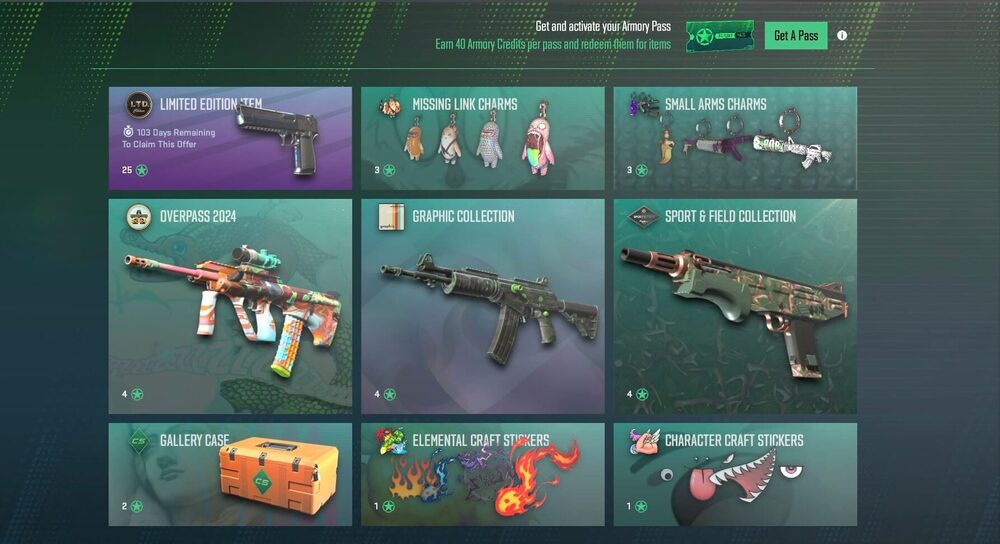
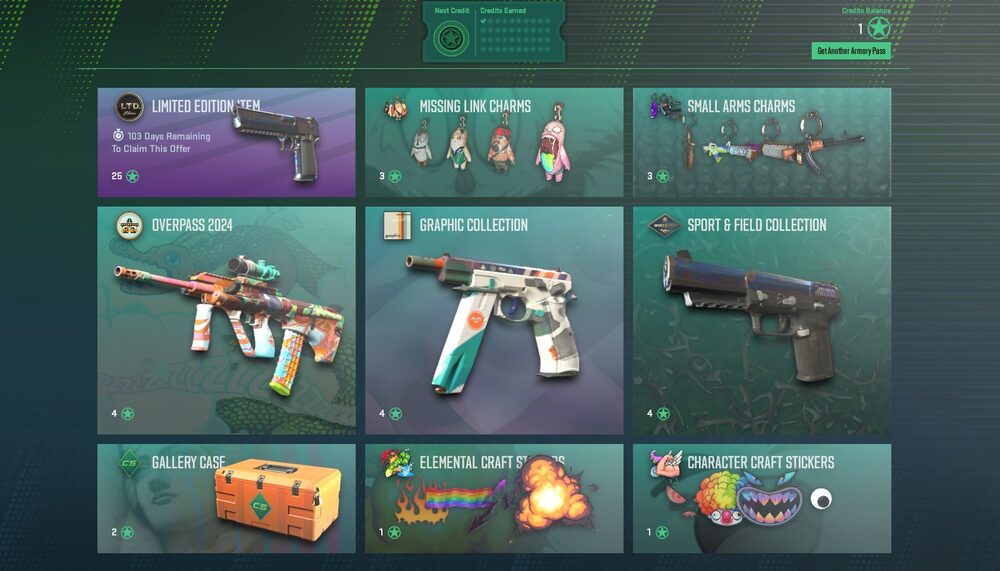
The Armory replaced the pure lottery of weekly drops with a purchasable grind. You buy an Armory Pass through the client, play matches to earn stars, and redeem those stars in the Armory for items of your choosing: current and selected older cases, sticker capsules, the charm collections introduced alongside the update, and Armory-exclusive content like the Gallery Case. The word doing the work in that sentence is choosing. The weekly drop was a random number generator; the Armory is a menu with implicit prices, and players read it exactly the way traders read an order book.

Two properties of this design matter for anyone holding inventory:
- Supply became demand-driven. Under the classic drop pool, case supply scaled with the player count — passive, slow, roughly predictable. Armory supply scales with how many people choose to buy passes and grind. When redeeming a case is profitable versus its market price, players farm it; when it isn't, they redeem something else. The system behaves like a soft price ceiling enforced by thousands of small arbitrageurs.
- Supply became selective. Valve chooses which cases appear in the Armory rotation. A discontinued case that gets added is no longer discontinued in any meaningful sense — its burn-only supply schedule reopens overnight.
What it did to prices
The immediate market reaction in late 2024 concentrated on the cases named in the Armory rotation. Cases that had been appreciating as rare drops reportedly gave back a meaningful share of their gains once players could mint them with stars — the direction was unambiguous even where trackers disagree on magnitudes. Cases outside the rotation were untouched mechanically but repriced anyway, because the market had just learned something general: no case's supply schedule is guaranteed. The arbitrage loop closed fast, too — within weeks, community spreadsheets were computing stars-per-case breakevens, and redemption flows visibly chased whichever rotation case traded richest against its grind cost.
That lesson is the update's real legacy. The bull case for old cases rests on the burn dynamic described in the deflationary-mechanics piece — openings destroy supply, drops dwindle, price grinds up. The Armory demonstrated that the "drops dwindle" half of that sentence is a policy choice, not a law of nature. Anyone modeling discontinued-case returns after October 2024 has to carry a reactivation-risk discount that simply didn't exist before.
The revenue logic
It's worth being unsentimental about why the system exists. The classic drop pool gives items away and monetizes them only when they're opened or sold. The Armory monetizes the acquisition itself: the pass is paid up front, and the grind keeps players in the game — which feeds the player-count flywheel that underpins the whole economy, as covered in the player-count analysis.
For Valve, that's strictly better. For the market, it cuts both ways:
- Bearish for anything in the rotation — elastic supply caps upside while the tap is open.
- Neutral-to-bullish for the ecosystem — a monetization channel this productive gives Valve a standing incentive to keep the item economy healthy, deep, and trusted.
- Bullish, arguably, for true fixed-supply assets — items the Armory can't mint (old operation cases, tournament capsules, discontinued collections) became relatively scarcer the moment everything else became mintable.
How the eras compare
| Distribution era | Supply driver | Investor read |
|---|---|---|
| Classic drop pool (2013–2024) | Player count × drop odds | Predictable flood, then predictable scarcity |
| Operation passes | Pass sales during a window | Fixed window, clean scarcity after |
| Armory (2024– ) | Pass sales + player choice, rotation set by Valve | Elastic supply; scarcity is provisional |
The Kilowatt Case is a useful contrast: launched in early 2024 as a classic drop, it followed the standard release-price lifecycle — hype, flood, flatline. Armory-era cases don't get a flood phase in the same shape; their supply curve tracks redemption economics instead. Comparing the two is the cleanest way to see how much the update changed, and the Kilowatt story makes the old pattern vivid.

Positioning as of mid-2026
Nearly two years in, the market has priced the Armory into a rough consensus. Rotation cases trade near their redemption-arbitrage bands. Non-rotation discontinued cases still appreciate, but the multiple the market pays for "scarcity" is more discriminating than it was in the 2021–2024 run documented in the growth-story timeline. Practical implications for accumulators:
- Diversify across supply regimes, not just across cases. Six discontinued cases share one reactivation risk.
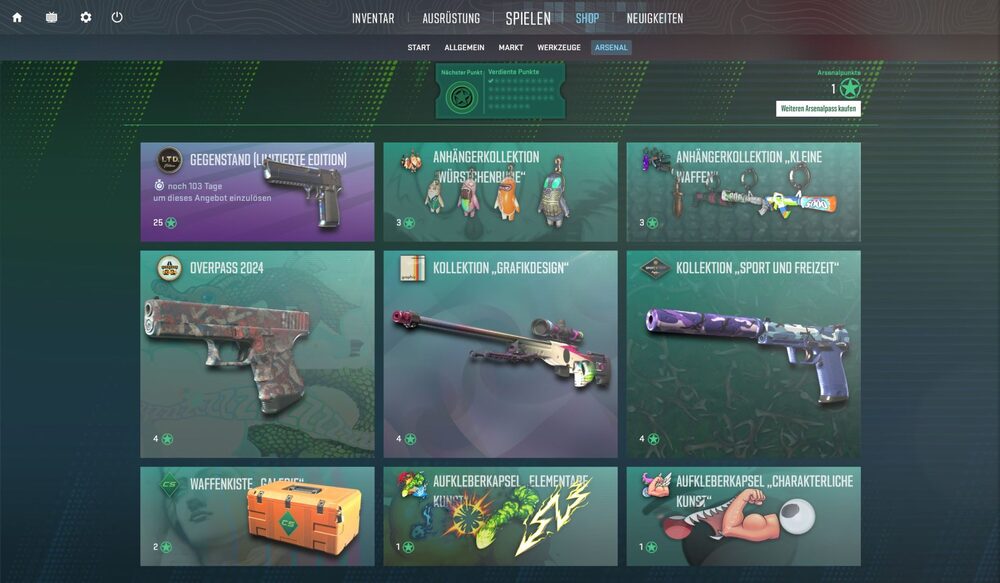
- Watch the rotation announcements the way equity traders watch earnings — they are the supply schedule now.
- Treat Armory-gated items as a separate asset class with its own (short) history and wider error bars.
The Armory wasn't a crash. It was quieter and more consequential: the day case supply stopped being a fixed input and became a lever — one more entry in the taxonomy of how Valve updates move this market.