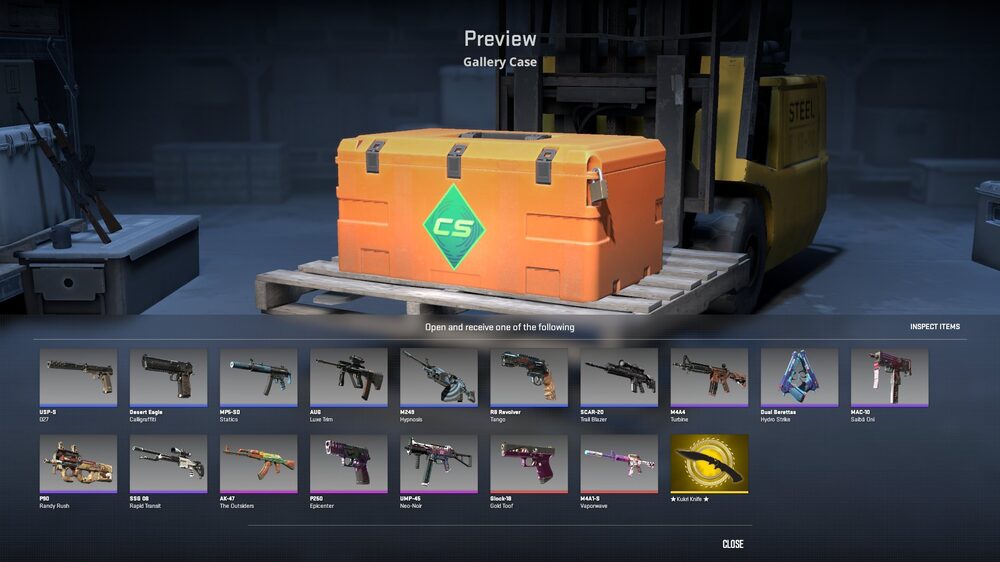
The Gallery Case and the Armory Era of Distribution
For eleven years, cases entered the economy one way: random weekly drops. The Armory changed the faucet itself — and the Gallery Case was the first container born inside the new plumbing.
What the Armory actually changed
The Armory arrived in late 2024 as CS2's first structural rework of item distribution. The mechanics: buy an Armory Pass, earn Armory Stars by playing (XP converts to stars), and redeem those stars for your choice of rewards — among them older cases, the new charm items, stickers, and the Armory-exclusive Gallery Case. The full market impact of the update is its own story; here the point is narrower. For the first time, a case's issuance was tied to paid, deliberate player choice rather than random luck.

That's a different supply DNA. Classic cases are minted by a lottery the player doesn't control and often doesn't want — which is why billions of unwanted drops pile up and pin prices to the floor for years, as with Fracture. An Armory-gated case is minted only when someone (a) pays for a pass, (b) grinds the stars, and (c) actively chooses that case over every other redemption option. Every unit in existence was, in a meaningful sense, ordered.
The Gallery Case: born gated
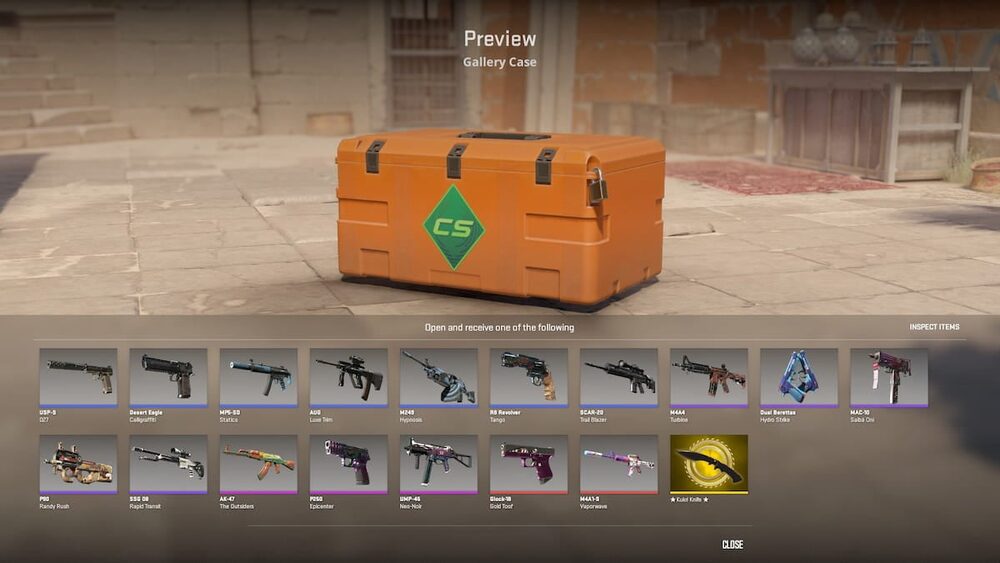
The Gallery Case is the flagship of this model — a community-finish showcase obtainable through Armory redemption rather than the weekly drop lottery. Its supply curve therefore behaves unlike anything in the classic cohort:
- Supply is demand-elastic. If the case's contents get hot, more players redeem stars for it, and supply expands to meet the interest. The runaway-scarcity dynamic of a discontinued drop-pool case can't happen while the redemption window is open — the faucet widens on demand.
- Supply has a price floor built in. Because minting a unit costs real money (pass) plus real time (XP grind), the case can't flood to five cents the way drop-pool cases do. The implied production cost acts like a soft floor under the market price.
- Issuance is measurable-ish. Redemption-gated supply grows only as fast as pass sales and playtime allow — a much more legible curve than "how many of 30 million players got lucky this week," even if Valve publishes none of the numbers.

What gating means for the long-term hold
The investment question for any Armory-era case is what happens when the window closes. A classic case's life has two phases — active drops, then the deflationary burn. A gated case has the same two phases, but phase one ends with a known-shape supply: no long tail of random drops trickling in for years afterward, just whatever was redeemed while the option existed. Once retired from the Armory, a case like Gallery becomes a fixed float being destroyed by openings — the same math that made discontinued cases the market's blue chips, arguably in a cleaner form.
The counterweights, and they're serious:
- Valve can reopen the faucet at will. The Armory is a permanent lever. Any scarcity premium on a retired Armory case carries the risk of the case rotating back into a future pass. The 2024–2026 era has already shown Valve routing older cases through Armory redemptions — supply resurrection is now a standing threat across the whole case market, not a hypothetical.
- The soft floor cuts both ways. Cases that never get cheap never offer the deep-value accumulation phase that built the best returns of the classic era. You're buying a narrower band: less downside, less convexity.
- The model is young. As of mid-2026 there is simply no completed lifecycle of an Armory-gated case to study. Everyone pricing these is extrapolating from classic-case history that may not transfer.
Positioning in a two-regime market
The practical consequence is that "CS2 cases" are now two asset classes sharing a UI. Classic-era containers — from Breakout back to the thin-supply antiques — carry the proven burn-down model plus resurrection risk. Armory-era containers like Gallery carry engineered supply with untested long-term behavior. A sensible portfolio treats them as separate buckets with separate theses, sized so that a surprise from either regime — a reopened faucet, a never-closing window — doesn't sink the whole position. Diversification across regimes now matters as much as diversification across items.
The Gallery Case will eventually tell us which regime ages better. Until it does, it's the most interesting experiment in the market: the first case whose scarcity, if it ever comes, will have been designed rather than accumulated. Watch two signals while the experiment runs — whether Valve retires Armory offerings cleanly when passes rotate, and whether retired ones stay retired. Those two data points, more than any price chart, will tell you what a gated case is actually worth holding for a decade.