
CS2 Case Prices, 2021–2026: The Full Growth Story
Five years ago you could fill a storage unit with discontinued cases for the price of a decent knife. The people who did are now explaining compounding to their friends.
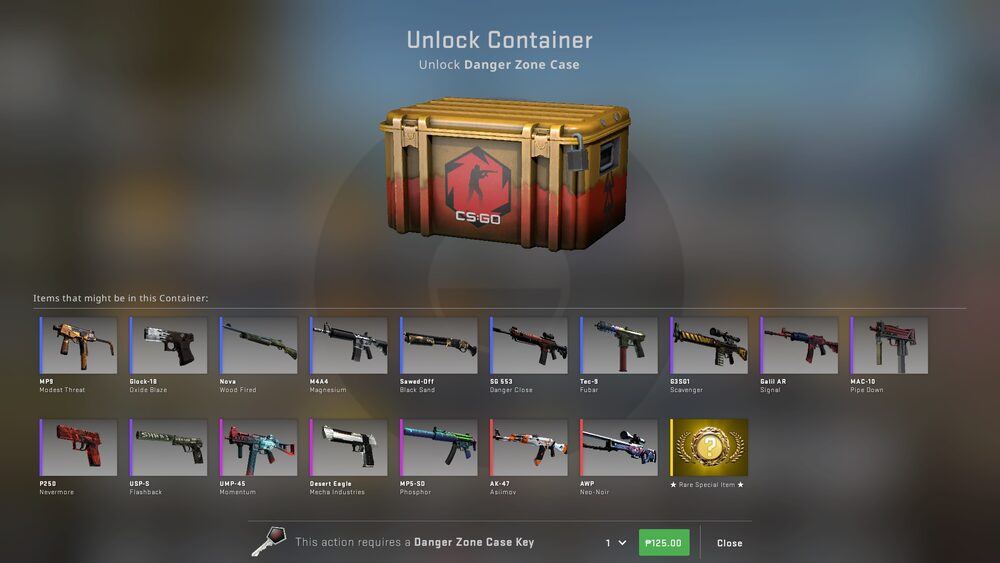
2021: the quiet setup
The starting point matters. Coming out of the pandemic player boom, case supply was enormous — lockdown-era grinding had flooded the market with active-drop cases, and many traded for pennies. The Fracture Case is the canonical example: billions in circulation, priced like a rounding error, a story we tell in full in its own case study.

The structural spark came from Valve's drop-pool changes in 2021, which sorted cases into an active pool and a "rare drop" pool. Older cases stopped raining from the sky and became genuinely scarce inflows overnight. Traders who understood the deflationary mechanics this created — openings permanently burn supply while drops slow to a trickle — started accumulating while prices still assumed infinite supply. Nothing about 2021 looked dramatic on a chart. In hindsight it was the whole entry.
2022: compounding in the dark
2022 was the year the thesis worked without headlines. Equities and crypto spent the year in a bear market; discontinued cases just ground upward as the rare-drop scarcity bit into float. Per third-party price trackers, many mid-tier discontinued cases doubled or better during a year when almost every other risk asset bled — early evidence of the decoupling we explore in the S&P 500 comparison.
It was also the era that taught the market the release-cycle lesson: new cases spike, crash under supply flood, and flatline for years — the standard lifecycle that separates buying cases from buying the right cases.
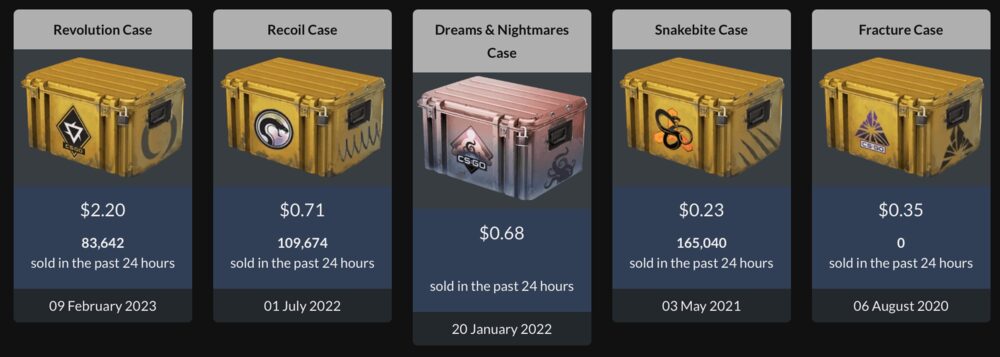
2023: the CS2 announcement changes everything
On March 22, 2023, Valve announced Counter-Strike 2 and confirmed that every item would carry over. The market's reaction was immediate and violent — arguably the single biggest bull catalyst in skin history, covered blow-by-blow in our CS2 launch retrospective. The logic was simple: same items, new decade of relevance. Cases across every tier repriced upward through the summer, and the September launch confirmed the continuity bet.
By late 2023, cases bought in 2021 for cents were trading for dollars. The market had also grown up: aggregators, float databases, and inventory trackers turned what had been a forum hobby into something with dashboards.
2024–2025: the Armory era and the turbulence tax
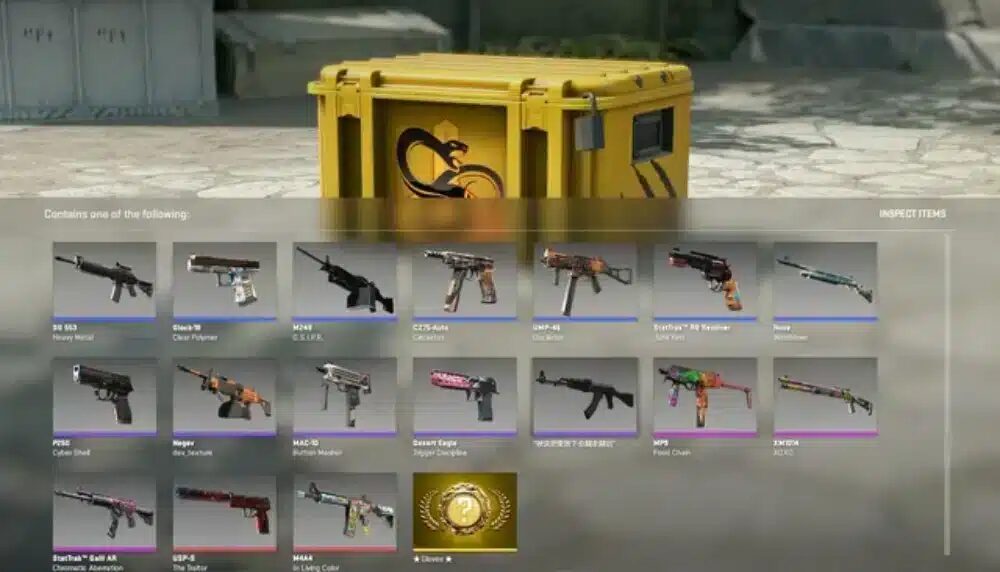
The CS2 era brought two structural shocks. First, the Armory update in late 2024 introduced a new distribution channel — buy a pass, grind credits, redeem cases — which changed the supply DNA of specific cases and revived some older supply lines. We break down the mechanics in the Armory analysis; the market's lesson was that Valve can and will reroute supply when it wants to.
Second, the May 2025 trade-up update let Covert skins trade up into knives, and the knife floor collapsed within hours while red skins spiked. Cases themselves weathered it better than knives, but the episode repriced risk across the whole market and reminded everyone what single-publisher exposure means. The recovery through late 2025 was real but uneven — and it flushed out a cohort of leveraged-feeling positions that had never seen a proper drawdown.

What the whole window compounds to
Put the eras together and the arithmetic is striking. Per third-party trackers, many discontinued cases compounded at something like 30–40% annually across the window — with wide dispersion around that range — which is how unremarkable items turn into 5–10x positions over five years:
- 2021: drop-pool rework creates the scarcity regime; prices barely react.
- 2022: quiet grind upward while everything else falls.
- 2023: CS2 announcement and launch — the step-change year.
- 2024: Armory era begins; supply becomes a policy variable again.
- 2025: trade-up shock, recovery, maturation.
- Mid-2026: many discontinued cases sit at or near all-time highs, per aggregator data.
Two features of that compounding deserve emphasis. First, it was lumpy: most of a given year's return often arrived in a handful of weeks around a catalyst, which is why traders who waited for confirmation kept buying tops and why the steady accumulators quietly outperformed. Second, it was tiered. The oldest, thinnest-supply cases moved first and hardest in every rally, with mid-tier discontinued cases following months later — a repeating wave pattern that let patient buyers rotate down the quality curve as each tier repriced. Neither feature shows up in an annualized average, and both matter more to actual execution than the average does.
The uncomfortable closing thought: every era's gains were driven by something nobody priced in beforehand — a drop-pool memo, an engine announcement, a pass system, a trade-up rule. The growth story is real, but it was never smooth, and the next chapter will be written by a patch note too. That's an argument for position sizing and steady accumulation — the DCA playbook — rather than for extrapolating the chart.