Sniping Undervalued Sticker Crafts
A four-sticker craft can carry more value on its stickers than on the gun under them — and the marketplace listing form doesn't care. Sellers routinely price crafts at base-skin value, because that's the number the interface suggests. That gap is one of the last soft edges left in the CS2 market, and it belongs to buyers who can value paper faster than the crowd.
Why crafts get mispriced in the first place
The root cause is structural. A skin's identity on every major marketplace is its market hash name — weapon, finish, wear tier, StatTrak flag. Stickers aren't in it. Two AK-47 Redlines in Field-Tested share one name, one price history, one "suggested price", even if one of them wears holo stickers from a decade-old Major and the other wears nothing. The default price a seller sees is the base skin's price, so that's what a large share of crafts list at.
Add the human layer: many sellers are players cashing out an inventory, not traders. They may not know their stickers stopped being purchasable years ago, and applied stickers can't be peeled off and resold — scraping deletes them. So the sticker value either transfers to a buyer who recognizes it, or it evaporates at base price. Pattern hunters exploit the same blindness with paint seeds; craft hunters exploit it with paper.
What stickers actually add — and when they add nothing
The first discipline of craft sniping is admitting that most applied stickers are worthless. A common rule of thumb among traders — hedged accordingly, because it varies wildly by craft — is that stickers return only a fraction of their standalone price when applied, and cheap stickers return effectively zero. What commonly moves the needle:
- Scarcity of the sticker itself. Old tournament holos — Katowice 2014 above all — carry value applied that newer paper doesn't. A Titan Holo on anything is an event.
- Full sets ("4x") over singles. Four matching stickers of one team and edition commonly command a premium a lone sticker never gets.
- Placement. Scope-position stickers on AWPs, "best-slot" placements on AKs — buyers pay for how the craft looks in-game, not the theoretical paper value.
- Base-skin fit. Color-matched crafts on desirable finishes sell; the same stickers on an ugly, illiquid skin mostly don't. Valuing the base item still comes first.
The inverse list matters just as much: mass-printed capsule stickers, mismatched singles, stickers on Battle-Scarred junk. If you wouldn't buy the sticker and you wouldn't buy the skin, their combination isn't a deal at any badge percentage.
How hunters actually surface mispriced crafts
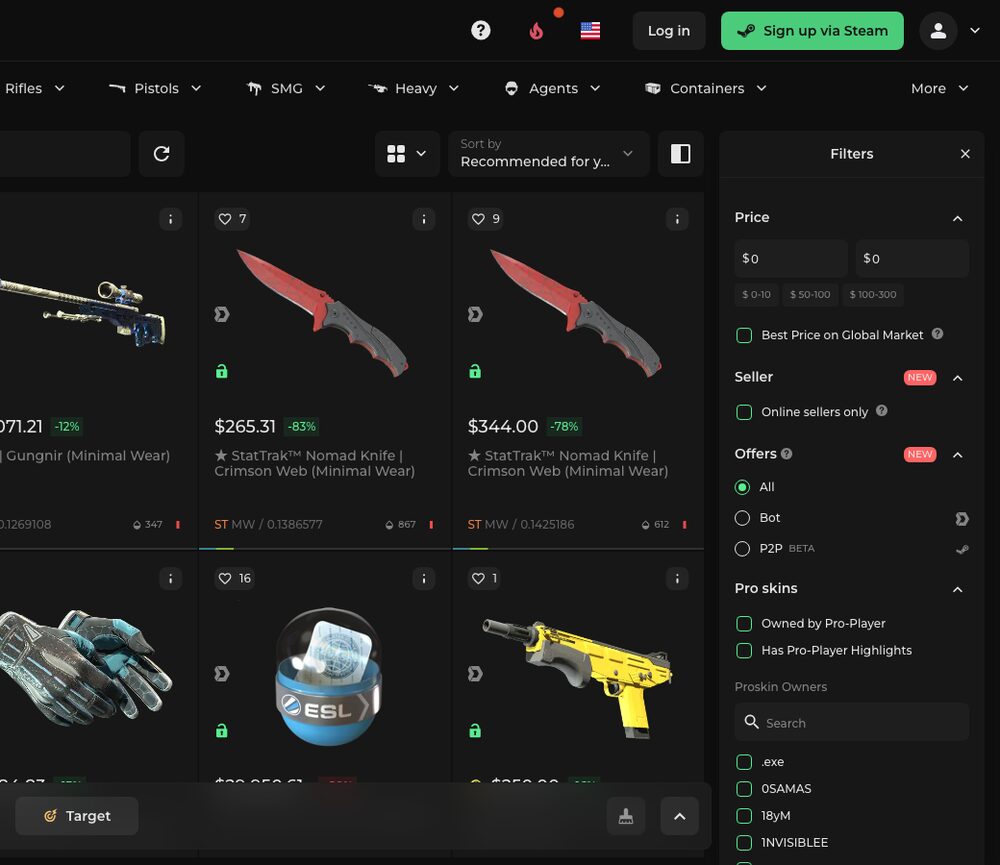
Marketplace search barely helps — you can't sort most venues by "applied sticker value". The working methods, as of late 2026:
| Method | How it works | Best for |
|---|---|---|
| Overlay extensions | Inject sticker-value estimates next to listings as you browse | Manual browsing on big venues |
| Craft scanners | Poll listing feeds, flag items whose sticker estimate exceeds a threshold | Coverage you can't do by hand |
| Community feeds | Discord channels reposting scanner hits | Free, but you're last in line |
| Niche expertise | Watching a handful of skins/sticker combos you know cold | Judgment-priced crafts bots misjudge |
Note the pattern: the tooling (deal scanners and their sticker-aware cousins) finds candidates, but the estimate it attaches is soft. Scanner math typically multiplies standalone sticker prices by a flat "applied" ratio — which is exactly where a human who knows the specific craft market can outbid the bot's confidence or dodge its mistakes.
The overpay trap: junk crafts wearing big numbers
Craft sniping's failure mode isn't missing deals — it's winning bad ones. A listing flagged "+$300 in stickers" can be a real edge or a fiction, and the difference is whether a buyer exists for this craft. Illiquid sticker markets make standalone prices themselves unreliable: a sticker that last sold months ago at a fantasy ask inflates every scanner estimate built on it. Common beginner losses — covered more broadly in the sniping mistakes list — cluster here:
- Paying near-full sticker value on a craft; applied paper commonly sells at a deep haircut.
- Ignoring wear: high-float crafts fight uphill regardless of stickers.
- Buying crafts on skins with no buyer base, where the resale takes months, not days.
The sober framing: sticker value is a negotiating asset, not a market price. You realize it by finding the one buyer who wants that craft — which takes time, listing patience, and usually a venue with craft-literate traffic. Selling a craft back into a marketplace's instant-sell flow returns base-skin money almost by definition, since the buying bot prices by market hash name just like the listing form did. The exit venue matters as much as the entry price: craft-heavy communities, trade forums, and P2P venues where listings carry screenshots are where applied paper actually converts to cash.
Is the edge durable?
More durable than float or price sniping, per most traders' experience — because it resists automation. A bot can rank floats; ranking whether a 2015 holo looks good on a Redline is taste. Sticker-aware scanners keep improving and the obvious hits (Katowice paper, Crown Foils, big 4x sets) get contested within seconds like everything else. But the long tail of "decent craft, priced as base skin" is wide, judgment-priced, and refreshes daily as players cash out. The knowledge also compounds: every craft you price teaches you the next one, which is not true of refreshing a listings feed.
If you're going to hunt one soft edge manually in 2026, this is a defensible pick — just budget for slow exits, size positions so a stuck craft doesn't freeze your bankroll, and let the boring, rule-clean side of your buying run itself while you do the part that needs a human.