Pattern Sniping: Blue Gems, Fades and the Paint-Seed Hunt
A Case Hardened AK is a mid-tier skin — unless the paint seed put blue in the right places, in which case it's a grail that has sold for life-changing money. Pattern sniping is the hunt for listings where the seed is special and the price is ordinary. It is the most knowledge-heavy corner of the sniping economy, which is precisely why it still pays humans.
What a paint seed actually is
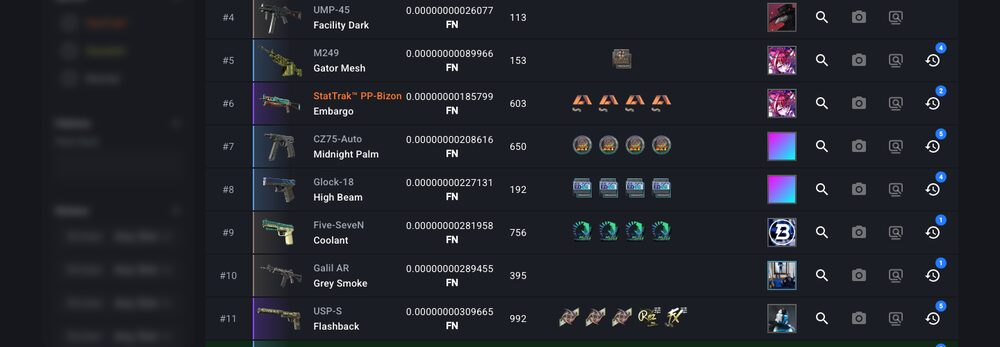
Every skin rolls a pattern index — the paint seed — at creation, a number that controls how the finish texture is placed on the weapon model. For most finishes the placement barely matters. For a handful, it changes everything: which parts of the texture land on visible surfaces decides whether a Case Hardened is mostly gold-brown or a wall of blue, whether a Fade runs full spectrum or cuts off early, whether a Marble Fade knife shows the coveted color balance. The seed is public — it's in the inspect data, alongside float — but unlike wear tier, no mainstream marketplace prices by it automatically. Sellers set one price for the skin; the seed rides along for free. The mechanics are laid out in our pattern-seed explainer; what follows is the buying side.
The three families where seeds move money
- Case Hardened blue gems. The canonical pattern trade. Community tier lists rank seeds by blue coverage on the play side; the famous ones are named numbers — AK-47 seed 661, the Karambit seed 387 that reportedly drew a seven-figure offer. Below the named grails sits a deep ladder of lesser blue seeds that commonly trade at premiums over base, per collector marketplaces.
- Fades. Fade-family finishes are graded by fade percentage — how much of the full gradient the seed captured. Higher percentages and particular color orders commonly command premiums, and the grading is standardized enough that fade percentage is often shown by third-party tools, which thins the edge but hasn't killed it.
- Doppler phases and gems. Doppler knives ship in distinct phases — Phase 1 through 4, plus the Ruby, Sapphire, and Black Pearl rarities. Phase is technically a pattern distinction, and while most venues now display it, phase-blind listings still surface on quieter sites, commonly among the most profitable pattern snipes when they do.
Beyond the big three sit niche hunts — full-web Crimson Webs, clean-scope AWPs, number patterns on certain finishes — each with its own small collector market and its own tier lists.
Why mispriced seeds keep appearing
Pattern mispricing persists for a structural reason: recognizing a valuable seed requires knowledge the average seller has no reason to hold. A player who unboxed a Case Hardened years ago sees "Case Hardened, Field-Tested" and prices it accordingly. The marketplace does the same — its reference price is for the skin, not the seed. Unless a human with tier-list knowledge inspects the listing, the premium simply never enters the price. Compare that with float, where the number's meaning is one-dimensional and increasingly auto-priced: seeds resist automation because their value is visual, per-weapon, and encoded in scattered community tier lists rather than a single formula. Bots have eaten the easy discounts; the speed race matters far less here than knowing that seed 321 on this particular knife is a top-tier blue.
The pattern hunter's workflow
Working pattern snipers converge on roughly the same loop:
- Specialize narrowly. One or two pattern families, a handful of weapons. Memorize the top seeds and learn to eyeball the next tier down. Breadth is the enemy — the edge is depth.
- Filter by seed where the venue allows it. Some float-aware marketplaces and tools let you search or filter listings by paint seed directly; where they don't, overlay extensions and inspect-link checkers fill the gap. A saved search for your target seeds on a venue that doesn't surface them prominently is a standing lottery ticket.
- Inspect before paying any premium. Tier lists describe the seed; wear decides how it presents. A blue gem at high float commonly loses much of its premium, and screenshots beat trust.
- Log comparable sales. Pattern premiums are set in small collector markets, often negotiated off-marketplace. Recent comparable sales — not asks — are the only honest anchor, and valuation discipline matters more here than anywhere else in skins.
The risks nobody puts in the screenshots
Pattern sniping's failure mode is the inverse of its promise: paying a premium for a seed the market doesn't actually reward. Mid-tier "blue-ish" seeds are commonly listed at gem-adjacent prices by sellers who read the same tier lists you did; buying those is how hunters become bagholders. The exit is the other trap — pattern premiums live in thin, patient markets, and turning a rare seed back into money can take weeks of finding the one collector who wants it, often through channels beyond a simple relist. Budget accordingly: pattern positions are illiquid by nature, and the classic beginner mistakes — overpaying on hype, skipping the inspect, ignoring the exit — cost multiples here of what they cost on liquid skins.
A sane structure treats pattern hunting as the speculative sleeve of a portfolio, not the core. Let boring accumulation build the base — this blog's product, cs2stack, exists for exactly that lane, running standing buys at cross-venue lows while its founder stacks $20 a day on a public ledger — and let the seed hunt be the high-variance overlay it honestly is. The grails are real. So is the graveyard of almost-gems.