
Snipe Liquid or Illiquid Skins? The Exit Decides
The deepest discounts in CS2 live on items almost nobody trades — and that is not a coincidence. Thin markets misprice more often and punish harder. Whether you should hunt there depends on a question most snipers ask too late: who, exactly, is buying this from you afterwards, and when?
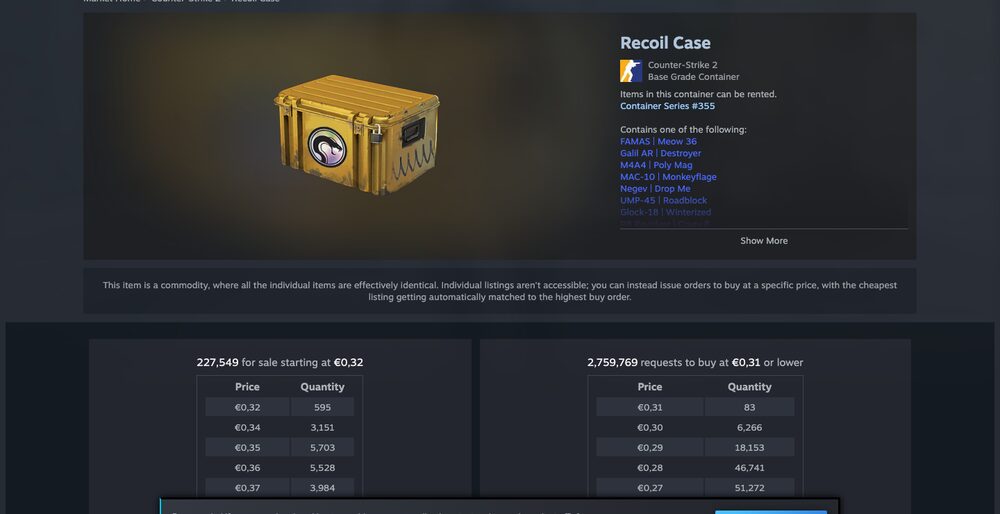
The discount you see is rent for the exit you don't
Sniping profit is usually described as "buy at 30% off, pocket 30%." The real equation has three more terms: the fee you pay to sell, the spread you cross to sell quickly, and the days or weeks of waiting if you refuse to cross it. On liquid items those terms are small and knowable. On illiquid items they can quietly consume the entire discount — the classic case of your own size being the strategy's ceiling.
That's why a "40% off" grail-tier listing is often a worse trade than a "12% off" liquid rifle. The rifle resells this week at a price you can see in the order book. The grail resells to a buyer who may not exist this quarter, at a price that was always partly imaginary. Liquidity in this market isn't a nice-to-have metric; it's the thing that converts paper discounts into money.
What each hunting ground actually pays
The two games differ in every dimension that matters. Commonly observed trade-offs, per third-party trackers and long-running community experience, as of late 2026:
| Liquid items | Illiquid items | |
|---|---|---|
| Typical mispricing | Shallow — commonly single digits to ~15% | Deep — 30%+ apparent discounts appear regularly |
| Competition | Fierce; bots dominate | Thin; a patient human can win |
| Reference price | Reliable, tight spread | Guesswork; last sale may be months old |
| Time to resell | Hours to days | Weeks to months, or "reprice until it hurts" |
| Where it fails | Edge too thin after fees | Exit never materializes |
Neither column is "better." They're different jobs. Liquid sniping is a volume business with thin, near-certain margins; illiquid sniping is a knowledge business with fat, uncertain ones. The disasters happen when people take one game's discounts and expect the other game's exits — most beginner blowups are exactly this trade.
How to price the exit before you click buy
A discipline worth stealing from market makers: never evaluate the entry without writing down the exit. Concretely, before buying any "deal":
- Count live buy interest, not listings. Order-book depth, recent-sale cadence, and how many venues show consistent volume. Venue liquidity rankings matter as much as item liquidity — a liquid skin on a dead site is an illiquid position.
- Assume you sell at the bid, not the ask. If the discount survives crossing the spread and paying two venues' worth of fees, it's real. If it only works "once someone pays list price," it's a hope.
- Budget the lock. A trade lock means days of market risk before you can even begin the exit. On volatile items, that alone can erase a shallow edge.
- Cap position size by depth. A rough rule many traders use: don't hold more of an item than the market absorbs in a period you can tolerate waiting. Ten copies of something that sells twice a month is a museum, not a portfolio.
Run this checklist honestly and a lot of glamorous discounts disqualify themselves — which is the point. The resale leg is where sniping PnL is actually decided, and it's the leg no discount badge ever tells you about.
One more test worth its weight: ask why the discount exists. On a liquid item, a modest markdown from a seller in a hurry needs no further story. On an illiquid one, a dramatic markdown from a seller who has watched the item sit for weeks is not mispricing — it's price discovery, and the market is telling you the reference was wrong. Buying "40% below" a number that no transaction has confirmed in months is how snipers end up owning the top of a dead market.
The hybrid most seasoned snipers converge on
Watch enough veterans and a pattern emerges: liquid items as the base, illiquid items as a small, deliberate satellite. The liquid base — popular rifles, knives with constant turnover, cases — generates steady fills where the exit is never in doubt. The illiquid satellite is reserved for items where the sniper has genuine valuation edge: high-tier pieces they've tracked for months, niche collections they know better than the market does. Sized so that a position going to sleep for a quarter is annoying, not ruinous.
This mirrors the liquidity-first principle from the investing side of this market: illiquidity is a cost you should only pay when you're being visibly compensated for it — and "a big discount badge" is not, by itself, compensation.
If the exit isn't the goal, the whole question changes
One postscript that dissolves half the dilemma: everything above assumes you're flipping. If you're accumulating — buying items you intend to hold for years — the exit stops being urgent and liquid items at ordinary cash-market discounts become the entire game. You don't need rare mispricings; you need a good average price, repeated. For what it's worth, that's the approach this blog's product is built around: the founder runs a public $20/day accumulation account (see /stack), and per its open ledger the purchases have averaged roughly 36% below same-day Steam prices — not by winning races, just by always buying the cheapest live listing on liquid items.
So decide which balance sheet you're running. Flippers should let the exit veto the entry, every time. Accumulators should stop paying attention to discounts on things they'd never hold, and put that attention into cadence and cost basis instead. The worst position is the accidental one: an "investment" that started life as a flip whose exit never showed up.