
Pricempire Review (2026): the Skin Price Aggregator
Standard disclosure: this is cs2stack's own blog, and we build a tool in the same broad market. Pricempire is mostly not our competitor — it aggregates and tracks prices, we execute purchases — but adjacent is adjacent, so read us with that in mind. The short version: as a market-wide reference layer, Pricempire is one of the most useful sites in the CS2 economy, and we use the aggregator category ourselves when writing about prices.
What Pricempire is
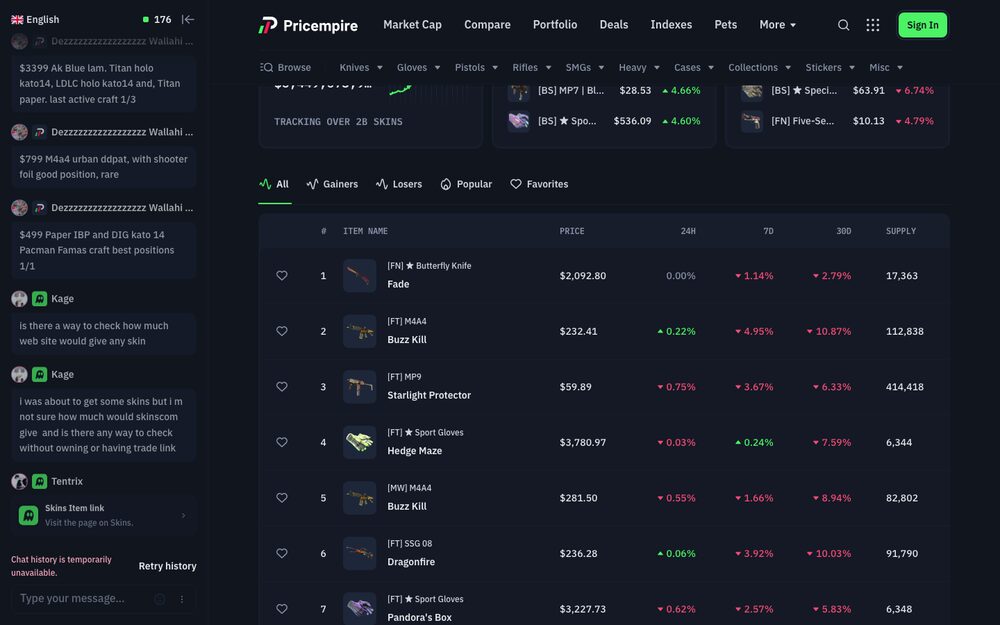
Pricempire is a price aggregator with portfolio tracking bolted on — and in this market, that combination is close to essential infrastructure. Per its public pages, it pulls current prices for CS2 items from a long list of marketplaces into a single item page, keeps historical price data, and lets you register your inventory so you can watch its value move across venues over time.
The problem it solves is real and daily: the same skin has five different prices at once, and none of them is the price. Steam runs high because wallet funds are trapped; Chinese venues often set the cash floor; European venues drift on currency and regional demand. We've written about why the same skin has five different prices — an aggregator is the practical answer to living with that fact. Instead of eight tabs, one page.
The strengths, per its public pages
As with any review of a live product, treat the specifics as what Pricempire's public pages describe as of late 2026, subject to change on their end:
- Coverage breadth. It aggregates across many venues — the majors like Steam, CSFloat, Skinport, DMarket and Buff163, plus a tail of smaller markets. For deciding where to buy or sell a specific item, that tail matters: quiet venues run sharp prices precisely because fewer people look at them.
- Price history. Historical charts per item, which is where an aggregator quietly becomes a research tool. Whether a case is expensive is unanswerable from today's price alone; it needs the shape of the last two years. Most trackers and articles in this scene lean on aggregator history, ours included.
- Portfolio tracking. Register your inventory and watch its aggregate value across venues — realizable cash value, not just Steam's fiction. If you hold more than a handful of items, knowing the honest number is worth the setup, a distinction we've hammered in Steam wallet dollars are not dollars.
- Developer access. Its pages describe API access for programmatic price data. We won't quote tiers, limits or prices — those specifics live on their site and change — but the existence of a paid data pipe is itself a signal: builders in this space treat Pricempire as a reference source.
Conceded without hedging: nobody serious about skin prices is worse off with Pricempire bookmarked. Breadth of aggregation is a moat built on unglamorous integration work, and they've done years of it.
The gaps
Three honest limits, none of them fatal.
Aggregated prices are reference prices, not executable ones. A listed low price is a snapshot: by the time you click through, it may be gone, and fees, trade locks and regional payment quirks sit between the displayed number and what lands in your inventory. Aggregators are honest about this; users sometimes aren't. The number on the page is where negotiation with reality starts.
Depth is invisible. One lowest listing tells you nothing about the second-lowest, or whether there are forty listings or two. For accumulating quantity — buying cases daily, say — depth matters as much as the headline price, a theme from our liquidity explainer.
It informs; it doesn't act. This is the categorical one, and it's a design choice, not a flaw: Pricempire tells you the market, and then its job is done. No purchase, no standing order, no budget enforcement. The distance between a dashboard and a filled order is the distance we've called the tracking-vs-acting gap, and no aggregator crosses it.
Aggregation vs execution — where our bias lives
Full disclosure again, because this is the paragraph where we sell something. cs2stack (ours) sits on the execution side of that gap: a free account gets a monitoring sheet with live lowest prices on DMarket and SkinBaron, and an autobuy engine that executes standing rules under a daily budget, per-item ceiling and hard cap — dry-run by default, non-custodial, with the founder's own $20/day running publicly at /stack. We watch two venues and buy; Pricempire watches many venues and informs. If your question is "what is this item worth everywhere?", Pricempire answers it far better than we do — genuinely, no contest on breadth. If your question is "how do I buy this item at my price every day without watching?", an aggregator was never going to answer it. Many disciplined buyers should use both: aggregator for research and valuation, an execution tool for the recurring buys, per the division of labor in our data-stack survey.
Verdict
Pricempire earns its place as the reference desk of the CS2 economy: broad aggregation, real price history, and portfolio numbers denominated in cash reality rather than Steam optimism, per its public pages. Its boundaries are the category's — snapshot prices, no market depth, and a hard stop where action begins. Use it to know the market. Just don't mistake knowing for owning; between the two sits a purchase, and something — you, a buy order, or a bot with a budget cap — still has to make it.