
Price Monitoring vs Refreshing Tabs: Stop Watching the Market by Hand
Everyone who's wanted a skin at a better price has done it: the marketplace tab that stays open for a week, refreshed between matches, at breakfast, at 1am. It feels like diligence. It's actually the worst possible way to watch a market — maximum time spent, minimum market seen. Here's the arithmetic of why refreshing fails, and what monitoring tools actually replace.
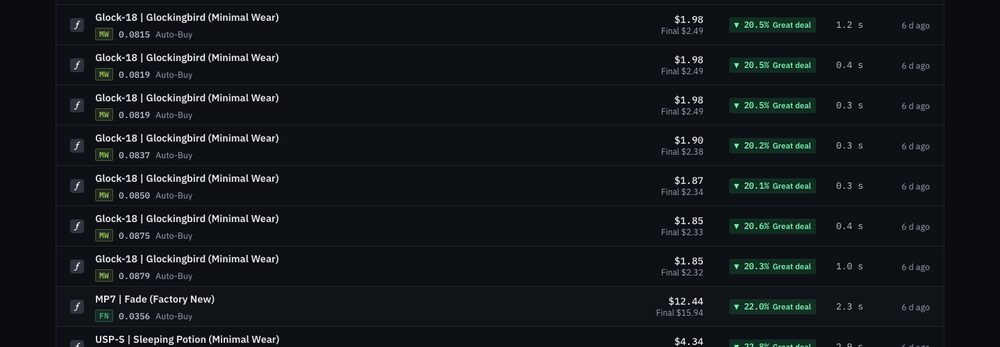
The arithmetic of refreshing
Say you check a listing page ten times a day, thirty seconds per check. That's five minutes daily — half an hour a week per item, and most watchers track several. The time cost of manual trading compounds embarrassingly fast: a modest five-item watchlist runs into multiple hours a month of pure page-refreshing.
Now the other side of the ledger: what does all that time buy? Ten checks a day is ten samples of a market that moves continuously. Between your samples, listings appear and vanish in minutes — the good ones fastest of all, because underpriced listings are exactly what bots and full-time snipers clear first. Your coverage of the day is ten slivers totaling five minutes out of twenty-four hours: well under 1% of the market's timeline, weighted toward moments you happened to be free rather than moments anything happened. Refreshing is a lottery where you pay in attention and hold a fraction of a ticket.
And it's worse than useless at the margins, because intermittent checking trains exactly the wrong reflexes: you see a price 4% below yesterday's check, can't know whether it's a dip or a trend, and buy out of fear the tab will look worse tomorrow. Sampled data plus impatience is how watchers end up overpaying for items they watched all week.
What monitoring actually means
A monitoring tool inverts every term of that arithmetic. Something checks the market continuously — every few minutes, all day, every day — and your involvement shrinks to reading results. Coverage goes from under 1% of the timeline to effectively all of it; your time cost goes from hours to minutes; and decisions get made against a continuous price history instead of anxious snapshots. The three escalating forms:
- A monitoring sheet — a live page showing current (and ideally cross-venue) prices for everything you track. You still decide and click, but "checking the market" becomes one glance at one page instead of a tab-refresh tour.
- Alerts — you set a threshold and get pinged when it's crossed. Zero watching at all; the market interrupts you instead of the reverse. The catch is alert design: thresholds too loose become notification spam you learn to ignore; too tight and they never fire. And you still have to be awake and near a device to act.
- Autobuy — a standing order executes under your threshold with no human in the loop. This is the only tier that actually competes with bots on speed, and the tier where guardrails (budgets, caps, dry-runs) stop being optional. Alerts vs autobuy covers how to choose.
The tools, honestly
Disclosure first: this blog is written by one of them. cs2stack's free tier is a monitoring sheet — for every item you track, it watches the live lowest price across DMarket and SkinBaron and shows the cheaper side, with optional autobuy under your caps (non-custodial, dry-run on by default). That's deliberately narrow: two venues, done properly, fee-aware.
Other corners of the market have their own watchers. CSWatcher offers free watching of Steam Market listings — per its public pages as of late 2026, its Spectator tier monitors items without requiring payment — with paid tiers for faster checks; it's Steam-centric where cs2stack is cash-market-centric, so the two barely overlap. Price aggregators like Pricempire cover the most venues at the cost of update lag, which makes them maps rather than monitors. And the broader tracker landscape has a tool for nearly every niche. The selection question is just: which venues do you actually buy on, and does the tool watch those venues faster than you would?
What monitoring doesn't fix
Fair warning against overcorrecting: monitoring is plumbing, not strategy. A live sheet won't tell you what a skin is worth — you still need a valuation habit — and an alert fired at a bad threshold just automates a bad decision. Monitoring also doesn't beat dedicated snipers to underpriced listings unless you're on the autobuy tier; if catching mispriced listings is the actual goal, that's a different discipline with different tooling. What monitoring replaces is precisely and only the refreshing: the mechanical, low-judgment, high-hour act of looking at prices. That's the part worth zero of your time, which is why delegating it is the highest-return automation most buyers ever set up.
The endpoint is pleasantly boring. You decide what you want and what you'd pay — once, calmly. A sheet or an alert watches the market with 100% coverage while you play the actual game. When your number appears, you (or your standing order) act on it. Total ongoing cost: minutes a month. The week-old tab, refreshed at 1am, was never diligence — it was a subscription to anxiety, paid in the one currency the market never refunds.