
Float Values Explained: The Decimal That Moves Thousands
Two Factory New copies of the same skin can differ 3x in price over digits the scoreboard never shows. Float is the market's most granular pricing variable — and most traders only half understand it.
What a float actually is
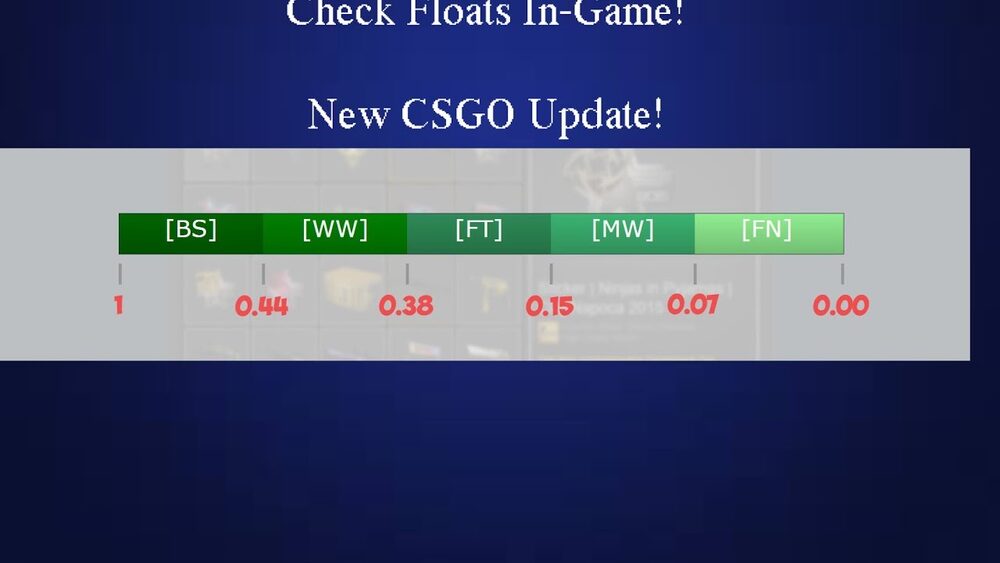
Every skin instance carries a wear value between 0 and 1, assigned the moment the item is created — unboxed, traded up, or dropped — and immutable forever after. The float determines how scuffed the finish renders, and the market slices that 0-to-1 line into the five wear tiers printed on every listing:
| Wear | Float range |
|---|---|
| Factory New | 0.00 – 0.07 |
| Minimal Wear | 0.07 – 0.15 |
| Field-Tested | 0.15 – 0.38 |
| Well-Worn | 0.38 – 0.45 |
| Battle-Scarred | 0.45 – 1.00 |
The tiers are just labels over a continuous variable, and that's the entire source of float trading: a 0.0701 and a 0.1499 are both "Minimal Wear," but one looks nearly Factory New and the other is a coin flip from Field-Tested. Wear-tier prices are averages; floats are specifics. The gap between the two is where the money is.
Floats are also not uniformly distributed. Community reverse-engineering of unboxing data has long suggested the game rolls a wear bucket first — with Factory New among the rarest outcomes — and only then a value inside it, before remapping to the skin's own caps. The practical consequence: extreme floats at either end are structurally scarce, not just cosmetically nice, and the supply of sub-0.01 copies of any given skin is a tiny, countable population.
Per-skin caps: why "Factory New" isn't one thing
Skins don't all span the full 0-to-1 range. Each finish has its own float cap — a minimum and maximum the game will ever generate. Some skins can't exist below 0.06 or above 0.80; a few can't be Factory New or Battle-Scarred at all. Crucially, capped skins still distribute their floats across the allowed range, which reshapes scarcity: on a skin capped at 0.10 minimum, there is no FN, so the lowest-float MW copies become the de facto top tier and price like it.
Caps also create some of the market's strangest collectibles at the high end. Because the M4A4 Howl pool is frozen, its cleanest floats trade at extraordinary premiums — but the same logic runs in reverse for "max float" collectors hunting the most destroyed possible copy of a skin. Scarcity is scarcity; the market doesn't care which direction it points.
Where the premiums actually live
Float premiums are not linear. They cluster at specific breakpoints:
- Sub-0.01 floats. The collector zone. A 0.003 copy of a popular skin can trade at multiples of the generic FN price, and 0.000x floats are auction material.
- Tier borderlines. A 0.069 MW-priced skin that renders like FN is the classic value buy; a 0.151 FT that looks MW is the same trade one tier down.
- Cap extremes. Floats near a skin's personal minimum or maximum, regardless of tier label.
- Unicorn combinations. Float stacked with rarity multipliers — StatTrak, patterns, souvenir status. The StatTrak M9 Crimson Web in Factory New is the canonical example: each attribute is rare, and their intersection is nearly empty.
Note what's absent from that list: mid-range floats. A 0.20 versus a 0.30 Field-Tested rarely moves price at all. Float only matters where it's scarce or visible.
The premiums also come with a liquidity tax. Instant-sell venues and buy orders pay the wear-tier price, full stop — a float premium is only realized by listing manually and waiting for the specific buyer who values the decimal. If you're paying 2x FN price for a 0.004, understand that exiting at 2x requires the same patience the seller you bought from just exercised.
Inspection and tooling
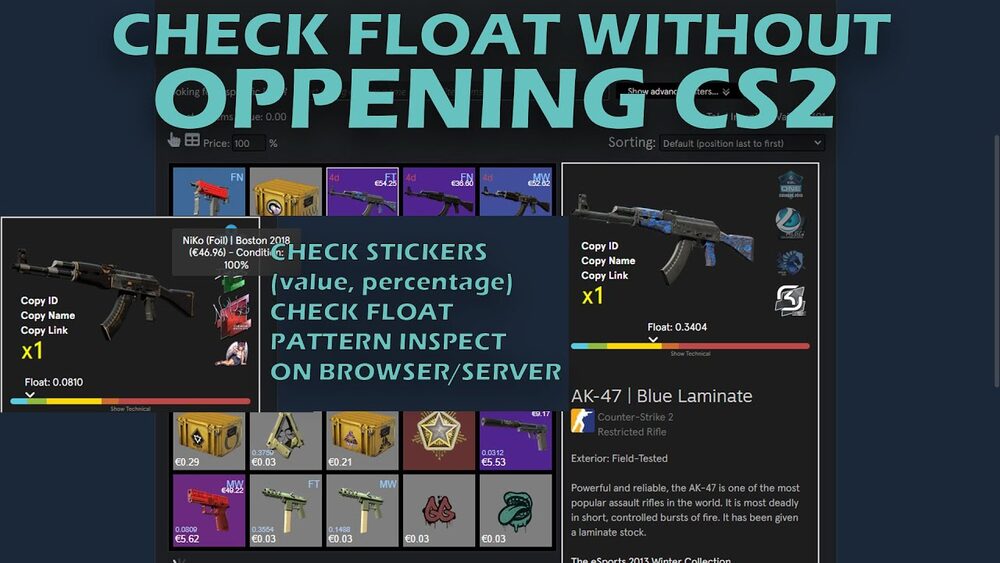
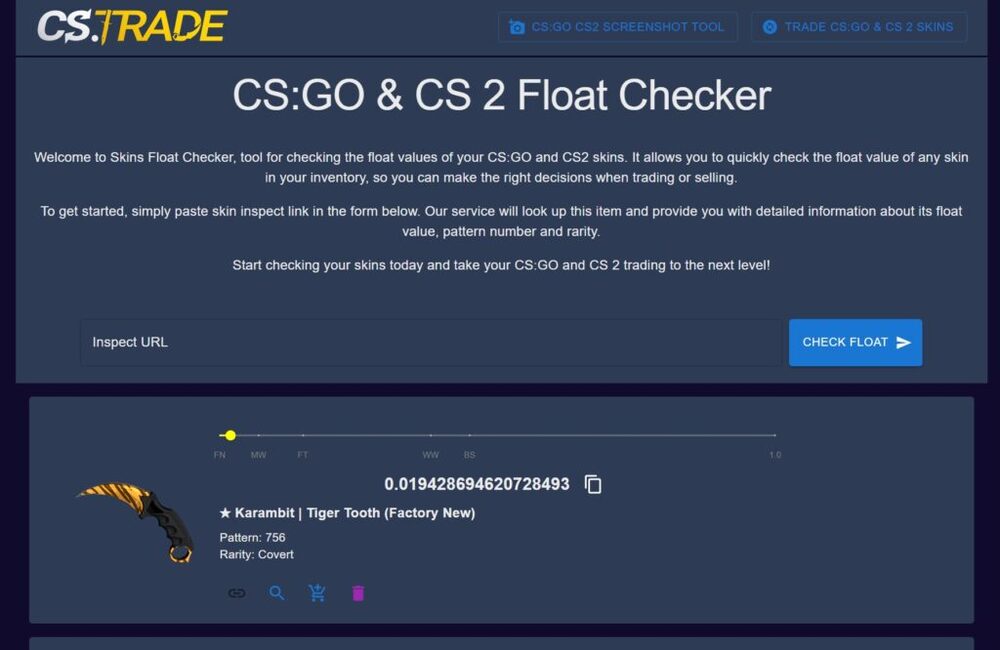
The Steam client shows wear tier, not float — you have to inspect in-game or, more practically, run listings through third-party float checkers that read the exact value, paint seed, and applied stickers from the inspect link. Serious buyers filter by float range on third-party marketplaces rather than paging through Steam listings blind, and database tools track the lowest-known floats per skin. This tooling layer is standard equipment now; our data stack guide covers the categories.
Trade-up float math
Floats stop being cosmetic and become arithmetic in trade-up contracts. The output skin's float is your ten inputs' average wear position mapped onto the output's own float range — low-float inputs produce low-float outputs, deterministically. That's why bulk low-float commons carry a quiet premium: they're feedstock. Since the 2025 trade-up update extended contracts to higher tiers, this input math matters across far more of the market than it used to, and float-aware trade-up spreadsheets have become their own cottage industry.
For valuation purposes, float is one adjustment among several — it stacks with pattern, StatTrak, and stickers into the final number. How to weigh all four against the price sources is its own discipline, covered in how to actually value a skin. The short version: start from the liquid wear-tier price, then justify every premium you pay with scarcity you can verify.