CS2 Investment Strategies, Compared
Six CS2 investment strategies account for nearly everything anyone does with money in the CS2 market. Each has a real edge, a real cost, and a real way to blow up. Here they all are on one page, rated the way a practitioner would rate them — so you can pick a lane instead of drifting between all six.
The taxonomy
Strip away the branding and every approach reduces to one of these: case stacking / DCA (accumulate sealed cases on a schedule), lump-sum holding (same thesis, one big entry), sniping (catch underpriced listings), event plays (position ahead of Majors and updates), arbitrage (exploit price gaps across venues), and trade-up grinding (manufacture skins via contracts). Rated on the four dimensions that matter:
| Strategy | Capital needed | Time cost | Edge durability | Blow-up risk |
|---|---|---|---|---|
| Stacking / DCA | Tiny — dollars a day | Near zero if automated | High — structural supply shrink | Low-moderate (update risk, slow) |
| Lump-sum hold | A lump, by definition | One afternoon | Same thesis as stacking | Moderate — entry-timing tail risk |
| Sniping | Small-medium, kept liquid | High — speed and screen time | Decaying — bots compress it | Moderate (mispriced "bargains") |
| Event plays | Medium | Bursty — intense around catalysts | Cyclical, crowd-dependent | High — binary outcomes |
| Arbitrage | Medium, split across venues | High for two-leg; zero for buy-side | Thin and self-erasing | Moderate (holds, venue risk) |
| Trade-up grinding | Small per contract | Very high — it's a job | Persistent but competitive | Low per trade, ruinous if sloppy |
Stacking and DCA: the default for a reason
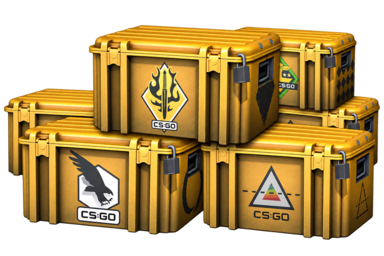
The base-case strategy: buy liquid cases on a fixed budget, hold for years, let one-way case attrition do the work. Its edge doesn't depend on out-trading anyone — it's the structural fact that opened cases are gone forever while unboxing demand persists. It's also the only strategy on this list that gets easier with automation until the time cost is effectively zero. Weaknesses: it's slow, it's boring, and it eats full market beta — when Valve ships a hostile update, your stack marks down with everything else and your only tool is patience. Verdict: the right core for almost everyone, sized with entertainment money.
Lump sum: same thesis, concentrated timing
Identical holdings, different entry. In a smoothly rising market it beats DCA on average; in a market that gets repriced by patch notes it carries a fat left tail that the averages hide. The full argument is in the lump sum vs DCA post linked above; the short version is that most people should lump a base and smooth the rest.
Sniping: paid for speed
Sellers fat-finger prices, need instant cash, or list on the wrong venue at yesterday's price. Snipers get paid for being first to those listings. The edge is real but it's a race — every year the bots get faster and the window narrower, and a human refreshing pages is now mostly competing for scraps. There's also a quieter failure mode: many "underpriced" listings are correctly priced for a reason you haven't spotted (wear, pattern, a market-moving announcement you missed). The sniping guide linked in the table runs the honest math; standing price caps are the lazy person's version worth knowing about.
Event plays: the highest beta in the market
Majors, operation rumors, and mechanics updates move prices in semi-repeatable patterns — the October 2025 trade-up change repriced Covert skins within days. Event traders buy exposure ahead of the catalyst and sell into the reaction. When it works it's the fastest money in skins; when the catalyst disappoints, or the crowd front-ran it months earlier, positions gap down with no exit. This is a sleeve strategy, never a core — sizing and exits are covered in the dedicated post linked above.
Arbitrage: real, thin, and mostly eaten by frictions
The same case genuinely trades at different prices on DMarket, SkinBaron, and Steam at the same moment. True two-leg arbitrage — buy cheap venue, sell dear venue — has to survive seller fees, trade locks measured in days, and FX conversion, which kills most of the visible gap. The version retail actually captures is buy-side routing: if you were going to buy anyway, always buy on whichever venue is cheapest right now. That edge is small, free, and compounds. The field guide linked in the table maps the whole terrain, and the buy-side case gets its own deep dive below.
Trade-up grinding: manufacturing, not investing
Ten same-rarity skins in, one higher-rarity skin out — and when input prices are right, the expected value of the output exceeds the cost of the inputs. Grinders find those spots with float math and liquidity checks, then repeat the loop dozens of times. It's the closest thing skins have to a wage: fairly reliable, fully earned, and demanding enough that it stops being passive income and starts being shift work. Details and failure modes in the deep dive linked above.

How to actually choose
- Start from your hours, not your ambitions. Grinding and sniping consume evenings indefinitely. Stacking consumes minutes a month once automated. Most strategy failures are time-budget failures, and the hidden time cost of manual trading is the line item everyone forgets to price.
- One core, at most one sleeve. A passive automated core plus a small, capped active sleeve is the sane structure (picking your lane). Running three strategies from one wallet mostly produces muddled books and fee leakage.
- Respect the shared risk. Every row of that table lives downstream of one publisher. No strategy diversifies away Valve risk; only position sizing does.
- Count fees before edge. Active strategies pay venue fees on every cycle; passive ones pay almost nothing. An edge smaller than your round-trip costs is a donation.
The unglamorous conclusion: the strategy rankings barely matter compared to execution consistency. A mediocre strategy run with discipline for three years beats a brilliant one abandoned in month two. Pick the lane you'll still be in when it's boring — for most people with jobs, that's an automated stack with everything else left alone.