Trade-Up Grinding as an Investment Strategy
Every other skin strategy waits for the market to move. Trade-up grinding manufactures its own product: feed ten cheap skins into a contract, receive one better skin, sell it for more than the ten cost. When the math clears, it's the closest thing this market has to a wage. The catch is in that word — wage. This is a job, and it pays like one.
The machine you're operating
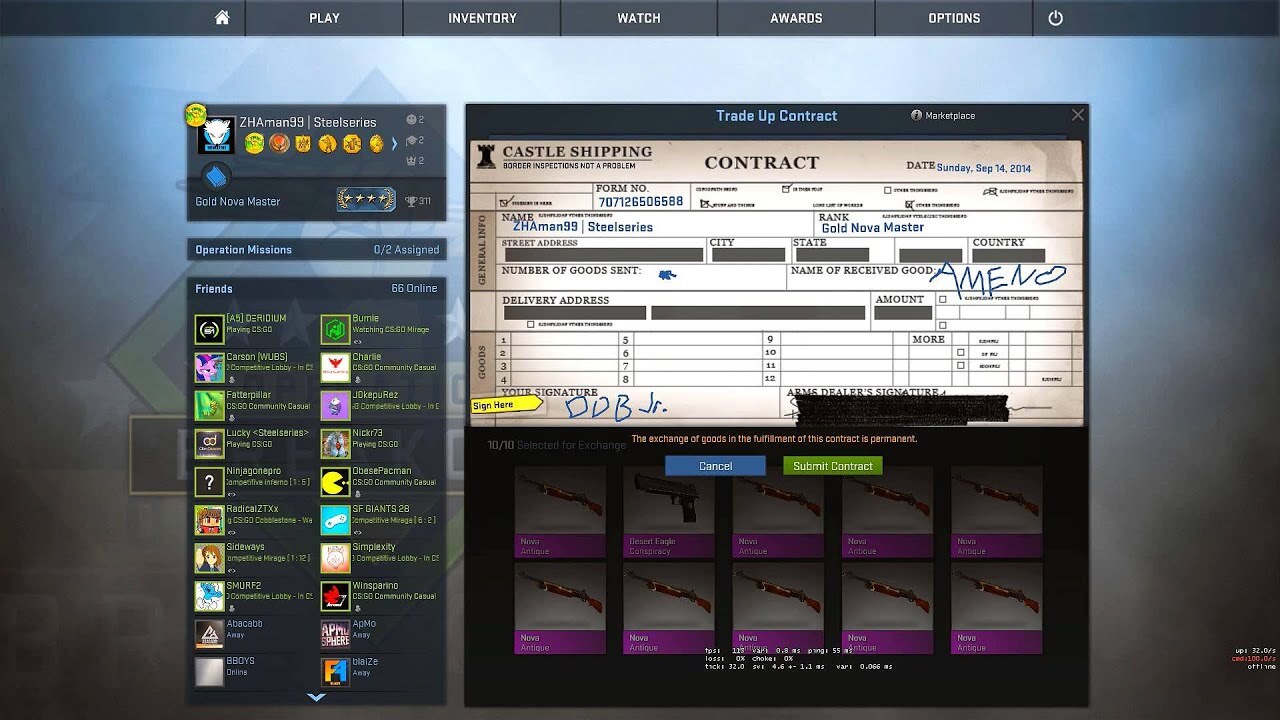
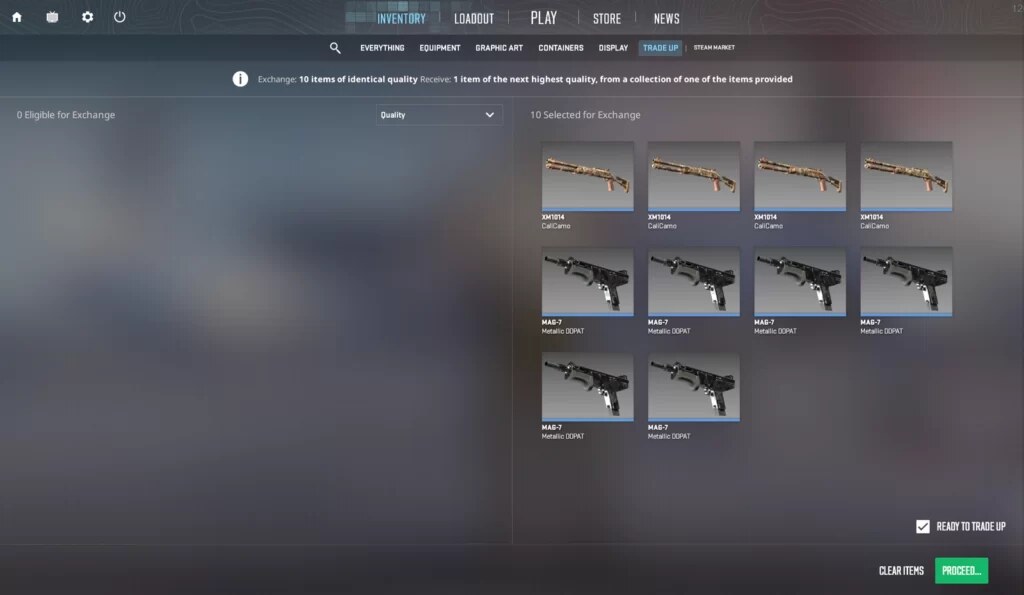
The trade-up contract is a Valve-built crafting mechanic: ten skins of the same rarity go in, one skin of the next rarity up comes out, drawn from the collections your inputs belong to. Two rules make it a game of skill rather than pure chance. First, the output pool is determined by your input collections — mix collections and you're weighting a lottery between their outcomes. Second, the output's wear is not random: the contract takes the normalized average float of your ten inputs and maps it onto the output skin's float range. Float — the decimal that determines whether a skin is Factory New or Battle-Scarred — is the difference between the same skin selling for a little or a lot, and it's worth understanding cold before you run a single contract.
That second rule is the grinder's real edge. By hand-picking low-float inputs from cheap collections, you can engineer a high-tier output in a wear bracket that sells at a premium. The people doing this well are not gambling; they're running a small manufacturing operation with known input costs and a probability-weighted output price.
The math that decides everything
A contract is worth running when its expected value clears its cost — where expected value (EV) means each possible output's market price weighted by its probability, minus the selling fees you'll pay to realize it. Sketching it out:
- Input cost: the real acquisition cost of ten skins, including any premium you paid to get specific floats.
- Output distribution: every possible output across your input collections, each with its probability and its price in the wear bracket your average float produces — not the headline price of the pristine version.
- Fees: the haircut on exit. Steam's cut runs roughly 13–15%, cash marketplaces typically charge sellers somewhere around 2–12% depending on venue. An EV that's positive before fees and negative after is the most common beginner trap — fees shape every trade.
- Liquidity: a paper EV means nothing if the output has three buyers a week. Thin order books turn "profit" into "inventory" — liquidity is a filter, not a footnote.
Profitable contracts exist because prices across thousands of skins drift out of alignment faster than the crowd corrects them. But each specific opportunity is self-erasing: grinders pile into a good contract, bid up its inputs, and the margin closes. The job is finding the next one, forever.
Why the goalposts move under your feet
Valve edits this machine. The October 2025 update added a headline path — five Covert skins trade up to a knife or gloves from an input's collection — and Covert prices jumped on the announcement alone, instantly rewriting every contract EV that touched the tier and crashing knife prices in the process. The 2026 IEM Cologne-era update opened souvenir skins to trade-ups (with souvenir attributes stripped), unlocking a pool of inputs that had been dead inventory for a decade. Each change created a gold-rush window for grinders who re-ran their math within hours, and losses for anyone holding inventory optimized for the old rules. A grinder's spreadsheet has a shelf life, and Valve decides when it expires.
What the job actually costs
Here's the day-to-day nobody advertises. Sourcing ten specific low-float inputs means searching listings across venues, checking each float, and often waiting out trade locks before items are usable. Then the contract, then listing the output, then repricing it as the market moves, then starting over. Multiply by dozens of contracts a month and you have real shifts of screen time — the time cost is the strategy's biggest hidden fee. Divide a good month's profit by those hours and many grinders discover they've invented a demanding minimum-wage job with capital at risk. There's also a churn tax: every buy-sell cycle pays fees, and grinding is nothing but cycles — the overtrading trap with extra steps if your margins are thin.
Software helps at exactly one point in the loop: the scanning. Comparing thousands of input-output combinations against live prices is spreadsheet work that machines do better — cs2stack, for instance, includes a scanner that flags hypothetical trade-up candidates as a research tool (flags, not executes). But no tool runs the contract for you: execution happens in-game, by hand, at your risk, and the judgment about which flagged candidate is actually liquid enough to exit remains fully human. Anyone selling you a "fully automated trade-up profit bot" is describing something that shouldn't exist — see what a skin bot should never do.
Who should grind, and who shouldn't
Grind if you enjoy the puzzle for its own sake, have real hours to commit weekly, and treat the proceeds as earned income rather than investment return. The skill compounds, the mechanic (in some form) has survived every update since 2013, and unlike sniping you're not in a millisecond race with bots.
Skip it if what you actually want is exposure to the skin market's long-term growth. Those are different products: grinding converts your labor into income; holding converts patience into (possible) appreciation. A stacker with an automated daily plan captures the market's structural supply story in minutes a month; a grinder captures a wage in hours a week. Plenty of people run a hybrid — accumulation core, occasional contract when a genuinely fat one appears — which lands you in the passive-core, active-sleeve structure. Just keep the books separate, because a strategy whose returns you can't attribute is a strategy you can't evaluate. Where trade-up grinding sits against every alternative is mapped in the full strategy comparison.