
Sticker Money: How Skin Sales Fund Pro Counter-Strike
The $1.25M prize pool is the number on the broadcast. For popular teams, the real Major payday is the capsule store — and it's the quiet financial spine of the entire pro scene.

How the revenue share works
Every Major, Valve sells tournament items in the game client during the event window: team sticker capsules, player autograph capsules, and the passes that feed the souvenir pipeline. The part that makes this an esports funding mechanism rather than just merch: per public reporting over many years, a substantial share of that revenue — widely reported at around half of the proceeds attributable to a team's items — flows back to the orgs and players whose names and logos are on them. Team capsules pay the org; autograph capsules pay the players whose signatures sell.

Valve has never published an official rate card or per-team statements, so every figure in circulation comes from org executives and players talking to press. But the consistent shape of those reports, across a decade, is unambiguous: for the most popular teams, a single Major's sticker share runs into the millions of dollars — frequently exceeding the $1.25M prize pool the winner takes, sometimes by multiples.
The strange arithmetic of pro CS: a team can go 0–3 in the group stage and still out-earn the champion, if enough fans bought their capsule.
The mechanism is as old as the sticker itself. Team stickers debuted at Katowice 2014, player autographs joined the store within the following Major cycle, and the revenue share has run through every event since — which means the system has now survived twelve years, four game-client eras, and every esports funding winter. Few revenue lines in gaming have that track record.
Why this money matters more than sponsorships
Esports as an industry spent the 2020s learning that venture money and sponsorship budgets are cyclical. Sticker money is different in kind:
- It scales with the fanbase, not the ad market. When esports sponsorship contracted industry-wide, Major capsule revenue held up — fans buy stickers in a way brands don't buy logos.
- It rewards qualification, not just victory. Making a Major puts your capsule in the store. That single incentive shapes roster investment across every tier of the scene.
- It pays players directly. Autograph revenue lands with the individuals, which is why veteran pros describe Major qualification as the financial event of their careers.
- It's why the scene survived the lean years. Orgs that quit other titles kept CS rosters partly because Majors are one of the few esports events that reliably generate cash instead of burning it.
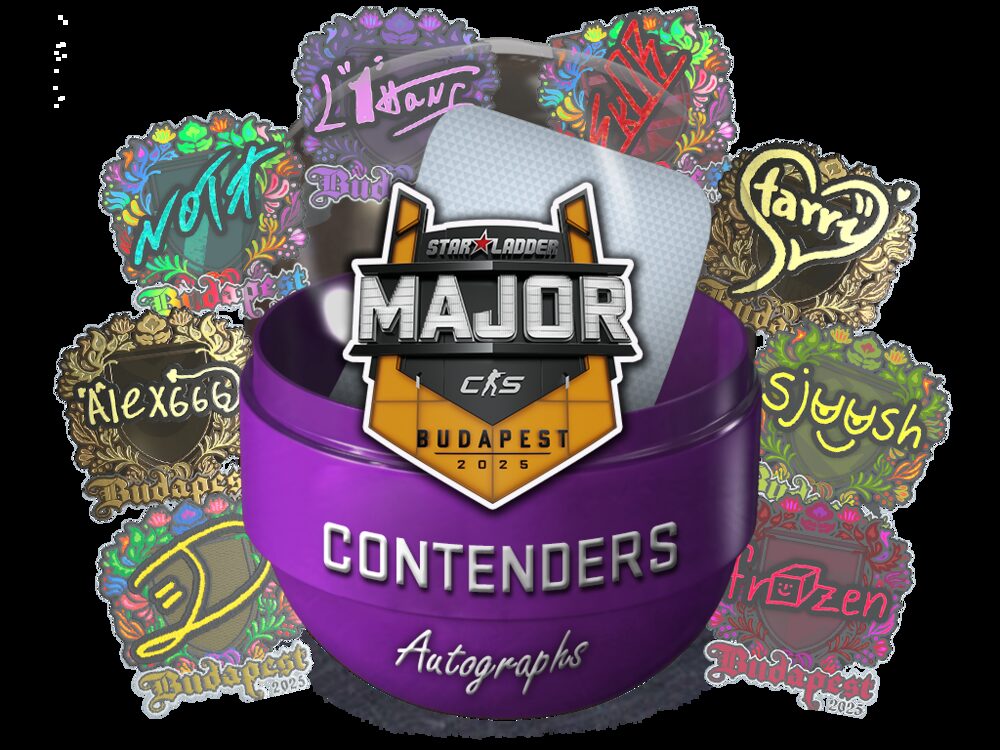
Design is a financial decision
Once you know the revenue model, capsule aesthetics stop being cosmetic. A team's sticker design directly moves its Major income: clean, craftable designs that look good on popular skins sell to the trading community, not just the fanbase. Holo and gold variants drive capsule-opening demand the way rare knives drive case openings. Players with distinctive signatures see measurably different autograph demand. The market layer feeds back into the sport: crafters deciding a sticker looks good on an AK — a culture that goes back to Katowice 2014 — is, functionally, a funding allocation.
The caveats worth keeping in view
The system's weaknesses mirror its strengths. It's entirely discretionary — there is no published contract, no rate card, and Valve could restructure the split at any time, exactly the kind of single-company policy risk that hangs over every corner of this economy. It's lumpy: two paydays a year, sized by fan enthusiasm, makes for difficult budgeting even at well-run orgs, and players and orgs have occasionally aired disputes over how autograph revenue is split internally. And it concentrates income at the top — the same handful of globally popular teams capture the bulk of capsule spending, while a qualifying underdog's capsule money is real but modest. Sticker money stabilized the scene; it didn't equalize it.

What it means for the market side
For traders, the funding mechanism has two practical consequences. First, supply is windowed: capsules are minted only while the event store is open, then never again — the entire basis of the Major sticker investment thesis and the broader capsule economics picture. Second, incentives are aligned in a way that's rare in virtual economies: Valve, the teams, and the players all earn more when the item economy is healthy and Majors are huge. That alignment is one of the structural reasons the scene has kept growing through every crisis, and it compounds with each event — Copenhagen, Shanghai, Austin — adding a new vintage of windowed supply to the market.
The system Valve built in 2013 — starting with a case that literally funded prize pools with key revenue — has matured into esports' most durable business model: the audience funds the sport by buying pieces of it.