Is the CS2 Market Dead? What the Data Actually Says
Type "CS2 market" into any search bar this summer and the autocomplete finishes the sentence for you: dead, crashing, over. The fear is understandable — per third-party trackers, a market that peaked around $14 billion has given back roughly half of that, and about 95% of tracked skins lost value between March and mid-August 2026. But "down" and "dead" are different diagnoses with opposite prescriptions. Here's what the data actually supports.
The bear case, stated fairly
No serious answer to this question starts by minimizing the damage. Per third-party trackers and analyses in 2026:
| Metric | Reading (hedged, per trackers) |
|---|---|
| Total market cap | Peaked around $14B; roughly halved by mid-2026 (some trackers print steeper) |
| Breadth of decline | 1,128 of 1,186 tracked skins (≈95%) down, March–mid-August 2026 |
| Gloves | Fell first and hardest — −10–20% by early 2026 |
| October 2025 trade-up update | An estimated $1.75B in value wiped in one repricing |
Every one of those numbers deserves a hedge — nobody audits this market, trackers disagree on methodology, and "market cap" multiplies fragile prices by uncertain supply. But the direction and rough magnitude are not in dispute. This is a genuine, broad, deep drawdown, not a media invention.
What "dead" would actually look like
A market is dead when the things that generate demand stop, not when prices fall. Concretely, a dead CS2 skin market would show some combination of:
- Collapsing player counts — nobody playing means nobody wanting cosmetics.
- Collapsing transaction volume — prices can fall on heavy volume (repricing) or on no volume (abandonment); only the second is death.
- Valve disengaging — no updates, no cases, no operations, no reason to believe the platform persists.
- Structural rails breaking — marketplaces shutting, cash-out routes closing, liquidity vanishing at any price.
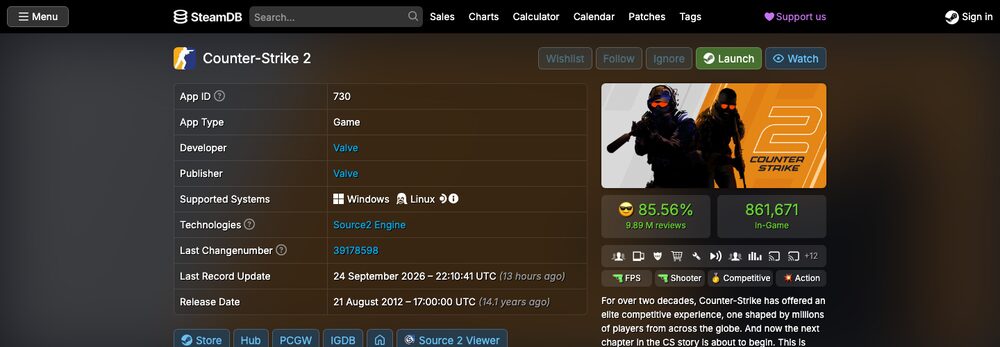
Measure 2026 against that checklist and the diagnosis changes. Player counts remain strong per public trackers — the game itself is arguably healthier than the speculative market built on top of it. Items keep changing hands; Steam Market activity during the crash shows repricing on real volume, not a bid-less void. And Valve has been conspicuously active: a mid-May 2026 update touched drop rates and shipped new cases, and back in December 2025 dataminers found the Rare Drop Pool set to zero — a supply squeeze on 35+ old cases that is the opposite of a company abandoning its economy.

The engine under the market is still running
The single most underrated data point in the "dead market" debate is Valve's own income statement. Per third-party analyses, CS2 generated over $1.16 billion for Valve in 2025 — on the order of 400 million cases opened at $2.50 a key, roughly a billion dollars gross, plus an estimated $166 million in Steam Market fee profit. That revenue machine runs on players opening cases and trading items, which means Valve is paid handsomely to keep this economy alive and has structured its whole CS2 business around it.
Markets die when their operators stop caring or their users leave. Neither is happening here. What happened instead is that a speculative premium — built up through the post-2023 bull years and stretched to a roughly $14B print — met a wave of new supply from the Armory era and a 2025 trade-up shock that showed everyone how fast Valve can reprice things. Confidence cracked, and prices found a lower level. That process has a name, and it isn't death. It's repricing.
Dead vs repriced: why the distinction matters
The distinction isn't semantic — it inverts what you should do:
- If dead: exit at any price. Every day held is value lost forever. The 2019 key holders who waited for tradability to return are still waiting.
- If repriced: the crash is a transfer of assets from the impatient to the patient, at a discount. Historically these windows — 2018, 2019, the 2023 wobble, October 2025 — rewarded accumulation and punished capitulation.
The honest position is that the data leans heavily toward "repriced" — intact demand base, intact operator incentives, active supply management — while acknowledging the scenario nobody can rule out: this market has exactly one landlord, and single-publisher risk never goes away. Anyone telling you recovery is guaranteed is selling something. The claim here is narrower: the evidence for death is prices, and prices alone have never been sufficient evidence.
The scoreboard to watch from here
If the dead-vs-repriced question stays live for you, the way to resolve it is not more commentary — it's a short scoreboard of numbers that would actually settle the diagnosis, checked monthly rather than hourly:
- Concurrent players. The demand base under every skin price. As long as public trackers show the player counts holding — and through this entire crash they have — the "nobody wants these items" thesis has no foundation. A sustained, multi-quarter slide in players would be the first genuinely bearish structural signal.
- Traded volume, not just price. Falling prices on steady volume is repricing; falling prices on evaporating volume is abandonment. So far the data shows the first pattern. Watch for the second.
- Breadth turning. The ~95%-down figure is a capitulation-era reading. When the monthly proportion of tracked skins declining starts shrinking toward half, the indiscriminate phase is ending — historically the tell that repricing is finding its level.
- Supply-lever news. The December 2025 Rare Drop Pool zeroing was found by dataminers, not announced. The next stabilizing move will surface the same way. Supply news is slow-acting and systematically underpriced during panics.
- The first-in segments. Gloves led the market down, falling 10–20% before anything else per trackers. First-in segments stabilizing before the broad market has been a recurring recovery precursor in past cycles.
None of these flip overnight, which is the point: a dying market fails these checks progressively, while a repricing one passes most of them even as prices grind lower.
The obituary has been wrong every time so far
This market has been pronounced dead after the 2016 gambling crackdown, the 2018 trade holds, the 2019 key removal, the 2023 launch corrections, and the October 2025 trade-up crash. Each obituary felt airtight in the moment; each preceded new highs. The full history of being wrong is worth reading precisely because 2026's version uses the same arguments with new dates. Past resilience doesn't guarantee future resilience — but a forecasting method that is zero-for-five should carry less weight than it does.
What the data supports in mid-2026: a badly wounded, structurally alive market, cheaper than it has been in years, with its central actor financially motivated to nurse it back. If you act on that, act small and act with rules — steady buying through corrections beats hero trades in both directions. One disclosure: this blog is written by cs2stack, a tool built for exactly that posture — it monitors live lowest prices across DMarket and SkinBaron and auto-buys on your schedule within hard caps, and its founder's public ledger kept buying through every red week of this crash.