Valve's Business Model: the Skin Economy IS the Product
Counter-Strike 2 costs nothing to install and nothing to play. Yet per third-party analyses it earned Valve over a billion dollars in 2025. The resolution to that paradox is the most important fact about this market: the shooter is the acquisition funnel, and the skin economy is the product. Here's how the machine is built — mechanism by mechanism, without moralizing.
Free game, paid economy
Since going free-to-play in 2018, Counter-Strike monetizes nothing that affects gameplay. No pay-to-win, no stamina bars, no season-gated weapons. What it monetizes instead is scarcity and ownership: cosmetic items with real market prices, dropped by a system Valve controls and traded on rails Valve owns.
That design produces a business with three properties most publishers would trade their back catalog for. Revenue scales with engagement rather than sales cycles. The content treadmill is partly outsourced to community artists, who submit finishes through the Workshop and take a revenue share when their work ships in a case. And the company earns not once per customer, but continuously — on every unboxing and every resale, forever.
The scale of the result, per third-party analyses of scraped Steam data: north of $1.16 billion in 2025 from CS2 alone, against a market of items whose total value peaked around $14 billion. The rest of this post is about the mechanisms that produce those numbers, because the mechanisms — not the totals — are what tell you how Valve will behave next.
The three mechanisms
Strip away the detail and Valve's skin income rests on three interlocking mechanisms:
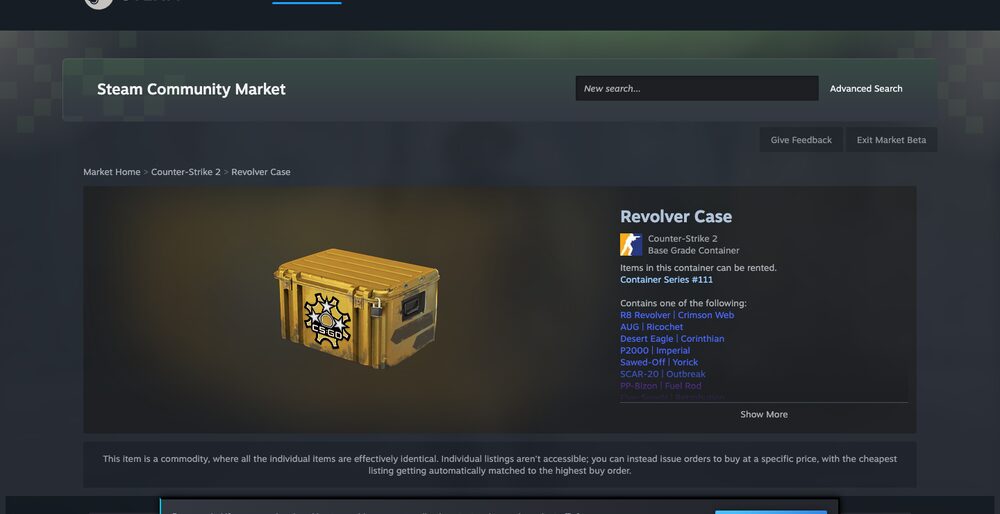
- Keys: the mint. Cases drop free while playing, but opening one requires a $2.50 key purchased from Valve, non-tradable and consumed on use. Per third-party trackers, players opened roughly 400 million cases in 2025 — approaching a billion dollars of gross key revenue, at near-total margin. Keys are how new supply enters the world, and Valve charges admission at the door.
- The marketplace cut: the toll. Every Steam Community Market sale carries a combined fee of roughly 15% — a 5% Steam fee plus a 10% CS2 game fee. Per third-party analyses this netted Valve on the order of $166 million in 2025. Crucially, the toll is direction-agnostic: it collects in euphoria and in capitulation alike.
- The wallet lock: the moat. Proceeds from Steam Market sales land in Steam wallet funds, which can be spent but never withdrawn. Steam wallet dollars are not dollars — they are store credit. A player who sells $500 of skins hasn't extracted value from Valve's ecosystem; they've pre-committed it to Valve's other products.
Third-party cash marketplaces exist precisely because of that third mechanism — the structural discount between Steam prices and cash prices is the price of the exit door. But even there, Valve sets the physics: trade holds, API rules, and item ownership terms all trace back to one company's policy decisions.
The flywheel
What makes the model compound rather than merely collect is the loop between playing and owning:
- Playing earns weekly drops, which gives every hour in-game a small lottery attached.
- Drops feed openings (key revenue) and listings (fee revenue).
- Owning skins raises the cost of leaving — an inventory worth four figures is a reason to keep playing CS2 rather than switch shooters.
- More play sustains the player counts that anchor demand for skins, which raises inventory values, which tightens the loop.
This is why skins are best understood as a retention system that happens to throw off a billion dollars, rather than a store bolted onto a game. The item you own is simultaneously Valve's product, your asset, and Valve's churn insurance. It also explains a puzzle that confuses newcomers: why Valve tolerates a secondary market at all when it could sell everything directly. Resale liquidity is what makes the items feel like property, and the feeling of property is what powers the flywheel. Kill the market and you kill the reason anyone pays $2.50 to open a case.
Ten years of consistent investment
A common bear argument is that Valve neglects Counter-Strike. The monetization record says otherwise. The table below is the release cadence of the economy itself:
| Instrument | Era | Role in the model |
|---|---|---|
| Weapon cases | 2013 → today, 40+ releases | The core mint; each release restarts the supply lifecycle |
| Operations & passes | 2013–2021, Armory since 2024 | Direct pass sales; episodic attention resets |
| Sticker capsules & Majors | 2014 → today, every Major | Event revenue, ~half shared with pro teams |
| Weapon collections | Ongoing | Non-case supply; feeds trade-up demand |
| Charms, name tags, storage | Ongoing | Small steady accessories revenue |
Ten-plus years without a skipped Major capsule cycle or a year without new items is not the behavior of a company that considers the economy a side effect. It is a product line with a roadmap — just one that's never announced, only shipped.
What the model predicts
Reading Valve's incentives beats reading Valve's silence, and the incentives make concrete predictions. Supply interventions will be managed for the long run, not the news cycle: the December 2025 rare drop pool removal, which quietly stopped 35+ old cases from dropping, is textbook issuer behavior — tightening float after a shock. Crashes will be tolerated but not allowed to become terminal, because the revenue engine runs on transaction flow and unboxing confidence. And policies that push trading fully off-Steam will stay rare, because the wallet lock is the moat.
None of this guarantees any particular price. Valve profits whether your inventory is up or down — that is the whole point of owning the toll booth. In a crash year when roughly 95% of tracked skins fell, per third-party data, Valve's flow-based income barely flinched. The model's one hard requirement is that people keep playing and keep transacting; everything else, including your cost basis, is your problem.
Our own read, stated with our bias disclosed: we build cs2stack, a free tool that auto-buys the cases and skins you target across DMarket and SkinBaron under hard price caps, because we think an economy this deliberately engineered — and this profitable for its operator — is one worth accumulating in patiently rather than trading on headlines.