Why Valve Won't Let the Skin Market Die
The 2026 crash cut the skin market roughly in half and filled every forum with the same question: what if Valve just lets it die? It's a fair fear about a company that never explains itself. It's also, on the evidence, the wrong one. This post lays out the incentive case — revenue, retention, and rails — for why the one party that could kill this market is the party with the least reason to.
Start with the money
Per third-party analyses of scraped Steam data — estimates the authors themselves describe as conservative — Valve made more than $1.16 billion from CS2 in 2025. The composition matters more than the headline. Roughly 400 million cases were opened during the year; at $2.50 a key, that's about $1 billion in gross key sales alone. On top of it sits an estimated $166 million in net profit from marketplace fees — Valve's ~15% cut of every Steam Market trade, skimmed from a market it built, hosts, and polices.
The usual caveats apply: Valve publishes no financials, so every figure here is reconstructed from public Steam data by outside analysts, and the true number could sit meaningfully higher — the methodology deliberately leaves out revenue it can't observe. But even taking the floor as the number, the scale is the point. CS2's item economy alone would rank among the largest gaming revenue lines in the world, from a single title, at almost no marginal cost.
Hold that number against the cost side. The skins already exist. The marketplace already runs. Workshop artists take a share of case revenue, servers cost what servers cost, and essentially everything else is margin. A business line that throws off a billion dollars a year at software margins, inside a private company with no shareholders demanding it diversify, does not get shut down. It gets managed.
Retention and the wallet lock
Revenue is the visible incentive. The structural one is retention. CS2 is a free game whose players have, collectively, billions of dollars of inventory value logged into it. Every weekly drop, every case sitting unopened, every knife someone is saving toward is a reason to launch the game again. Skins turn a 25-year-old shooter into something closer to a savings account you have to visit.
Valve has honored that loop even when it was expensive to. The 2023 engine transition carried every item forward — a 2014 inventory landed in CS2 untouched. That single decision, and the precedent it set, is why people treat pixels as property: Valve has behaved, for over a decade, as if they are.
The third pillar is the one traders grumble about and Valve profits from: Steam Wallet money is not money. Sell a skin on the Steam Market and the proceeds can never leave — they can only become other skins, other games, other Valve revenue. The skin economy is a closed loop that leaks inward. Even the panic selling of a crash generates fee revenue on the way down and traps the proceeds inside Steam on the way out. There is no version of this market, bull or bear, in which Valve isn't collecting.
Ten years of receipts
Incentives are an argument; behavior is evidence. Valve's revealed preference, across more than a decade, is continuous investment in the item economy:
- Cases — a new one nearly every year since 2013, each a fresh revenue instrument with a known, repeatable price lifecycle.
- Operations — paid passes bundling missions with exclusive drops, reliably reused whenever engagement needed a jolt.
- Sticker capsules and Majors — a twice-yearly monetization event that also funds the pro scene through revenue sharing.
- Collections — quiet supply drops that seed future grails.
- The Armory — 2024's pass system, which industrialized case distribution and showed Valve still designs new supply plumbing.
Companies neglect products by not shipping. Valve has shipped monetization infrastructure for the item economy in every single year of its existence. The lever set has only grown.
A price crash is not a revenue crash
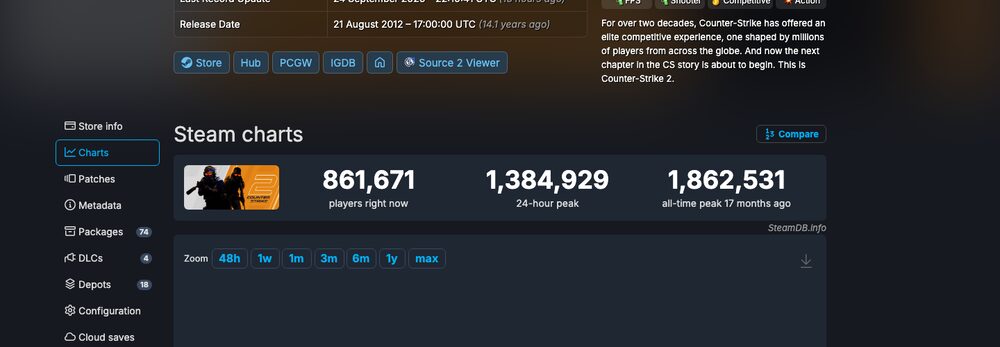
Here is the point most doom threads miss: Valve does not hold inventory. Per third-party trackers, the market's ~$14 billion peak roughly halved by mid-2026, with something like 95% of tracked skins down between March and August. That is a catastrophe for holders' paper value. It is not a catastrophe for Valve's income statement — Valve earns on flow, not on marks. Keys get bought when cases get opened; fees get paid when items change hands. Crashes, if anything, spike trading volume. And the demand engine under all of it — player counts — has stayed strong throughout, per public trackers.
| Metric | 2026 crash effect | Who feels it |
|---|---|---|
| Skin prices | Down ~50% from peak (per trackers) | Holders |
| Case openings / key sales | Continue with player activity | Valve — intact |
| Marketplace fee flow | Paid on every trade, up or down | Valve — intact |
| Player counts | Strong per public trackers | Both — intact |
There's even a case that downturns feed the machine. Cheaper cases lower the cost of a gamble, and every opening still requires a full-price key; per third-party data, opening volumes held up through the drawdown. The people hurt by a crash are the ones marking inventories to market. Valve doesn't have an inventory. It has a toll booth.
Meanwhile, the "Valve has abandoned the market" narrative has to explain awkward facts. On December 17, 2025, per dataminers, Valve zeroed the rare drop pool, pulling 35+ old cases out of regular circulation — a structural supply squeeze on exactly the assets long-term holders own. Armory iterations kept coming through 2026. A company letting a market die does not keep adjusting its supply valves; it stops touching them. Silence plus structural patches has been Valve's response to every crash on record, and it's what 2026 looks like too.
The honest counter-arguments
The case isn't airtight, and pretending otherwise would make it weaker. Three objections deserve real weight. Regulation: gambling-adjacent mechanics draw genuine scrutiny in several jurisdictions, and a forced redesign of cases is the scenario Valve's incentives can't simply outvote — it's a big enough topic that we treat it separately. Neglect: Valve moves at Valve speed. Operation droughts have run years; a market can bleed a long time while Valve says nothing, and "won't let it die" is not "will rescue your entry price." Concentration: everything here depends on one private company that owes traders nothing, contractually or otherwise. The TF2 economy — older, smaller, still running after two decades of minimal attention — cuts both ways: proof Valve doesn't kill economies, and proof it will let one coast.
But notice what each objection concedes. None of them describes an incentive for Valve to end the CS2 economy. They describe risks of interference, slowness, and dependency — reasons to size positions carefully, not reasons to expect the platform to burn down its own billion-dollar loop.
What this means if you're holding
The rational read is narrow but real: the market's existence is well-protected; your prices are not. Valve will keep the machine running because the machine pays; it will not run it for your benefit, on your timeline, or with any warning. That argues for strategies that don't require predicting Valve — position sizes that survive patch-day repricings, and accumulation paced through the cycle rather than timed against it. It's the thesis we run our own money on: the founder of cs2stack, the free buying tool we build, has kept buying through the crash on a public ledger, on the bet that the operator of a billion-dollar loop keeps the loop alive. Whether that bet fits your risk tolerance is a separate question — but "Valve rug-pulls its own casino" should sit at the bottom of your worry list, not the top. The market that halved in 2026 is the same market Valve spent 2026 quietly re-plumbing. Watch the hands, not the silence.