How Much Money Valve Makes From CS2
CS2 is a free game attached to one of the most profitable monetization machines in entertainment. Per third-party analyses of scraped Steam data, Valve's CS2 revenue cleared $1.16 billion in 2025 — from keys, fees, and a marketplace it owns end to end. This post itemizes where that money comes from, how the estimates are built, and why the machine kept printing straight through a historic market crash.
The headline number: $1.16 billion in 2025
Valve is a private company. It publishes no earnings, breaks out no segments, and answers no analyst calls. Every figure in this post is therefore an estimate — but an estimate built on unusually good raw material. Because Steam exposes market listings, case-opening odds are published, and every unboxing leaves a public trail in inventories and price feeds, third-party analysts can scrape their way to a revenue picture most private companies could never leak.
The most-cited analysis of 2025 puts Valve's CS2 income above $1.16 billion for the year. Its authors describe the methodology as conservative: it counts only what can be observed or bounded from scraped Steam data, and where a range exists it takes the low end. The real number is plausibly higher. Even at face value, one free-to-play shooter out-earned most publicly listed game publishers' entire portfolios.
Treat the precision accordingly. Scraping catches what happens on Steam's rails — market listings, inventory changes, unboxing traces — and misses what happens off them, such as Valve's share of activity routed through regional storefronts. Nothing about the method inflates the total; most of its blind spots point the other way. When a conservative floor already reads $1.16 billion, the interesting question stops being "how much" and becomes "from where."
Two streams do almost all of the work.
Stream one: keys — roughly a billion dollars of them
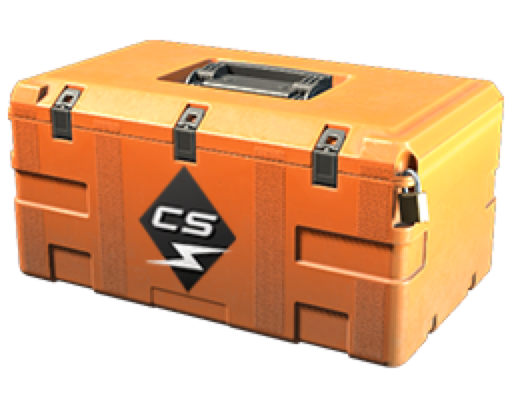
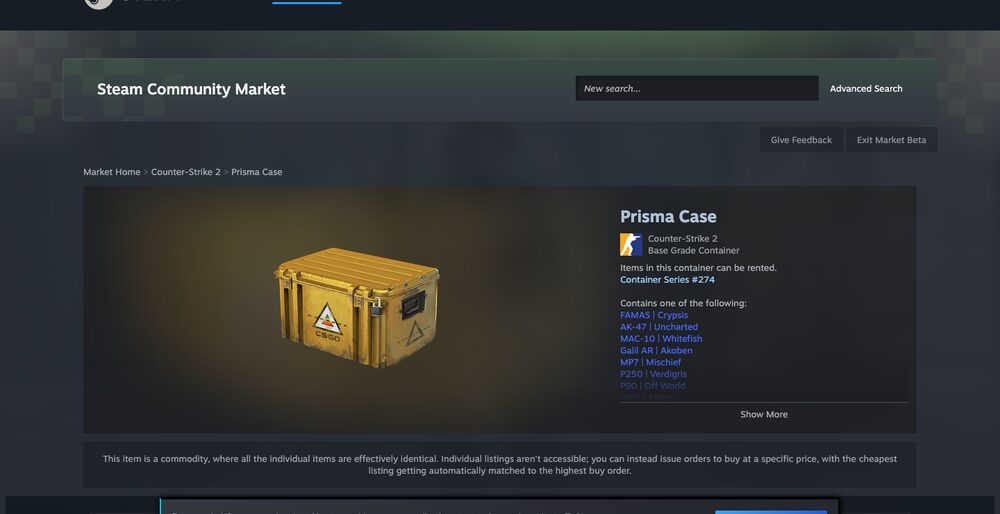
Every case that drops in CS2 is worthless until someone pays Valve $2.50 for a key to open it. Keys are bought from Valve directly, cannot be traded or resold since the 2019 key ban, and are consumed on use. That makes key sales the cleanest revenue line in the business: pure margin on a digital SKU with effectively zero marginal cost.
Per third-party trackers that count unboxings from public data, players opened roughly 400 million cases in 2025. At $2.50 per key, that is approximately $1 billion in gross key sales in a single year. A slice flows onward — community artists whose finishes appear in a case receive a revenue share, and some have become genuinely wealthy from it — but the engine belongs to Valve.
Worth pausing on: 400 million openings happened in a year when the expected value of opening a case was, as always, brutally negative. The unboxing demand that torches player money is the same demand that makes sealed cases an asset — every case opened is one permanently removed from supply.
Stream two: the marketplace toll booth
The second stream is quieter but structurally more interesting. Every Steam Community Market sale carries a roughly 15% combined fee — a 5% Steam transaction fee plus a 10% CS2 game fee. Valve is not a broker competing on fees; it owns the venue, sets the toll, and collects on both the panic-selling and the euphoria.
Per the same analyses, marketplace fees netted Valve an estimated $166 million in profit in 2025. And because the proceeds land in Steam wallet funds that can never be withdrawn, even the seller's 85% stays inside Valve's ecosystem, waiting to be spent on games, keys, or more skins.
The elegance, from a business standpoint: fee revenue is direction-agnostic. Bull market, bear market, crash — volume is what matters, and crashes produce volume.
The full menu, itemized
Keys and fees are the recurring engine, but Valve has spent over a decade layering monetization on top of Counter-Strike. The table summarizes the streams as third-party analyses frame them:
| Stream | Mechanism | Scale (per third-party estimates) |
|---|---|---|
| Case keys | $2.50 per opening, non-tradable, consumed on use | ~$1B gross in 2025 (~400M openings) |
| Market fees | ~15% of every Steam Market sale | ~$166M net profit in 2025 |
| Operations & passes | Paid battle passes; Armory passes since 2024 | Episodic, historically significant per event |
| Sticker capsules & Majors | Capsule sales during events, ~50% shared with teams | Hundreds of millions gross per Major cycle at peak |
| Collections & misc. | New skin collections, charms, name tags, storage units | Smaller, steady |
Operations deserve a line of their own: for ten years they have been Valve's proven lever for converting attention into direct pass revenue, and their absence since 2021 is one reason drought-era speculation runs so hot. Major sticker sales, meanwhile, fund a large share of professional Counter-Strike — teams and players receive roughly half the community-item revenue, which means even Valve's esports subsidy is self-funding.
Flow, not market cap: why the crash didn't touch Valve
Here is the distinction most crash commentary misses. The skin market's total value — which peaked around $14 billion per third-party trackers and roughly halved by mid-2026 — is not Valve's money. It is the paper wealth of holders. Valve's revenue is flow: keys bought, fees skimmed, passes sold. The stock crashed; the toll booth kept collecting.
Consider what actually happened during the 2026 downturn, in which roughly 95% of tracked skins fell between March and August:
- Player counts held. Public trackers showed CS2 concurrents staying strong through the crash. The demand engine under everything — people playing the game — never blinked.
- Panic selling paid fees. Every capitulation sale on the Steam Market handed Valve its ~15%. High-volatility months are high-revenue months for the house.
- Openings continued. Cheaper cases lower the cost of a gambling ticket; unboxing demand is remarkably crash-resistant.
- The supply causes were Valve's own levers. The Armory's industrialized case supply and a mid-May 2026 update sit high on the list of crash causes per trackers — both of them monetized on the way in.
This is not an accusation of malice; it is a description of structure. Valve earns on issuance, on destruction, and on every transfer in between. It is the only participant in this economy with no price risk. Holders who model Valve as a fellow investor — hurt by drawdowns, cheered by rallies — consistently misread the patch notes. Model it as the exchange, the mint, and the tax authority rolled into one, and the last decade of decisions gets a lot less mysterious.
What a billion dollars of incentive buys holders
The reason the revenue number matters to anyone holding skins is what it implies about behavior. A business line producing north of a billion dollars a year, at software margins, inside a private company with no shareholders to appease, does not get abandoned — it gets managed. Valve never says this; Valve never says anything. But the patch record reads like active stewardship: the December 2025 rare drop pool removal quietly pulled 35+ old cases from circulation two months after the October trade-up shock wiped an estimated $1.75 billion in paper value. Whether that stewardship extends to rescuing the current bear market is its own question — but betting that Valve is indifferent to the health of a billion-dollar engine has been a losing trade for ten years running.
For what it's worth, that incentive logic is why we build cs2stack the way we do — our tool (free, disclosed bias: we like this market) watches DMarket and SkinBaron and auto-buys the items you target under hard caps, and its founder has kept buying through the crash on a public ledger, precisely on the thesis that the house has every reason to keep the casino open.
The itemized answer, then: about a billion in keys, nine figures in fees, episodic nine-figure event revenue — all from a game that costs nothing to install. Understanding that machine is the closest thing this market has to reading the central bank's balance sheet.