
The Rare Drop Pool Removal: Valve's Quiet Supply Squeeze
On December 17, 2025, per dataminers digging through game files, Valve set the rare drop pool's weight to zero. No blog post, no patch-note bullet, no acknowledgment of any kind. Just a config value flipped — and with it, 35 or more old cases stopped entering the economy through weekly drops. It may be the most consequential supply change of the CS2 era, and almost nobody read it.
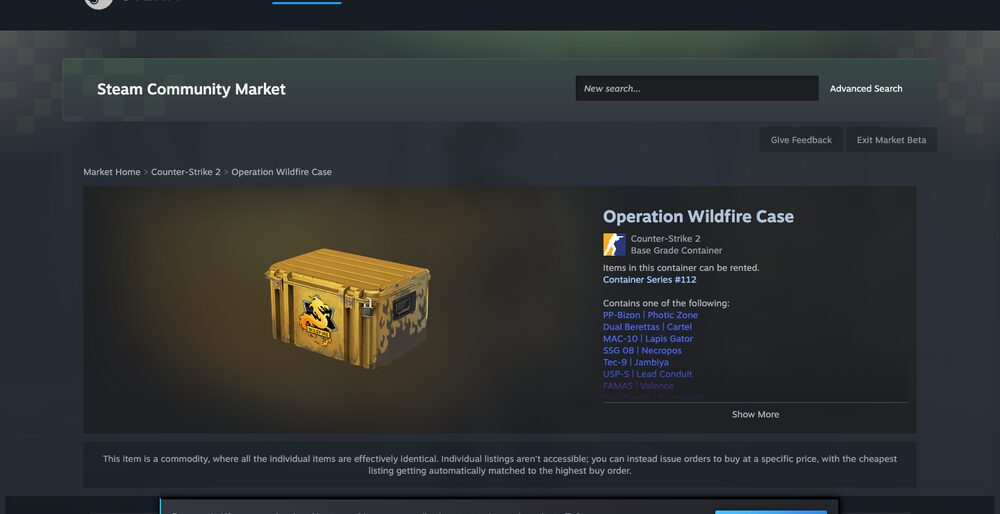
What the rare drop pool actually was
Every week, active CS2 players earn item drops, and cases make up a large share of them. Those cases don't come from one bucket. The active drop pool contains recent cases, dropping at full rate. Older cases graduate into the rare drop pool: still dropping, but at a small fraction of the active rate. The mechanic mattered because it kept a trickle of new supply flowing into cases that had long since left the front page — a slow, permanent dilution of every "discontinued" case in the game.
That trickle was the asterisk on every case-investing thesis. A case in the rare pool wasn't truly discontinued; it was on a slow drip. The distinction is central to why case supply shrinks structurally: cases are destroyed forever when opened, so the price question is always the race between the burn rate and whatever inflow still exists. The rare drop pool was that inflow.
What changed on December 17, 2025
Per dataminers — Valve itself has never said a word about it — the update shipped with the rare drop pool's weighting set to zero. In practice:
- 35+ older cases stopped dropping through the weekly reward system entirely.
- Inflow for those cases went from "small" to "none". Their supply is now strictly shrinking: every opening is a permanent burn with no replacement.
- The active pool kept working. Recent cases still drop; the change only severed the tail.
- Nothing was announced. The community found out because people diff game files for a living.
The supply flip, side by side:
| Before Dec 17, 2025 | After | |
|---|---|---|
| Old-case inflow | Reduced-rate weekly drops | Zero |
| Old-case outflow | Openings (permanent burn) | Openings (permanent burn) |
| Net supply | Slowly diluting | Strictly shrinking |
| "Discontinued" status | Nominal — still dripping | Real — hard-capped float |
For the affected cases, this is the same economic event that made Operation Bravo cases and their peers the blue chips of the market: a hard cap on supply while demand from unboxing continues every day. Except this time it happened to three dozen cases at once, silently.

The timing is the tell
Context matters here. In October 2025, a trade-up rule change had just wiped roughly $1.75 billion in paper value from the market in days, per third-party trackers — one of the sharpest repricings in the market's history. Weeks later, Valve zeroes the rare drop pool: a change whose only first-order effect is to make old cases scarcer and, over time, more valuable.
Read as an isolated event, it's a config tweak. Read in sequence, it looks like the pattern Valve has followed after every crash: never comment, then ship a structural change that quietly supports the side of the market that just got hurt. Valve doesn't do investor relations. It does patch notes — and sometimes not even those. As we've argued in our piece on reading Valve's silence, the config files are the closest thing this market has to central-bank minutes.
We should be honest about the epistemics: nobody outside Valve knows the intent. Maybe it's economy management; maybe it's groundwork for re-releasing old cases through some future paid channel, the way the Armory already gates certain cases behind credits. Both readings have precedent. What's not in dispute is the mechanical effect — inflow to 35+ cases stopped.
What it means for the affected cases
The playbook for hard-discontinued cases is well documented in a decade of price history: once drops stop, the burn from openings grinds supply down year after year, and prices tend to follow — not smoothly, but structurally. The rare-pool cases now join that cohort. A few caveats keep this from being a simple buy signal:
- The effect is slow. Supply squeezes play out over years, not weeks. The market's first reaction to the datamine was a speculative pop, much of which faded into the broader 2026 downturn.
- Valve can flip it back. A zeroed weight is one patch away from being un-zeroed. Single-publisher risk never sleeps.
- The macro swamped the micro. The 2026 crash — roughly a halving of the market from its ~$14B peak, per trackers — dragged even supply-squeezed cases down with everything else. Scarcity is a tailwind, not an exemption.
The bigger picture: a lever, pulled deliberately
The rare drop pool removal is best understood as one control on a large dashboard. Valve decides what drops, how often, to whom, and what can be traded — every supply lever in this economy runs through one company. What makes December 17 notable is not the size of the immediate price move but what it demonstrates: Valve monitors this market and adjusts its plumbing in response to conditions, while saying nothing. For holders, that cuts both ways. The same hand that capped 35 cases' supply loosened the trade-up rules two months earlier.
For accumulators, the practical takeaway is unglamorous: changes like this reward people who were already positioned, slowly, rather than people who chase the headline. That's the posture we build for — our tool, cs2stack, is a free bot that watches DMarket and SkinBaron and auto-buys the cases you target under hard price caps, and its founder has kept his own ledger buying publicly through the crash. Structural scarcity plus patient accumulation is the whole thesis; December 17 just made the scarcity part more literal.
The patch nobody read
Most market-moving CS2 updates announce themselves — a new case, a Major, a mechanic change with a patch note. This one didn't, and that's precisely why it's worth studying. The market's biggest counterparty edits the money supply in config files, and the only disclosure regime is dataminers with diff tools. If you hold cases, the December 17 change is quietly one of the most bullish things Valve has ever done for the old tail of the market. If you needed a reminder of who actually runs this economy, it's that too.