
Case Prices in the Crash: Squeezed From Both Sides
Every other segment of the 2026 crash has one story. Cases have two, and they point in opposite directions: new supply flooding the active end of the market while the December 2025 Rare Drop Pool zeroing choked off the flow of old cases forever. That collision makes cases the most analytically interesting corner of the entire drawdown — and the one where holders' fortunes diverged most.
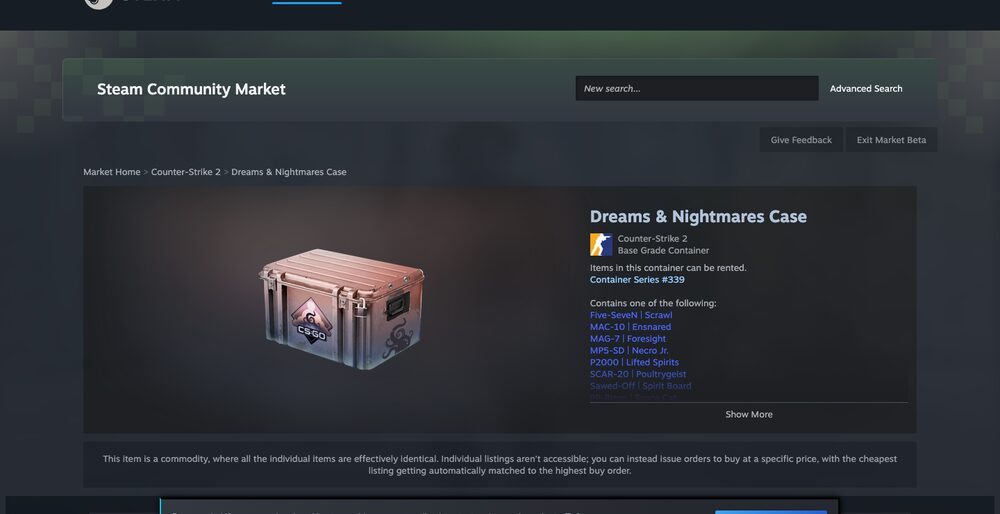
One label, two opposite assets
"Cases" always hid two different instruments. Active cases drop constantly and behave like a commodity with a production line. Discontinued cases stopped being produced and behave like collectibles on a slow burn — the deflationary machine described in our case-supply piece: opened cases are destroyed forever while new supply trickles or stops.
The 2026 crash didn't just test both models — it rewrote both in the same six months, against a backdrop where third-party trackers had the overall market roughly halving from its ~$14 billion peak and some 95% of tracked skins falling. The full market context is in the damage report.
Side one: the supply flood hits actives
The bearish side of the squeeze targeted active cases. The Armory system had already changed how items enter circulation, adding a redemption path alongside classic drops. Then the mid-May 2026 update adjusted drop rates and introduced new case supply — and trackers mark that update as the moment a drifting market became a declining one.
For active cases the mechanism is textbook: more supply per player-hour meets unboxing demand that grows slower than the flood, and prices sag. It's worth stressing that unboxing demand did not collapse — by public estimates Valve's 2025 CS2 item revenue exceeded $1.16 billion, on the order of 400 million cases opened at $2.50 a key plus roughly $166 million in market fees. The burn rate stayed enormous; the mint rate simply outran the narrative that case supply only ever shrinks.

Side two: the Rare Drop Pool goes to zero
The bullish side arrived earlier, on December 17, 2025, when Valve zeroed the Rare Drop Pool — removing 35+ older cases from circulation entirely. Cases that had trickled into inventories for years as rare drops now enter the world at a rate of exactly zero. Every one opened from here is a permanent, unreplaced burn.
For those 35+ cases, the supply story flipped from "slowly deflationary" to "strictly capped" overnight. In a bull market this would have been rocket fuel. Landing weeks before a confidence crisis, it produced something stranger: structurally scarcer assets falling anyway, because in a panic, holders sell what has a bid — the dynamic dissected in panic-selling psychology. Scarcity arguments don't pay out on the schedule you'd like; they pay out when buyers return.
There's a precedent for this shape of event. When Valve made keys untradable in 2019, the surviving tradable keys became a fixed-supply collectible class overnight — and their repricing upward took time to play out, not hours. The RDP zeroing is a gentler cousin: it didn't freeze anyone's assets, it froze the faucet. If the 2019 pattern rhymes, the market will spend months treating the zeroed cases as ordinary crash casualties before their supply status gets priced as a feature.
How the two sides netted out
| Case type | Supply in 2026 | Crash behavior (per trackers) | Structural story |
|---|---|---|---|
| New / active cases | Flowing — drops + Armory | Soft; supply-pressured | Commodity with a production line |
| Recently discontinued | Frozen since RDP zeroing | Fell with the market despite scarcity | Newly capped; thesis intact, mood broken |
| Vintage / rare cases | Long frozen, ultra thin | Thin trading; marked prices lag | Collectible tier; see the survivor traits in crash survivors |
The honest summary: in the short run, sentiment beat structure everywhere. Cases with permanently frozen supply still fell, because crashes price fear, not float. But the two sides of the squeeze set up very different recoveries — the actives need demand to outgrow an open production line, while the RDP-zeroed cases need only for burning to continue against a fixed stock.
What it means for stackers
If you accumulate cases as a strategy, 2026 delivered three lessons worth writing down:
- Know which asset you own. An active case and an RDP-zeroed case are now different instruments with different theses. Sorting your stack by supply status matters more than sorting by price.
- Supply policy is one patch note away. December's zeroing helped old cases and May's update hurt actives — both were single decisions by Valve. Position sizing against policy risk is the core of the holder's playbook.
- Crashes are when accumulation math works best — if it's rule-bound. Buying scarce cases into fear, at capped prices, on a schedule, is the whole argument of DCA through corrections; buying on vibes at any price is how stackers become bagholders. A structured version of the entry side lives in the dip-buying framework.
Cases went into this crash as the market's index-fund story and came out as its clearest natural experiment: the same six months, two supply regimes, one panic. Whichever way the recovery breaks, the split between minted and frozen supply is now the first question to ask about any case you're offered — and the second question, as always, is what you're paying relative to the day's actual lowest listing, not last month's chart.