
Buying Through a Skin Market Correction (Without Flinching)
Every DCA plan sounds great in the spreadsheet. Then the market drops 25%, your stack is red, the subreddit is a funeral, and tomorrow morning your schedule says: buy more. This post is about that morning — the arithmetic that says the buy is right, and the machinery that makes it happen anyway.
What a correction does to a schedule
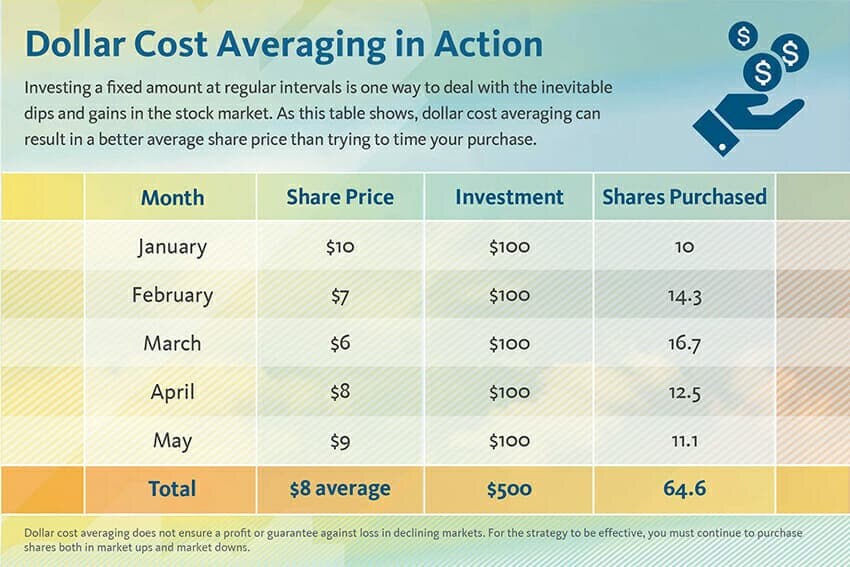
Start with the mechanics, because they're genuinely counterintuitive. A fixed dollar budget buys more units as prices fall — not "feels like more," arithmetically more. Here's a deliberately simplified, illustrative correction: a case you're buying with $10 a week slides from $1.00 to $0.75 and recovers only partway, to $0.90.
| Week | Price | $10 buys | Cases held | Average cost |
|---|---|---|---|---|
| 1 | $1.00 | 10.0 | 10.0 | $1.000 |
| 2 | $0.85 | 11.8 | 21.8 | $0.919 |
| 3 | $0.75 | 13.3 | 35.1 | $0.855 |
| 4 | $0.80 | 12.5 | 47.6 | $0.840 |
| 5 | $0.90 | 11.1 | 58.7 | $0.851 |
Illustrative numbers, but the shape is the whole lesson. The price never returned to $1.00 — and the position is still up, because the average cost fell to about $0.85 while the heavy buying happened at the bottom. The weeks that felt worst (3 and 4) did the most work. Meanwhile the buyer who "waited for clarity" and resumed at $0.90 owns fewer cases at a higher average. The general principle — your average price is the whole game — gets its full treatment in entry smoothing.
The asymmetry nobody feels
There's a second piece of arithmetic working for the through-the-dip buyer: drawdown math is asymmetric. A price that falls 25% needs +33% to get back; a fall of 50% needs +100%. That asymmetry is brutal for a lump-sum holder — but it flips sign for an accumulator, because every dollar deployed below your old average shortens the recovery distance your position needs, even while the price still has the full climb ahead. The gory details live in drawdown math. Corrections are when accumulation is mathematically most productive; that's not a pep talk, it's division.
Why humans still skip the buy
If the math is this clear, why does manual DCA die in drawdowns? Because the information environment is screaming the opposite. Skin market corrections come with a story attached — a patch note, a ban wave rumor, a "market is dead" thread — and stories are more vivid than arithmetic. The flinch has three standard forms:
- Pausing "until it stabilizes." Stabilization is only visible in hindsight; in practice this means resuming after the recovery, converting the correction from a discount into a missed window.
- Waiting for the exact bottom. Upgrading a schedule into a timing strategy — the thing DCA exists to avoid. Nobody rings a bell at the bottom of a case market either.
- Capitulating. Selling the stack into the hole, realizing the drawdown, and paying the fee stack for the privilege. The historical record of this market's crashes is substantially a record of this move.
Note that all three failures are decisions. The schedule never fails on its own — it fails when a human overrides it. Which suggests the fix.
The bot doesn't read Twitter
Automation's most underrated property isn't speed or convenience — it's that software has no amygdala. An automated schedule executes the week-3 buy with exactly the enthusiasm of the week-1 buy: none. It doesn't know there's a correction. It knows your budget, your item list, your price caps, and today's cheapest venue, and it acts on precisely that list. The founder of this site runs his own plan this way — $20/day, executed automatically, every fill in a public ledger — specifically so that the person who reads the news and the process that does the buying are no longer the same entity. That separation is the actual product of automation in a drawdown; we've called it FOMO insurance, and it works in both directions — it also stops the euphoric overbuying at tops.
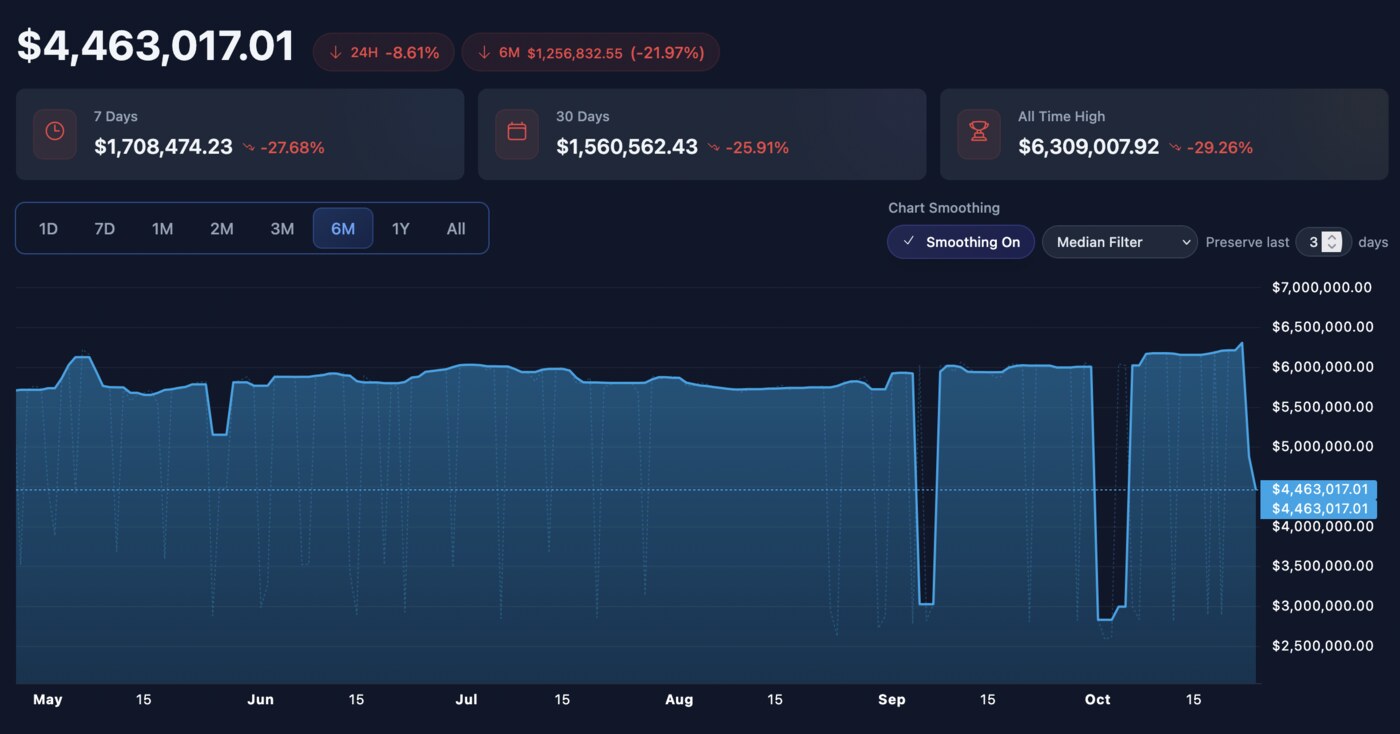
One honest caveat: automation executes your plan; it doesn't validate it. If the correction is actually a structural break — an item whose demand driver was genuinely removed — buying more is throwing money at a mistake. The distinction between a drawdown and a death, and the pre-written conditions under which you halt a line, is covered in when to stop buying a case. Write those conditions on a calm day too. The rule isn't "never stop"; it's "never stop because of a red candle and a scary thread."
A correction checklist, written in advance
Practical version, one calm evening's work. Confirm your budget is money that can stay invested through a full cycle — resizing mid-drawdown means the sizing was wrong, per the entertainment-money rule. Write down what would actually invalidate each item you're buying (not a price level — a reason). Pre-commit your schedule mechanically, ideally in software with caps. And decide now that portfolio checks happen weekly at most during corrections; the position doesn't need your supervision, and you don't need the cortisol. Deeper drawdowns get the fuller playbook in bear markets are for stackers.
The correction will come. It always comes. This market has never gone more than a couple of years without one, and the next patch note is always unannounced. The only question a stacker actually controls is whether their average cost is set by their plan — or by their flinch. Buyers who solve that question once, mechanically, stop needing to be brave; the schedule is brave for them, one unremarkable morning at a time.