
Entry Smoothing: Why Your Average Price Is the Whole Game
A stock has earnings. A bond has coupons. A CS2 case has a shrinking supply and a crowd of unboxers — and no formula that tells you what it's "worth" today. When you can't value an asset, the only number you fully control is the price you paid. Entry smoothing is the discipline of making that number good.
No fundamentals, no anchor
Traditional valuation works by comparing price to something the asset produces: cash flows, dividends, rent. Cases produce nothing. Their value comes entirely from what future buyers — mostly unboxers chasing the knife pool — will pay later. You can reason about supply and demand direction, and serious people do (here's the closest thing to a valuation method this market has), but nobody can tell you whether a given case is 20% overpriced this week. There is no fair-value line to buy below.
That has a liberating consequence. Since you can't out-analyze the market on value, your edge has to come from somewhere else. For a long-term accumulator, it comes from two places: holding through fee-free time (no churn, no 15% marketplace haircuts), and entering at a sane average price. The second one is entry smoothing.
What smoothing actually does
Buy your whole position in one afternoon and your cost basis is one draw from a volatile distribution — you get whatever price that afternoon happened to offer. Buy the same position in small pieces across 90 days and your cost basis converges toward the typical price of that whole period. Statistically, you're swapping a single random sample for something close to the median. You'll never buy the bottom this way. You are also structurally protected from buying everything at the top.
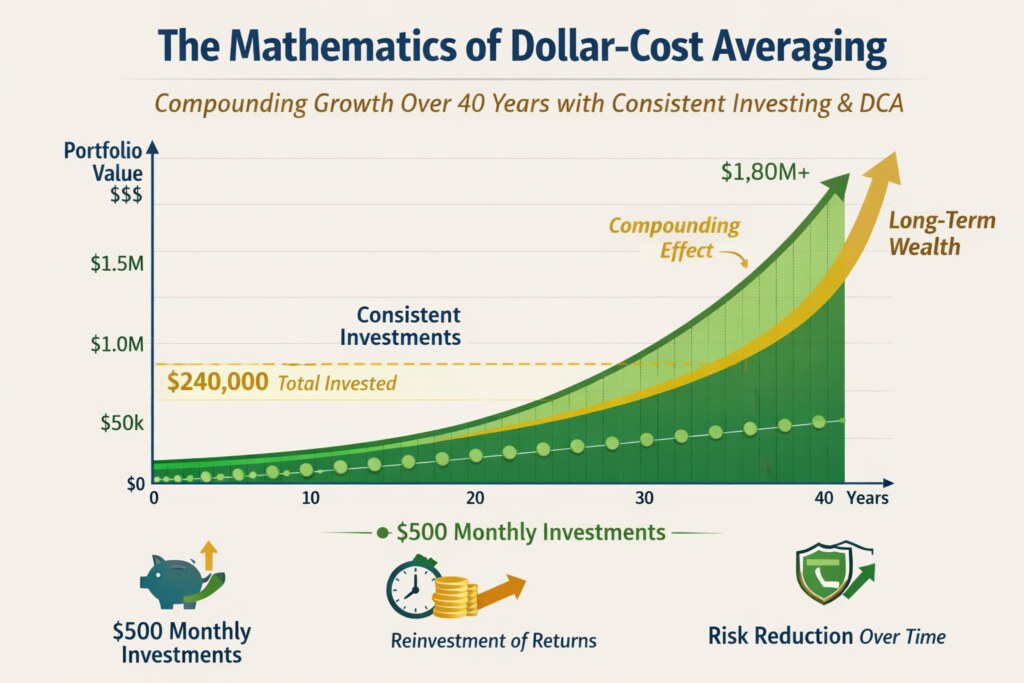
There's a subtle bonus baked in when you fix the budget rather than the quantity: spending, say, a fixed $10 per day buys more units when the case is cheap and fewer when it's expensive. Your average cost per unit ends up slightly below the average market price over the period — a small mechanical tilt in your favor that requires zero forecasting. This is the engine inside dollar-cost averaging; smoothing is the reason it works.

An illustrative example — numbers invented for arithmetic, not a price prediction. Suppose a case trades at $1.00, dips to $0.70 after an ugly update month, and recovers to $1.10 over a quarter. A lump-sum buyer who entered on a strong-looking day near $1.05 needs a 5% rise just to break even. A daily buyer spending the same total caught the $0.70s and $0.80s on the way down and sits near a $0.90 average — comfortably green at $1.10, and they never had to guess when the dip would end. The dip helped them. That inversion — volatility as friend rather than enemy — is the entire psychological payoff, and it's what makes buying through corrections tolerable for normal humans.
Your average price is also your sell discipline
A clean cost basis does double duty at the exit. "Sell a tranche at 2x my average" is an executable rule; "sell when it feels toppy" is not. Every exit framework worth using is expressed as a multiple of your entry, which means a sloppy or unknown average price quietly breaks your selling plan too. This is why tracking cost basis isn't accounting trivia — it's the number that decides whether you're actually up, and the reference point for every future decision. If your buys live in your memory instead of a ledger, you don't have a cost basis; you have a feeling.
What breaks smoothing in practice
- Skipping scared days. The days that most improve your average are red ones, and those are precisely the days manual buyers skip. A schedule you only follow when it's comfortable isn't a schedule.
- Doubling up on exciting days. FOMO buys after a green week do the opposite of smoothing — they concentrate your entries at local highs. Automation is decent FOMO insurance because the bot's sizing doesn't read Twitter.
- Cadence drift. Daily becomes "most days" becomes weekly-ish. Any consistent cadence smooths (daily vs weekly vs monthly is mostly a convenience choice); an inconsistent one re-introduces the timing luck you were trying to remove.
- No price ceiling. Smoothing averages your entries, but it shouldn't mean buying at literally any ask. A max-price line per item keeps one manipulated or illiquid spike from polluting the average.
Notice the pattern: every failure mode is behavioral, not mathematical. The formula never breaks; the human running it does. That's the honest case for handing the execution to software — not because a bot buys smarter, but because it buys every day, at the ceiling you set, with each fill written down. This site's founder runs exactly that in public at $20/day, and the ledger — not vibes — is what his average price is built from.
The one-line takeaway
You can't control what a case will be worth in 2028. You can completely control the average price you accumulate it at between now and then. In a market with no fundamentals, that average is your strategy — everything else is commentary. Whether lump-summing part of it ever makes sense is a real question with a real answer, covered in lump sum vs DCA.