
GamerPay Review (2026): the Trust-First Marketplace
Most skin marketplaces compete on price and treat safety as a footer link. GamerPay, a Danish venue built by people from the Nordic payments world, inverted that: identity verification and fraud prevention are the product. That pitch still deserves a fair hearing — but the review now opens with something more urgent. As of late September 2026, a banner on gamerpay.gg announces that the marketplace will be shutting down on May 29 (the year isn't stated). The site still displays listings and appears operational, which changes how you should use it — starting with: don't deposit money you plan to leave there.
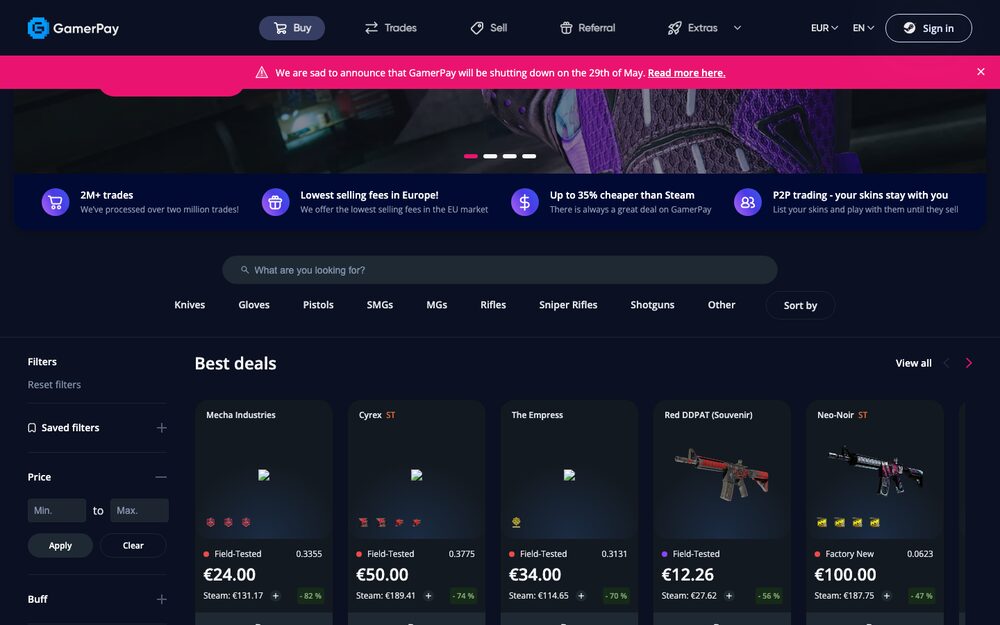
Before you deposit: the shutdown announcement
Per a banner displayed on gamerpay.gg in late September 2026: "We are sad to announce that GamerPay will be shutting down on the 29th of May." The banner doesn't state a year, and the marketplace continues to show listings and process trades today — so the honest reading is that GamerPay is operational but has publicly announced an end date. That combination has one practical consequence: treat it as a venue to wind down on, not to build on.
Concretely: don't accumulate a balance there — withdraw proceeds as soon as trades settle rather than letting money sit. Don't list long-tail items that may take months to sell on a platform with a countdown running. If you hold funds or active listings now, plan an orderly exit well before any plausible deadline rather than joining the rush at the end; wind-downs are usually honored, but queues, support load, and payout friction all get worse as the date approaches. And route new activity to venues without an expiry date — Skinport and DMarket cover the P2P and custody models respectively, and our 2026 safety rankings map the rest of the field. Everything below stands as a fair review of what GamerPay built; read it with the banner in mind.
The model: verified humans on both sides of the trade
GamerPay is a peer-to-peer marketplace at its core — sellers list items from their own inventories and delivery runs over Steam trades, with the platform escrowing payment until the item arrives. The differentiator is who's allowed to trade: the venue leans hard on identity verification, drawing on the Nordic bank-grade ID culture its founders came from, so the counterparty on the other side of your trade is far more likely to be a verified, accountable human than an anonymous throwaway account. In a market where the standard scam catalog relies on anonymity, that design choice removes a whole class of attacks rather than patching them one by one.
Strengths
Trust is the obvious one, and it's real rather than cosmetic: verified counterparties, escrowed payments, and a compliance-forward posture that reads more like a fintech than a skin site. For a first-time buyer nervous about the space — the audience our safe-buying guide is written for — GamerPay is one of the least intimidating venues to start on.
Second, European payment rails: cards and the common EU methods, with payouts oriented toward European accounts. Third, seller economics — commission positioned aggressively low, and sellers who value a low-fraud environment (chargebacks are the quiet killer of P2P selling) genuinely get something for it. Fourth, the catalog skews toward real players' inventories rather than bot-farmed stock.
Weaknesses
Liquidity is the honest weakness. GamerPay's books are thinner than the majors': fewer listings per item, wider gaps between the cheapest and second-cheapest listing, and slower fills for sellers of anything unusual. If you're hunting a specific float or pattern, you'll often simply not find it here. Prices reflect the trust premium too — not dramatically, but the deepest discounts in the market tend to live on venues with looser vetting, which is not a coincidence.
The track-record caveat applies in its milder form: GamerPay is EU-based and publicly identifiable, but its volume history is shorter and its Western coverage thinner than DMarket's or Skinport's. The standard advice stands — start with small transactions, verify a payout early, and run the red-flags checklist plus our 2026 safety rankings before scaling, even on a venue whose whole pitch is safety.
The context that makes the pitch credible
Trust-first positioning is easy to claim and expensive to build, so provenance matters. GamerPay comes out of the Nordic payments world — the culture that normalized MobilePay-style instant transfers and bank-grade digital identity — and it shows in structural choices: verification gates before trading rather than before withdrawal, and dispute processes that assume both parties are identifiable. That's the difference between a safety pitch that's marketing and one that's architecture. The sad irony of the shutdown banner is that the architecture apparently wasn't the problem; the economics of a small venue in a fee war were.
Fees: hedged ranges
Per published schedules as of late 2026, GamerPay's seller commission has sat toward the low end of the field — low single digits percent in its standard tier, with variation by promotion and volume — but verify the live schedule before listing, because introductory fee positioning is exactly the kind of thing that changes once a venue matures. Buyers pay the sticker price plus payment-method costs. Context against every other venue is in our fee comparison.
Payments and KYC
Payments run over European rails: cards and common EU wallet methods in, bank-oriented payouts out. KYC is the point of the venue rather than an afterthought, so expect identity verification earlier and more thoroughly than elsewhere — a feature if you're cashing out real money, an annoyance if you wanted to stay anonymous. Where that sits versus other venues is mapped in our KYC comparison.
Who it's for
Historically, GamerPay fit three users well: the nervous first-timer wanting the least-scammable on-ramp; the EU seller cashing out an inventory who values verified buyers and bank payouts; and the casual trader happy to pay a small trust premium. The shutdown banner narrows that to one: the seller with an exit already in motion. New buyers and anyone building a position should start elsewhere — a closing venue is the wrong on-ramp however good its verification is. (Disclosure: cs2stack, the product behind this blog, automates purchases on DMarket and SkinBaron — custody venues — and compares the two on every buy.)
Verdict
The most credible safety-first venue the Western field produced — and, per the banner on its own site, one with an announced end date of May 29 (year unstated). The design lessons stand: verification-first architecture works, and other venues should copy it. But you don't open new positions on a marketplace that has told you it's closing. Use it only to wind down existing holdings, withdraw promptly, and take your ongoing trading to active venues from our safety rankings.
| Dimension | Assessment |
|---|---|
| Status | Operational, but site banner announces a May 29 shutdown (year unstated) |
| Model | P2P with escrow and heavy identity verification |
| Trust | Best-in-class posture; verification is the product |
| Prices | Fair, but deepest discounts live elsewhere |
| Liquidity | Thinner books than majors; likely to thin further as the date nears |
| Deposits | Avoid building a balance — withdraw as trades settle |
| KYC | Early and thorough, by design |
| Best for | Winding down existing holdings; new activity belongs on active venues |
GamerPay's exit is a reminder that in this market, longevity belongs to habits rather than platforms: individual venues shut down, but the practice of comparing prices across the marketplaces that remain keeps working through every churn cycle. Build your buying around a comparison layer that spans venues, and no shutdown banner can strand your strategy.