
Fake Discounts on CS2 Marketplaces: Reading '-40%' Correctly
Every skin marketplace paints discount badges on its listings, and every badge answers the same question: cheaper than what? The reference price behind that percentage is chosen by the venue — and venues are not neutral. A "-40%" against an inflated reference is a full-price sale wearing a costume. Learning to compute the real discount is the single highest-return skill in deal hunting.
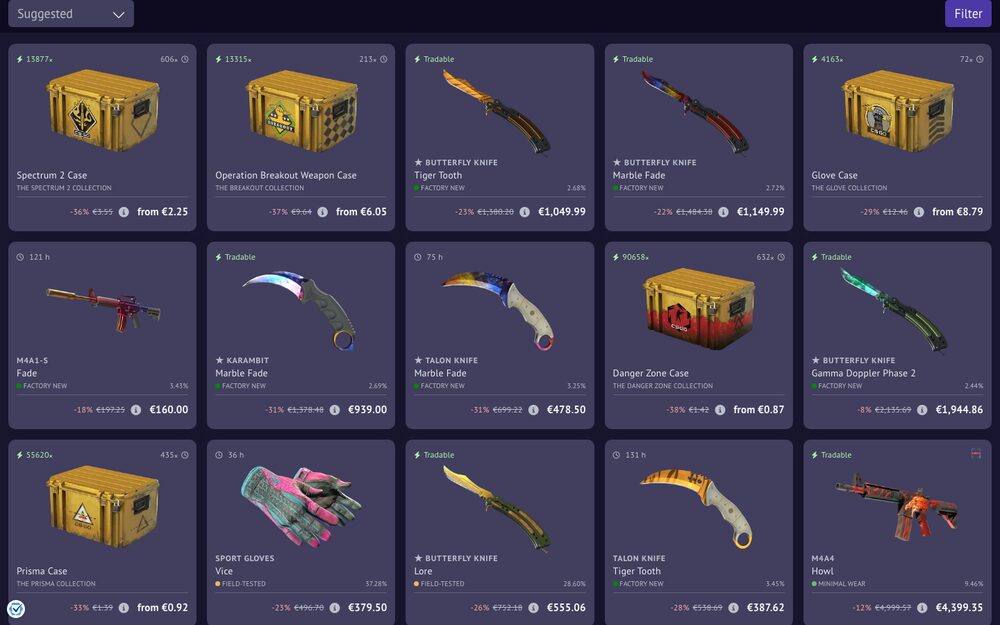
What a discount badge actually measures
A badge is arithmetic: listing price versus reference price. The listing price is real. The reference price is an editorial decision. Depending on the venue it might be a Steam Community Market figure (itself inflated by fee structure and wallet-money economics), a "suggested price" computed by the venue's own formula, a trailing average of past sales, or a third-party aggregator's number. None of these is wrong by definition — but none of them is "the market" either, and the venue commonly benefits when the reference reads high, because every listing looks like a bargain against it.
The tell is disagreement. The same skin routinely shows different "suggested prices" on different venues, sometimes far apart — the mechanics behind that are covered in why the same skin has five prices. If references were measurements, they'd converge. They're marketing surfaces, so they don't.
The standard reference-price games
- Steam as the anchor. Comparing a cash-market listing to Steam's price bakes in the structural gap between wallet funds and withdrawable money — commonly a very large one, as the cash-vs-wallet math shows. A cash listing "30% under Steam" can be exactly the going cash rate.
- Stale or thin references. For illiquid items, the reference may trace to a handful of old sales or a fantasy ask that never filled. The badge inherits the fiction.
- Wear-tier blending. Some references blur across floats; a high-float listing "under reference" may be dead-on for its actual condition.
- Defect-blind math. The badge doesn't know the item has ugly stickers scraped, a bad pattern, or trade-lock friction the price already reflects.
None of this requires bad faith to hurt you. Even honest references lag; after a sharp market move, every badge on the site is measuring against yesterday. And the incentive gradient is one-directional: a venue that quietly nudges its reference formula upward makes every seller's listing look more attractive and every buyer's purchase feel like a win, at no cost to anyone who doesn't check. Some venues are notably more conservative than others — but you learn which by comparing, not by trusting.
Computing a real discount in four steps
Traders who buy well ignore badges and rebuild the number:
- Find the liquid mid. Check the current lowest asks for the exact item — same wear tier, same StatTrak status — across two or three cash venues. The cluster of competitive asks is your true reference; the 60-second comparison workflow makes this routine.
- Sanity-check with sales, not asks. Recent sold prices beat listed prices; an ask nobody pays is not a price. Aggregators like Pricempire surface sale histories across venues.
- Recompute the percentage. Listing price versus your reference. It's common for a "-40%" badge to shrink to single digits — or to nothing.
- Subtract the round trip. If you're buying to resell, the exit's fees and time come out of the discount. A real 12% edge can be a real 0% profit.
Overlay extensions such as BetterFloat automate steps one and two in-page, replacing the venue's badge with a cross-venue estimate — one of the few browser add-ons that pays for its screen space.
Red flags that a discount is fictional
| Signal | What it usually means |
|---|---|
| Every listing on the page shows -25% or better | The reference is inflated site-wide; the badge is decoration |
| Big badge, illiquid item | Reference built on stale or fantasy data |
| Badge survives a market crash | Reference lags; the "discount" is just the new price |
| Deep discount, no story | If it's not a quick-sell, a mistake, or a cross-venue lag, it's probably not a discount — real reasons sellers underprice are enumerable |
The last row is the discipline that separates buyers from marks: genuine underpricing has a cause — a seller who needs cash tonight, a quick-sell flow paying out below market, a listing that hasn't caught up to a cross-venue move. When the badge is the only evidence, the badge is the product.
Wear tiers deserve a special warning here, because they're where honest-looking badges mislead most. A Field-Tested listing measured against a reference blended across the whole wear range can show a fat discount while being expensive for its float; conversely, a clean low-float example can look "overpriced" against the same blend while being the actual bargain on the page. Always compare within the exact wear tier, and for float-sensitive skins, within the float neighborhood — the float primer covers why the decimal moves money.
Make the baseline automatic
You can't recompute references by hand for every listing — and past a watchlist of a few items, you shouldn't try. The scalable version is a standing baseline: track the live lowest price for each item you care about across the venues you'd actually buy on, and evaluate every "deal" against that number instead of the venue's. That's precisely how this blog's product works, for disclosure: cs2stack's monitoring sheet holds live lowest prices across DMarket and SkinBaron per item, so a badge never enters the decision — a rule fires only when the real cross-venue low crosses your ceiling. However you implement it — spreadsheet, aggregator, alert filters — the principle is the same: bring your own reference, and read every "-40%" as a question rather than an answer.