
Tradeit.gg Review (2026): Instant Trades and Their Price
Why sell for cash, wait for a payout, then buy again — paying fees twice — when one trade can do the whole job? That's Tradeit.gg's proposition: hand over the skins you're bored of, receive the skins you want, settled in minutes against the site's own stock. One hop, one spread, and on liquid exchanges that math often beats the round trip outright — a legitimately cheap way to upgrade. There's a spread to read before you accept, and we'll show you how. Here's the full case.
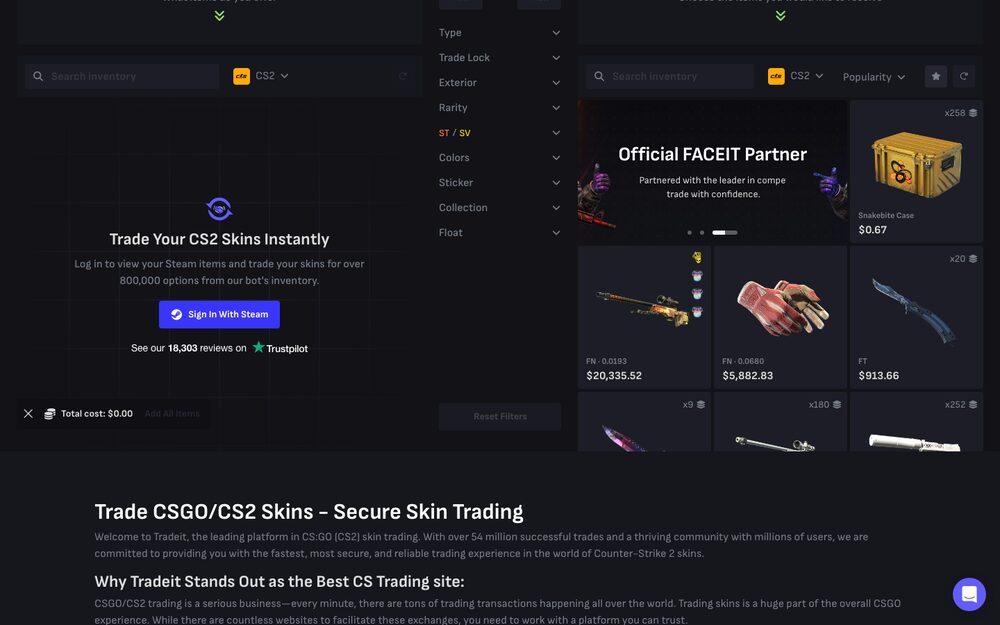
What Tradeit.gg is
Tradeit.gg is a long-running trading site that lets you exchange your CS2 items directly against a large house inventory, top the difference up with cash if needed, or simply buy from that inventory outright. Where a classic marketplace matches you with another human seller, Tradeit is the counterparty itself: its bots hold the stock, quote you a value for your items, and send the trade the moment you accept.
That makes it an on-site-inventory venue in the taxonomy that matters most for CS2 buyers — the split between peer-to-peer trade-offer marketplaces and venues that hold stock in their own custody, which we've broken down in depth here. Because the house already owns what you're buying, there is no waiting for a human seller to wake up and accept a Steam trade offer. Delivery is a bot sending you the items, usually within minutes, subject to the usual Steam trade locks on recently moved items.
The economics: the spread is the fee
Here's the single most important thing to understand about swap sites, Tradeit included: the fee is mostly invisible. You won't find one clean commission line the way you do on a sell-side marketplace. Instead, the cost lives in two valuations — the site prices your incoming items somewhat below open-market value, and prices its own stock somewhat above it. The gap between those two numbers is the house's margin, and it varies by item, liquidity, and demand. Per the site's published information the effective spread lands in ranges rather than a single number, and promos move it around constantly — verify against live prices before any big swap.
On top of the spread sit bonuses: deposit bonuses, promo codes, percentage boosts on your item values. These aren't fake, but they make the true cost genuinely hard to eyeball, because a "+X% bonus" on an already-discounted valuation can still net out below what you'd get selling the item for cash elsewhere. The only honest comparison is end to end: what you gave up at open-market value versus what you received at open-market value, using a neutral reference like the ones in our skin valuation guide.
That said, the swap model has a real economic case. Selling on one venue and buying on another means two fee events, a cash-out delay, and often a currency conversion. A swap is one hop with one spread. For a like-for-like exchange of liquid items, that single spread can genuinely undercut the two-fee round trip — and it's always faster. Whether it does in your specific case depends on numbers you should check, not assume; our cross-venue fee comparison is the place to start.
Strengths
- Speed and friction. Instant delivery from house stock is the whole pitch, and it delivers. No seller-online lottery, no trade-offer choreography — accept, receive, done.
- Consolidation trades. Turning a drawer of small, annoying-to-sell skins into one item you actually want is Tradeit's best use case. Selling twenty $1 skins for cash is death by fees; swapping them in one trade is painless.
- Large browsable stock. The house inventory is broad across popular skins and price tiers, so the thing you want is usually in stock in some float.
- Low commitment. No order books, no listings to babysit, no waiting for a buyer. For casual users that simplicity is worth real money.
Weaknesses
- Spread opacity. The cost of a swap is spread across two valuations and dressed in bonuses, which makes it structurally harder to comparison-shop than a venue with one posted commission.
- Your items get valued conservatively. The quote for what you're giving up can disappoint, especially on less-liquid skins where the house pads its risk.
- Rarely the cheapest place to buy for cash. If you're a pure buyer holding money rather than skins, dedicated marketplaces usually beat house-stock pricing — see where CS2 skins actually sell cheapest.
- Promo noise. Bonus percentages reward the users who do the math and quietly tax the ones who don't.
Fees, payments, and KYC posture
Cash purchases and top-ups support cards and a rotating set of payment methods, with crypto options appearing and disappearing over time — check the live checkout rather than any review, ours included. Cash-out is not the site's center of gravity: this is a venue optimized for items-in, items-out, and its withdrawal options for money are narrower than at cash-first marketplaces. If exiting to a bank account is your goal, the cash-out routes we've mapped run through other venues. Identity checks follow the standard industry pattern — light at small scale, real KYC when meaningful money starts moving, per its published policies at the time of writing.
Strengths and weaknesses at a glance
| Strengths | Weaknesses |
|---|---|
| Instant delivery from house stock | Fee hidden in a two-sided valuation spread |
| One-hop swaps beat two-fee round trips (sometimes) | Conservative valuations on your items |
| Great for consolidating small skins | Seldom the cheapest pure cash-purchase venue |
| Simple, low-commitment UX | Bonus/promo mechanics obscure true cost |
Who it's for — and the verdict
Quick disclosure so the framing is clear: this is cs2stack's blog, and our own product automates cash buying on DMarket and SkinBaron — not on Tradeit — so we're reviewing a venue we don't route to. With that said, if your capital already lives in skins, Tradeit is a genuinely great place to redeploy it. It's the best consolidation desk in the space: a drawer of small, fee-hostile items becomes the one skin you actually want in a single fast hop, and on liquid-for-liquid exchanges that single spread regularly undercuts the sell-then-buy round trip while skipping the cash-out entirely. The informed user gets a materially better deal than the casual one, so spend the five minutes checking quotes against Steam's own cut and open-market references — that small habit is the whole entry fee. Tradeit's bundle math shines, yet on any given item another venue may print lower that afternoon. Winning long-run isn't about crowning one marketplace; it's about letting every purchase audition all of them.