
Steam Buy Orders vs Third-Party Autobuy
Valve ships an autobuy system with every Steam account: the Community Market buy order. It's free, it settles instantly, it will never scam you, and millions of people use it without ever calling it automation. So why does a whole industry of third-party bots and buy-order systems exist alongside it? Because Steam's version has two structural constraints — a roughly 15% fee baked into every price, and money that can never leave — that quietly change what every "cheap" fill actually costs. Here's the honest comparison, and the cases where each side is simply correct.
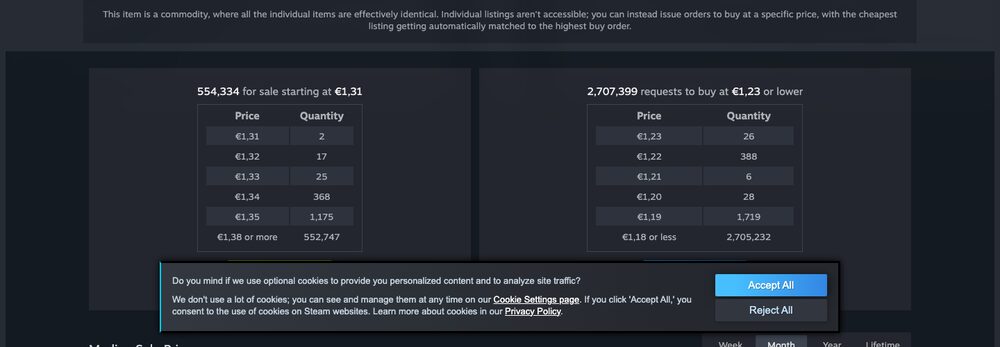
What a Steam buy order gets you
Mechanically, Steam's implementation is the gold standard. You commit wallet funds at your price; when a seller lists at or below it, Valve matches the trade automatically and the item lands in your inventory. No API keys, no third-party servers, no seller confirmation, no counterparty other than Valve itself. The order book is deep on almost everything, because the Community Market remains the single most liquid venue in the ecosystem — its structural strengths and weaknesses are covered in the Steam Market review.
For pure reliability, nothing third-party competes. The question is never whether Steam buy orders work. It's what the working costs.
The two catches: the fee and the lock
First, the fee. Every Steam Market sale carries Valve's combined transaction fees — roughly 15% on CS2 items. Sellers know this and price it in, which keeps Steam listing prices structurally above cash-market prices for the same items. Your buy order executes against that inflated level: even a fill well below "Steam price" can sit above what the same item costs on a cash venue that day. The mechanics are dissected in Steam's 15% cut, explained.
Second — and this is the one people underweight — the lock. Steam wallet funds are a closed loop: money goes in, and it never comes out. Every dollar you commit to a Steam buy order has already been converted, irreversibly, into game-and-item credit. That changes the real value of the money itself. A wallet dollar is worth less than a bank dollar, by whatever discount you'd accept to convert back — historically a substantial haircut on cash-out routes. The accounting argument is made fully in Steam wallet dollars are not dollars and the cash vs wallet math.
Stack the two, and Steam buy orders are best understood as convenience purchased with spread: you pay above cash price, in a currency worth less than cash, for execution that never fails.
What third-party autobuy gets you
Cross the street to the cash markets — DMarket, SkinBaron, CSFloat and their peers — and the trade-offs invert. Prices are real-money prices, typically sitting below Steam's fee-inflated levels. Balances are withdrawable; an exit is a bank transfer, not a haircut. And automation is richer: venue-native target orders and buy orders, plus external tools that watch several venues at once and route each buy to whichever is cheapest — the architecture behind that is in the complete autobuy guide.
The costs are real too. You've added counterparties whose solvency and security are now your problem — the diligence framework is in the safest marketplaces roundup. Settlement isn't always instant: P2P venues need a human seller to complete each trade. And getting items to Steam ultimately involves trade holds and withdrawal steps that Valve's in-house loop skips entirely.
Side by side
| Steam buy orders | Third-party autobuy | |
|---|---|---|
| Price level | Fee-inflated (~15% baked into asks) | Cash prices, typically below Steam |
| Your money | Wallet-locked forever | Withdrawable balances |
| Settlement | Instant, automatic, Valve-run | Instant on on-site-inventory venues; seller-dependent on P2P |
| Counterparty risk | Valve only | Each venue and tool you add |
| Venue coverage | One book | Multiple venues, cross-compared |
| Setup cost | None — it's in your account | Accounts, funding, keys, a tool to trust |
When each is simply correct
- Use Steam when the money is already trapped. Wallet balance from selling drops or old items can't leave anyway — its cash discount is sunk. Spending it via buy orders at the best possible wallet price is strictly right, and no third-party tool can touch that money at all.
- Use Steam for instant, guaranteed, small-stakes fills. One case to open tonight, a cheap skin to use — the convenience premium on ten dollars is pennies, and zero setup wins.
- Use third-party for anything you account in real money. If you track your skins as a position with an exit — the whole premise of cashing out — buying at wallet prices with locked money starts every position roughly 15% underwater in cash terms before it moves.
- Use third-party for scale and repetition. Accumulating daily, the Steam-vs-cash spread compounds into the dominant cost of the whole strategy. Disclosed, since this is our blog: this is the case cs2stack exists for — standing max-price rules filled at the cheaper of DMarket and SkinBaron's live lows, with the founder's own $20/day running publicly at /stack, filling at roughly 36% below same-day Steam prices per that ledger.
- Use both when the split is natural. Trapped wallet money works Steam's book; fresh money works the cash markets. There's no rule against running the native tool and a third-party one on different budgets.
The one-line verdict
Steam buy orders are flawless execution at a structurally bad price; third-party autobuy is a structurally good price with homework attached. Small, casual, or wallet-funded buying belongs on Steam. Deliberate, repeated, cash-accounted buying belongs on the venues where a dollar is still a dollar — with the safety rails that make the homework manageable.