
The Steam Community Market in 2026: Strengths and Weaknesses
Every CS2 trader starts on the Steam Community Market — the highest-traffic skin venue on Earth and the honest baseline the whole third-party ecosystem prices against. The good news: outgrowing it is a feature, not a failure, because the third-party field sells the same skins cheaper the moment you're ready to move. This line-by-line audit covers the three things Steam still wins outright, the two structural gaps that make the move so profitable, and the cases where the default is still right.
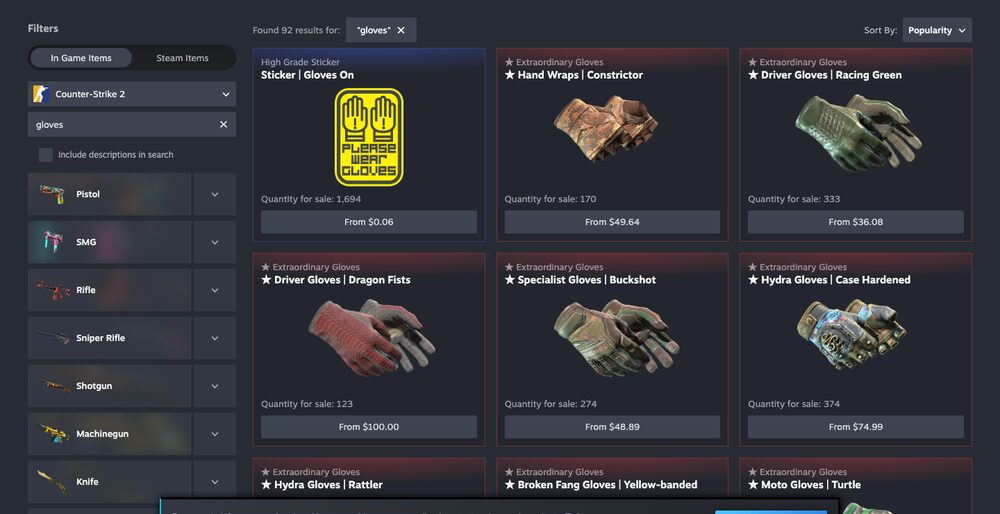
What it is, structurally
The Community Market is Valve's own exchange, running since 2012 (its history is a story of its own): items and money never leave Valve's system, every listing settles instantly into your inventory, and proceeds land in your Steam wallet — a currency that buys games and skins and nothing else, ever. That closed loop is the single fact from which every strength and weakness below flows.
Strength one: liquidity nothing else matches
Steam has the most buyers and sellers of any venue by a wide margin. Liquid items — cases, popular skins — clear in seconds at any hour, order books are deep, and the bid-ask spread on commodity items is routinely the tightest anywhere. If your goal is "this item is sold, now, at a fair wallet price," nothing else competes. Depth also means honest price discovery at the commodity end: the Steam median price for a case is a real number backed by thousands of daily transactions, not three optimistic listings.
Strength two: zero counterparty risk
There is no seller to trust, no trade offer to verify, no escrow to evaluate, no venue that can exit-scam you. Valve holds both sides of every transaction. For a market whose third-party history includes some spectacular failures, "the operator is Valve" is a real, bankable feature — the entire threat model in our red-flags guide simply doesn't apply inside the walls.
Strength three: buy orders, natively
Steam lets you place standing buy orders — name your price, and the order fills automatically the moment a matching listing appears. It's the one piece of automation Valve gives every user for free, and for patient accumulation at below-ask prices it works. How it stacks against third-party equivalents is covered in our buy-orders comparison.
Weakness one: the fee
Roughly 15% of every sale goes to Valve — a 5% Steam fee plus a game-specific 10% for CS2, with exact rounding quirks explained in our fee breakdown. Third-party venues charge sellers a fraction of that. On a single casual sale the difference is an annoyance; compounded across an active trader's volume it's the whole margin.
Weakness two: the wallet is a roach motel
Money enters the Steam wallet and never leaves. That single property means Steam prices aren't real prices — they're wallet-denominated prices, and wallet dollars trade at a structural discount to cash, typically cited in the 20–30% range when people compare Steam listings to cash-market listings for the same items. Steam wallet dollars are not dollars, and anyone valuing a portfolio in Steam prices is marking to a currency they can't withdraw. Cashing out for real requires the third-party rails our cash-out guide maps. Add the smaller frictions — market holds on some transactions, listing price caps that wall off the top of the grail market, no API meant for trading — and the ceiling on serious use becomes visible.
A third, smaller weakness deserves a line: friction creep. Between mobile confirmations, occasional market holds while Valve's fraud systems evaluate a transaction, and pricing quirks like regional currency conversion, the "instant" market is instant most of the time rather than all of the time. None of it approaches the friction of third-party trading — but it's worth knowing the default venue isn't entirely frictionless either.
The line-by-line audit
| Dimension | Steam Community Market | Third-party venues (typical) |
|---|---|---|
| Liquidity | Deepest anywhere on liquid items | Good on majors, thinner books |
| Counterparty risk | None — Valve operates both sides | Venue- and model-dependent |
| Seller fee | ~15% (5% + 10% CS2) | Commonly single digits — verify per venue |
| Proceeds | Steam wallet only — no cash-out, ever | Cash, bank, or crypto rails |
| Effective prices | Higher stickers in locked currency | Lower cash prices (the cash-out discount) |
| Buy orders | Native, free, automatic | On some venues (e.g. via market APIs) |
| Price ceiling | Listing caps exclude top grails | No meaningful cap |
| KYC | None beyond your Steam account | Scales with cash-out amounts |
| Automation | No trading API intended for users | Varies; some venues are API-first |
When Steam is actually the right venue
Three honest cases. If you're spending the proceeds on games or more skins anyway, the wallet lock costs you nothing and the liquidity is free — sell on Steam, keep it simple. If you're a beginner making your first trades, zero counterparty risk is worth more than the fee while you learn what everything else in this ecosystem can go wrong. And if you need an instant, guaranteed sale of a liquid item at 4 a.m., Steam's depth is the reliable button. Everyone else — anyone accumulating seriously, selling for real money, or optimizing cost per item — has outgrown the default, which is why the rest of our marketplace coverage exists. (Disclosure: cs2stack, the product behind this blog, lives on that third-party side — it compares DMarket and SkinBaron on every automated buy.)
Verdict
The Steam Market is the best venue in the world at the three things it does — and that's exactly what makes the third-party move so rewarding: everything Steam can't do, the cheaper venues can. Keep Steam for instant liquidity, zero trust required, and native buy orders; do your real buying where prices run lower, and account for your portfolio in cash prices, not wallet prices.
The takeaway isn't that Steam is bad — it's that no venue, Steam included, offers the best price every single day. Comparing the third-party field before each buy is how you keep Steam's convenience as a baseline while pocketing the discount somewhere else, over and over.