
The Skin Investing Glossary: EV, Float, DCA, Trade Hold & Friends
Every niche market defends itself with vocabulary. This page disarms the skin economy's: forty terms, defined plainly, grouped by what they're actually about. Bookmark it, send it to the friend who keeps asking what a float is, and never nod along to "the EV on this crate is nuts" again.
The items themselves
Skin — a cosmetic finish for a weapon in Counter-Strike 2. Changes nothing about gameplay; changes everything about price.
Case (crate) — a sealed container that yields one random skin when opened with a key. Sealed cases are themselves tradeable items, which is what makes case stacking possible.
Key — the purchase required to open a case. Sold by Valve at a fixed $2.49 and, since 2019, not tradeable — which killed keys as a currency.
Rarity tiers — the color ladder of drops: Mil-Spec (blue), Restricted (purple), Classified (pink), Covert (red). Official case odds run from 79.92% for Mil-Spec down to 0.64% for Covert.
Rare special item — the knife or gloves slot, the "gold" at 0.26% odds. The pool of possible knives is the main reason any case holds value.
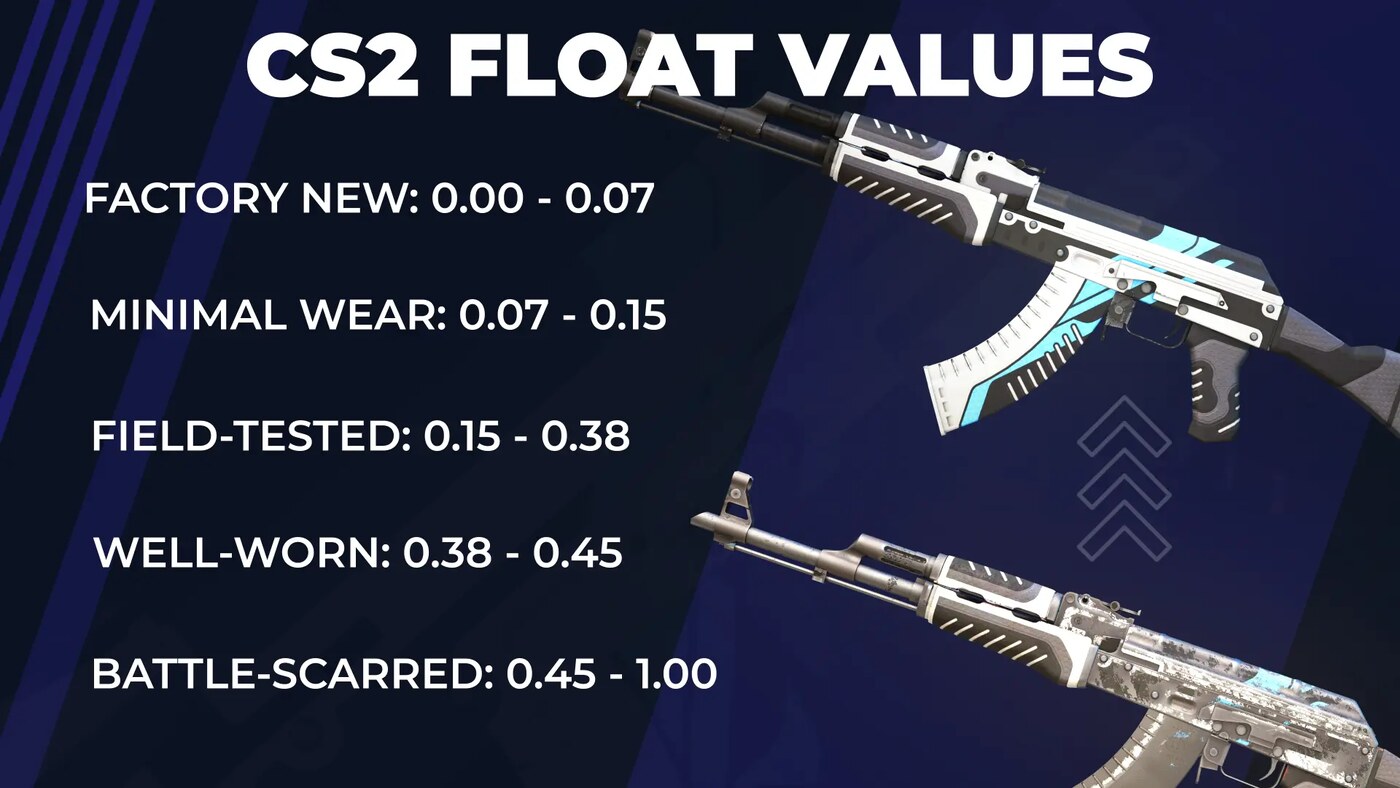
Float (wear value) — a decimal between 0 and 1 stamped on each skin at creation, determining how worn it looks. Lower is cleaner and usually pricier; the full mechanics are in float values explained.
Wear tier — the named bucket a float falls in: Factory New, Minimal Wear, Field-Tested, Well-Worn, Battle-Scarred.
Pattern (seed) — a number deciding how the finish is placed on the weapon. Certain seeds ("blue gems," full-web Crimson Webs) trade at enormous premiums.
StatTrak — a variant with a kill counter, dropping less often and priced at a premium.
Souvenir — a tournament-drop variant with event stickers. A 2026 update let souvenir skins into trade-ups, with souvenir attributes stripped from the output.
Sticker / capsule — team and artwork stickers, sold in capsules. Katowice 2014 capsules are the asset class's founding legend; a 2026 update discontinued sticker capsules in favor of a token shop.
The mechanics of the market
EV (expected value) — the average outcome of a random event, weighted by probability. A case's opening EV is what an average unbox returns versus case-plus-key cost; it's almost always negative for the opener, which is why holders exist. See scanning case EV.
Drop pool — the set of cases that can still drop to players in-game. Leaving the active pool chokes new supply; it's the engine of the whole stacking thesis.
Discontinued / rare drop — cases no longer dropping at normal rates. Their supply only shrinks from there.
Trade-up contract — the in-game recipe: ten skins of one rarity convert into one skin of the next rarity from an input's collection, with float carried over as a normalized average. Since October 2025, five Coverts can trade up to a knife or gloves.
Trade lock / trade hold — a waiting period before a bought item can move again. DMarket purchases have been observed with roughly 2–7 day locks; the patience economics are in trade locks explained.
Liquidity — how quickly an item sells near its quoted price. High-volume cases are among the most liquid items in the market; rare patterns are among the least.
Spread — the gap between the highest buy order and the cheapest listing. Wide spreads are a tax on impatience.
Slippage — the extra you pay (or forfeit) when your own order size moves the price. Small market, real effect.
Order book / depth — the stack of standing buy and sell orders at each price. Depth is what your size disappears into.
Price floor — the soft level below which unboxing demand tends to absorb supply, keeping cheap cases from going to zero.
Volatility — how violently a price swings. Skin prices swing harder than most people's risk tolerance; budget accordingly.
Drawdown — the fall from a peak to a trough. The asymmetry (−50% needs +100%) is the most underrated number in investing.
The venues and the money
Steam Community Market — Valve's built-in marketplace. Fees around 13–15%, and proceeds are Steam wallet funds, which brings us to:
Steam wallet — Valve-store credit. It cannot be withdrawn as cash, ever. A "$1,000 inventory" priced in wallet funds is not $1,000.
Cash marketplace — third-party venues (DMarket, SkinBaron, CSFloat and others) where sales pay out in withdrawable money, with seller fees typically in the ~2–12% range. Compared in detail in the marketplace roundup.
Cash-out — converting items into bank-account money. The paths, fees, and traps deserve their own guide.
FX conversion — translating euro listings into dollar terms (or vice versa) so venues can be compared fairly. Small detail, real money, easy to get wrong by hand.
Fees / round trip — everything the venues take between your buy and your eventual sell. The silent killer of high-frequency flipping.
Cost basis — the true all-in price you paid, fees and conversion included. Without it, "I'm up 40%" is a mood, not a measurement.
The strategies
Case stacking — accumulating sealed cases on the shrinking-supply thesis. The default strategy of this site.
DCA (dollar-cost averaging) — buying a fixed amount on a fixed schedule regardless of price, so corrections lower your average entry instead of testing your nerve. The complete treatment is here.
Lump sum — investing everything at once instead of over time. Better on average, worse for sleep; the honest comparison depends on your regret function.
Sniping — catching underpriced listings before anyone else. Real edge, real time cost, ruthless competition.
Arbitrage — exploiting the same item priced differently across venues. For retail buyers, the practical version is simply always buying on the cheaper market.
Flipping — short-hold buying and reselling for spread. Fee-hungry; see overtrading, above and everywhere.
Exit strategy / tranches — pre-planned selling in slices at pre-set levels, so profit-taking is a schedule instead of an emotion.
The automation layer
Buy-side only — software that can purchase but is structurally incapable of selling your items. The single most important safety property of any skin tool.
Budget cap / hard cap — the per-day spending limit a bot obeys, plus the higher fixed ceiling behind it that survives even bugs. The one setting that makes automation safe: budget caps.
Max-price line (price ceiling) — a per-item limit: never pay above this, skip the day instead.
Standing order — a recurring instruction like "buy one CS:GO Weapon Case per week," expressed as configuration instead of memory.
Dry run — executing the full buying logic against real prices with spending disabled. The rehearsal every bot should default to.
Idempotent — a system that produces the same result even if a step accidentally runs twice; in buying terms, a bot that can never double-spend a day's budget.
Ledger (append-only) — the tamper-evident record of every transaction, written at execution time. The difference between claims and receipts.
Name validation — checking a configured item name against live markets before spending, so a typo halts the run instead of buying the wrong thing.
That's the working vocabulary. Terms you'll meet next as you go deeper — knife pools, allocation schemes, cadence choices — each have their own posts, and the stacking FAQ is the natural next page if you came here as a beginner.