
Scanning Case EV: Which Cases Are 'Too Cheap' Right Now
Cases are supposed to be impossible to value — no cash flows, no earnings, just vibes and supply curves. Except that's not quite true. Every case has one computable number attached to it: what its contents are worth, on average, if you open it. That number is a valuation floor, and scanning for cases trading near or below it is the closest thing stackers have to fundamental analysis.
The one number you can actually compute
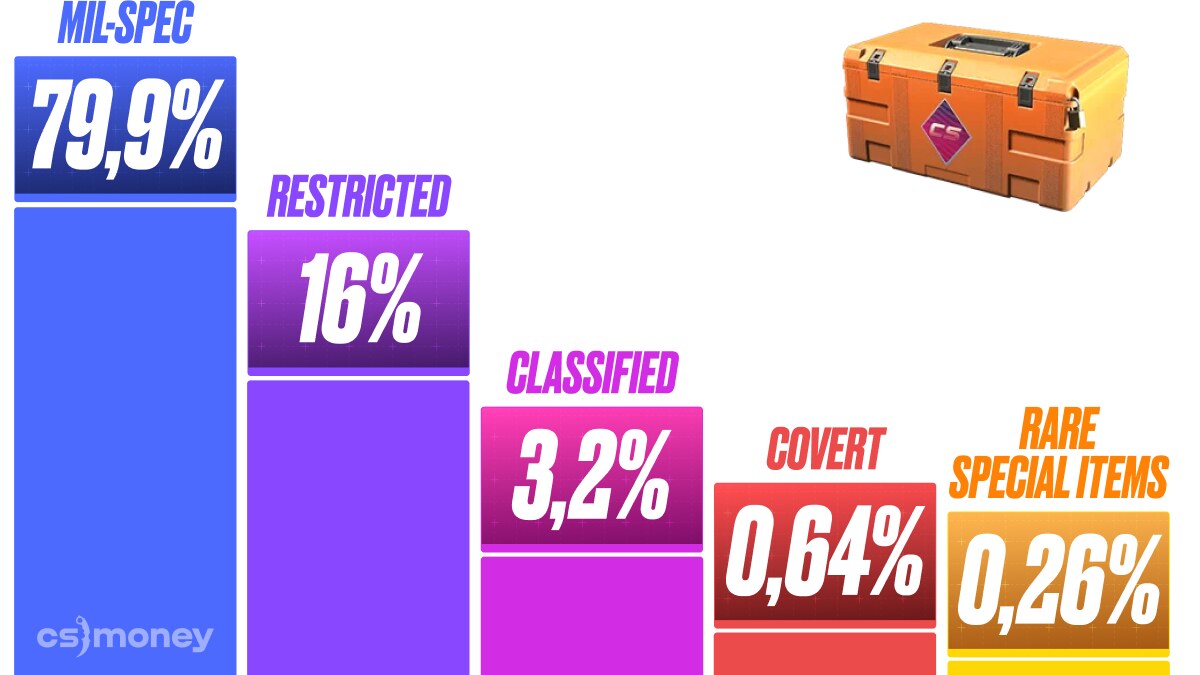
Expected value (EV) is the probability-weighted average of outcomes. For a case, the outcomes are public: Valve disclosed the odds, and they're the same for every case — Mil-Spec 79.92%, Restricted 15.98%, Classified 3.2%, Covert 0.64%, and a rare special item (knife or gloves) at 0.26%. Multiply each tier's probability by the average market price of that case's items in that tier, sum it up, and you have the case's opening EV: the long-run average return per unboxing, before costs.
| Tier | Odds | What it contributes |
|---|---|---|
| Mil-Spec (blue) | 79.92% | Almost every roll; usually pennies each |
| Restricted (purple) | 15.98% | Small but frequent contributions |
| Classified (pink) | 3.2% | Occasional mid-value hits |
| Covert (red) | 0.64% | Rare, meaningful hits |
| Rare special (gold) | 0.26% | The knife pool — often the largest single EV slice |
The striking part of the math: the gold row, at 1-in-385 odds, often contributes an outsized share of total EV, because knives and gloves are worth hundreds of times the average blue. That's why the knife pool anchors every case's value — an aging case whose knives appreciate drags its own EV floor upward, whatever its skins do. And the cost side has a known constant: the key is $2.49, fixed by Valve, which means every EV comparison is really "contents EV versus case price plus $2.49."
Why EV acts as a price floor
Here's the arbitrage logic. If a case's opening EV (net of the key and realistic selling fees) rises above the case's market price, opening it becomes positive-expected-value — a rational gamble rather than a donation. Unboxers and EV-hunting whales notice, buy cases in volume, and open them. That does two things at once: the buying pressure lifts the case price, and the opening destroys supply, which supports the price further. The gap closes from both directions. A case can't sit far below its EV floor for long any more than a $10 bill sits on a busy sidewalk — the mechanism is one of the load-bearing reasons cheap cases rarely go to zero.
Note what this does not say. It doesn't say opening cases is smart — in normal conditions EV sits well below case-plus-key cost, and the math of opening versus buying stays brutal. The floor argument runs the other way: for a holder, EV is a level below which arbitrage-minded buyers become your bid. You're not planning to open your stack; you're comforted that someone would profitably open it if the price fell far enough.

Scanning: turning the formula into a screen
One case's EV is a homework problem. The useful version is the scan: compute EV-to-price for every case simultaneously and rank them. The ratio is a crude but honest screen — cases trading near their EV floor have limited downside by the arbitrage argument above; cases trading at many multiples of EV are being priced entirely on scarcity and story, which can be fine (see discontinued-case economics) but should at least be a conscious choice. Snapshots of such scans circulate in the community, and occasionally a whole family of related cases shows up EV-positive net of costs — cs2stack's own scanner has flagged clusters like the Spectrum-family cases that way in one snapshot, though any specific reading is stale the week after it's taken. That's the nature of the exercise: a scan is a photograph of a moving object.
Doing it honestly requires respecting the inputs, and the inputs are slippery:
- Prices must be sale-realistic. EV computed from listing prices overstates what an opener nets; fees of roughly 13–15% on Steam (less on cash venues) come off the top, and thin items sell below their tickers — slippage is part of the formula whether you include it or not.
- Wear distribution matters. Each unboxed skin arrives with a random float, and tier prices differ several-fold across wear brackets. A scan using best-wear prices is fiction; use distribution-weighted averages or accept wide error bars — float basics covers why.
- StatTrak and outliers distort. A handful of chase items with thin order books can swing a case's computed EV. Good scans cap or sanity-check outlier contributions rather than letting one illiquid knife price carry the answer.
- Updates reset everything. The October 2025 trade-up change repriced Coverts within days — every EV scan from the prior week was instantly wrong. Fresh data or no conclusions; the data-stack post lists what's worth pulling.
What a stacker should actually do with this
EV scanning earns a modest, specific role in an accumulation plan: it's a tiebreaker and a sanity check, not an oracle. When you're choosing which cases to buy, an EV-to-price ranking helps you avoid the one genuinely avoidable error — paying a huge scarcity premium for a case whose floor sits miles below its price — and occasionally surfaces a case where you're accumulating close to the arbitrage floor, which is as close to "margin of safety" as this market offers. Then the boring machinery takes over: fixed budgets, daily averaging, price caps, years of patience. The scan tells you what looks reasonably priced this quarter; it says nothing about when to buy, and it never overrides the schedule. Treat any EV table — including ours — as a dated snapshot with error bars, and let the humans make the list. The floor is real; the timing is still yours to not-predict.