
Case Stacking vs Sticker Capsule Bets (the Stockholm 2021 Lesson)
Ask a capsule investor about Stockholm 2021 and you'll hear one of two stories. In the first, they bought early, sold into hype, and quote returns that sound made up. In the second, they're still holding. Both stories are true — and together they explain why capsules and cases are not the same trade wearing different art.
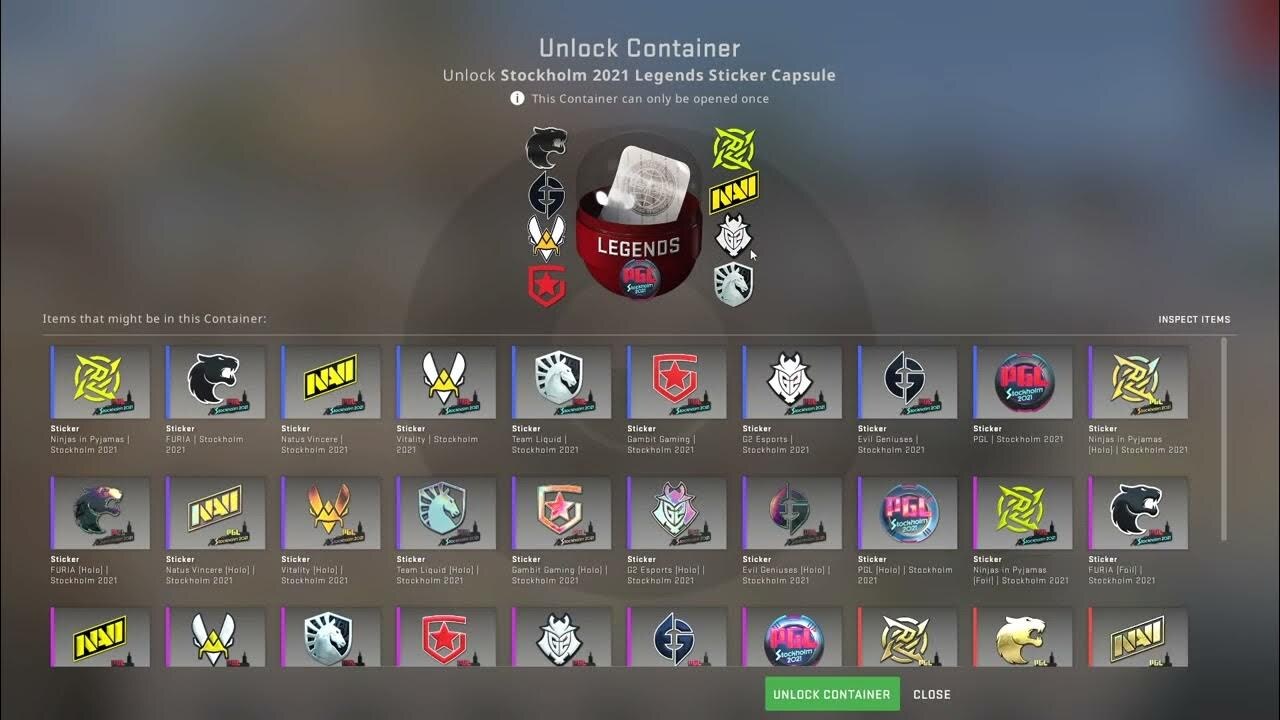
Two containers, two economies
On the surface, weapon cases and sticker capsules look like siblings: sealed containers, limited supply, opened by players, hoarded by investors. The economics underneath are different animals.
A weapon case earns its demand continuously. People open cases every day of the year because unboxing is entertainment with a knife lottery attached — the demand doesn't care what month it is. Capsule demand is event-shaped: it spikes around the tournament the stickers commemorate, fades when the crowd moves on, and revives only if the specific stickers inside become fashionable on popular loadouts. One is a subscription business; the other is a concert ticket.
Supply is different too. Cases stopped dropping for a series only gradually, and the drop mechanics shrink supply on a slow, predictable curve. Capsules were sold for a limited window and then never again — a hard cutoff that creates scarcity fast, but also means the entire future supply was bought by speculators in one season, all of whom eventually want to sell to each other.
What Stockholm 2021 actually taught
The Stockholm 2021 Major capsules became the case study both camps cite, and both are right about their half. Per third-party trackers, several Stockholm capsules and stickers appreciated dramatically in the years after the event — the winners' story is real. What the winners' screenshots skip is the distribution: capsule outcomes were reportedly wildly uneven across teams and sticker variants, exit liquidity was thin exactly when everyone wanted out at once, and buyers who entered late in the hype cycle waited a long time to see daylight, if they did at all.

The pattern rhymes with the older legend. Katowice 2014 stickers became the most valuable paper in gaming — but almost nobody who owned them in 2014 held long enough to collect, and the people quoting those returns today are mostly describing a trade they didn't make. Lottery markets are like that: the jackpot is real, the median outcome is forgettable, and the gap between the two is what the highlight reels are built to hide.
Then 2026 added a structural footnote: with the IEM Cologne-era update, Valve discontinued sticker capsules in favor of a token shop. Existing capsules became permanently finite overnight — bullish for holders of the right ones — but the episode is also the purest demonstration of single-publisher risk: an entire product category's future was rewritten in one patch, and no holder got a vote.
The honest comparison
- Demand. Cases: continuous, driven by unboxing, resilient across seasons. Capsules: event-driven and fashion-driven, capable of long dead zones between hype cycles.
- Liquidity. Liquid cases trade constantly at tight spreads; you can exit meaningful size without moving the price much. Capsule and sticker order books are thin — liquidity evaporates precisely when sentiment turns, and slippage eats paper gains on the way out.
- Variance. Capsules offer lottery-shaped outcomes: a few legendary winners, a wide field of dead money. Cases offer a compressed range — historically less spectacular upside per pick, far fewer total wipeouts among liquid series.
- Timing sensitivity. Capsule returns depended heavily on when you entered the hype cycle. Case returns, per third-party data, depended mostly on how long you held — which is a much more forgiving variable.
- DCA-ability. This is the underrated one. Cases can be accumulated a few dollars a day, every day, for years — the strategy survives contact with a normal life. Capsules must be bought in a window, in size, on a thesis. You can't dollar-cost average into a concert ticket.

Which one belongs in your plan
Framed as risk profiles rather than rivals, the answer stops being tribal. A capsule bet is a concentrated, timing-sensitive, illiquid speculation with a real jackpot tail — reasonable as a small, deliberate punt by someone who follows the sticker meta closely, per the sober case in the major stickers guide. Case stacking is the base layer: liquidity-first, continuous-demand, schedulable, and boring in the way that lets ordinary people actually stick with it.
It's telling which one automates. Nobody has built a sensible robot for capsule speculation, because the whole trade is judgment about hype. Case accumulation automates completely — fixed budget, item list, price caps, daily execution — because the strategy's edge is the consistency. If a strategy can be written down as rules a machine can follow, that's usually evidence the strategy doesn't depend on being lucky.
The stacker's version of a capsule bet, if you want one: keep it small enough that a total zero changes nothing, and treat any gain as a bonus round. The case stack is the part of the portfolio with a thesis; the capsule drawer is the part with a story.