
When to Sell a Case Stack: Exit Strategies That Don't Rely on Luck
Nobody plans their exit at the top. They plan it at the beginning, or they improvise it in a panic — those are the only two options the market ever offers. This post is about the first one: tranche selling, price ladders, demand-spike exits, and the respectable version of never selling at all.
Why exits get decided badly
Accumulating cases is emotionally easy — every buy feels like progress. Selling is where the psychology turns hostile. In a rally, selling feels like betraying the position ("it's still going"). In a crash, selling feels like surrender at the worst price. The result is that undecided holders reliably do the worst available thing in both directions: they hold through the euphoria they should have sold into, then dump into the fear they should have held through.
The fix isn't discipline in the moment. It's removing the moment: write the exit rules while you're calm and unleveraged by emotion — ideally before the first buy. The same logic that makes DCA work on the way in (pre-committed rules beat live judgment) works on the way out.
Strategy one: tranches at pre-set multiples
The workhorse. Decide in advance that at certain multiples of your average cost, you sell fixed slices of the stack. A common shape:
- At 2x your average cost: sell a quarter. Depending on fees and how early you started, this can recover most or all of your principal — everything left is playing with house money.
- At 3x: sell another quarter.
- Keep a core — the remaining half — for the long tail, or run further rungs at higher multiples.
The exact numbers matter less than three properties: the trigger is a multiple of your own cost basis (which is why an accurate cost basis is non-negotiable), the size is a fixed fraction decided in advance, and no rung requires you to believe anything about the future. You'll never sell the exact top with a ladder. You'll also never round-trip a 4x back to break-even, which is the actual failure mode ladders exist to prevent.
Strategy two: sell into demand spikes
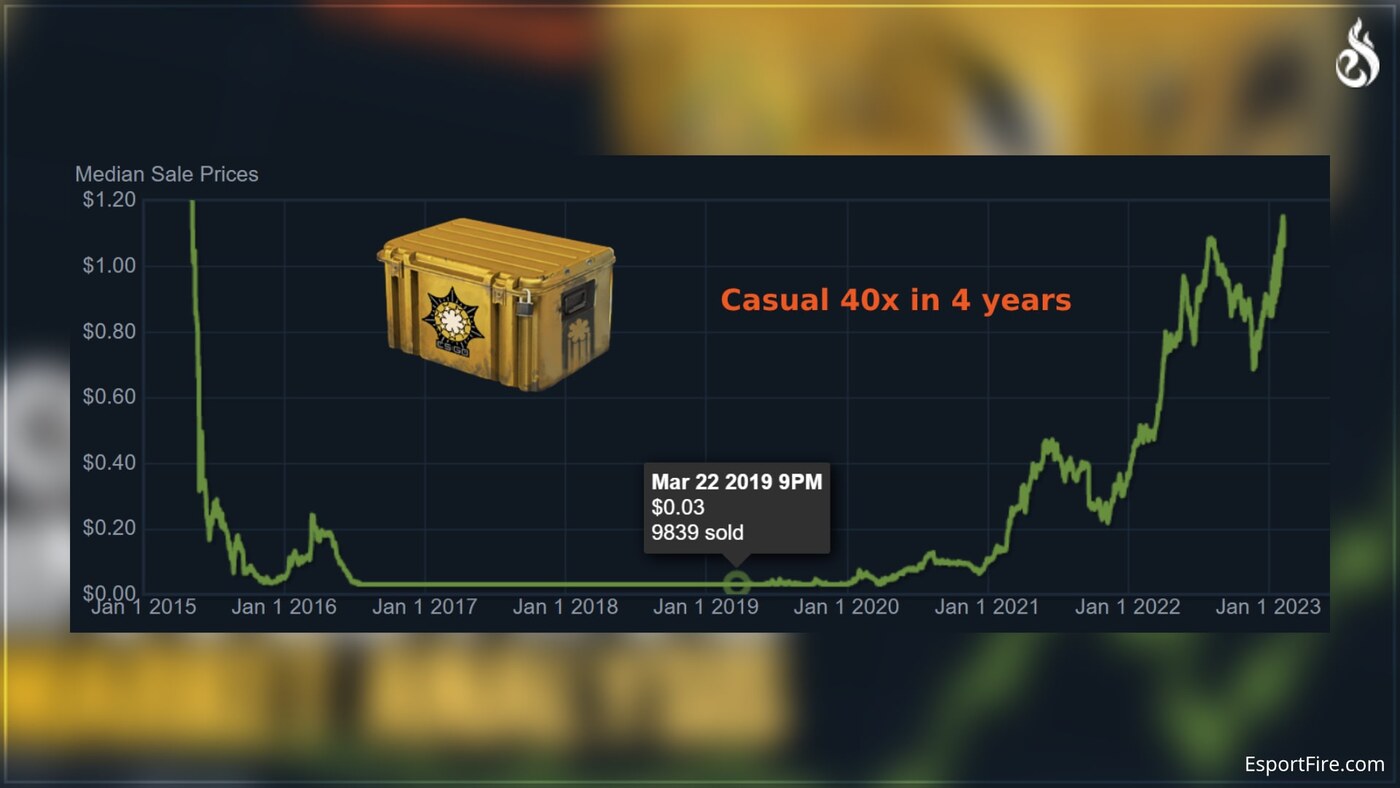
Case prices don't drift to their highs — they spike, usually when an update gives unboxers a new reason to open. The October 2025 update, which let five Covert items be traded up to a knife or glove, repriced Covert skins on announcement and pulled demand toward the cases containing them. Events like that — new contract mechanics, operations, viral knife moments — are when spreads tighten, order books deepen, and a seller gets filled instantly at prices that looked fantastical a month earlier. The repeatable pattern is covered in how updates move markets.

The discipline: sell into the spike, not after it. Hype windows in this market have historically been short, and the holder who waits for confirmation that "this time it's a new plateau" usually sells the retrace. A practical hybrid is to let event spikes accelerate your ladder — if a spike carries the price through a rung, execute that rung immediately rather than waiting to see how high it goes.
Strategy three: never selling — chosen, not defaulted
A permanent hold is a legitimate strategy with a real thesis: supply only shrinks, the game keeps setting player records, and every past seller of the oldest cases regretted it, per the price paths third-party trackers show. If you consciously decide the stack is a decade asset — sized so you never need the money, per the entertainment-money rule — "never sell" is coherent.
But choose it. The degenerate version — never selling because no threshold ever felt like enough — isn't a strategy, it's the absence of one, and it ignores that this market has a single point of failure that stocks don't. A written sentence is enough: "This stack is a long-term hold; I will revisit only if Valve materially changes case mechanics." That's a plan. Silence is not.
The tax nobody prices in: fees
Every exit strategy must clear the friction hurdle. Selling on the Steam Community Market costs roughly 13–15% — and pays you in wallet funds that can never become cash. Cash marketplaces typically charge sellers around 2–12% depending on venue, plus withdrawal steps. Two consequences:
- Round-trips are expensive. Selling with the intent to rebuy lower needs the market to fall by more than your total fee load just to break even. That's why "I'll trade around my stack" mostly donates the edge to the venue.
- Venue choice is part of the exit plan. Where you sell decides whether proceeds are money or Steam credit. Plan the cash-out path before the rung triggers, not during.
Write it down before you need it
A complete exit plan fits on an index card: the ladder rungs and slice sizes, the event-spike rule, the venue for each sale, and the definition of the core you keep. Pair it with an accurate ledger of what you paid — if your buying is automated, the audit trail already exists — and the hardest decisions in stacking become clerical work. Note the division of labor, though: buy-side automation like cs2stack will build the stack and hand you exact cost-basis numbers, but it deliberately has no sell button. The exit is, and should be, a human decision — made once, on paper, in advance.